
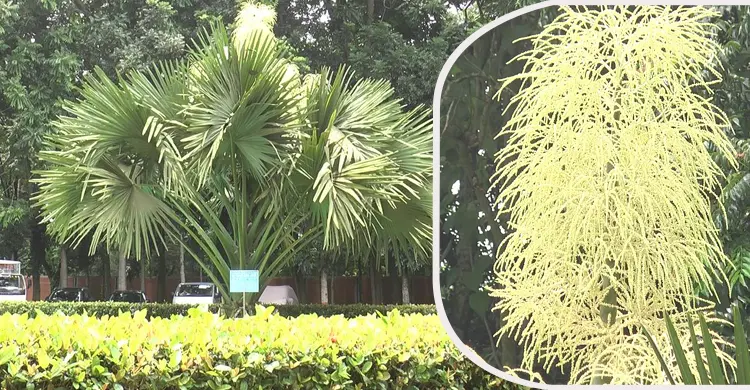
The last known specimen of the talipot palm, a species critically endangered worldwide, stood in the grounds of the pro-vice-chancellor's residence beside Fuller Road on the University of Dhaka campus. The tree is unusual in that it flowers and fruits only once, after nearly a hundred years, and then dies, completing its life cycle. One of these critically endangered trees stands at the Tangail Circuit House. But well short of a hundred years, at just 10 years old, it has produced its "death flower".
Inquiries show that the tree was planted on 18 June 2012 by the then deputy commissioner, M Bazlul Karim Chowdhury, who brought it from the Dhaka University pro-vice-chancellor's residence. Two more seedlings were planted at the same time on the campuses of Government Sa'dat University College in Karatia, Tangail, and Kumudini Government Women's College. Those have not yet flowered, but the palm at the Circuit House has bloomed only nine years after planting.
On hearing that the tree had flowered so soon, a team of plant researchers came to Tangail Circuit House on the morning of Tuesday, 3 August, to inspect it.
Researchers collect samples
Led by Dr Akhtaruzzaman Chowdhury, a talipot researcher and assistant professor of chemistry at Government Bangla College, the team, including Dr Mala Khan, director general of the Bangladesh Reference Institute for Chemical Measurements, and Sharmin Sultana, a gynaecologist at Health In Hospital, inspected the tree closely. They collected its flowers, leaves, roots, branches and other material for research. Tangail Deputy Commissioner Dr Ataul Gani and other officials were present.
Records show that the British botanist William Roxburgh found the talipot species in the eastern part of undivided India in 1799. It was known locally as "buno tal" (wild palm). He reported that it was endemic to East Bengal, meaning that it grew only in a particular, limited area. He identified the species and gave it its scientific name.
There was another talipot tree at Santiniketan in Birbhum district of West Bengal. It is said that when it flowered in 1979, members of the Santal community took it as a bad omen and cut it down. Earlier, in 1950, Professor M Salar Khan of the Department of Botany at the University of Dhaka had identified the Dhaka University tree as a talipot.
As the species was not found anywhere else in the world after 1979, the Dhaka University tree came to be regarded as the only specimen of the wild palm in the world, known as the "talipot". In 1998 the International Union for Conservation of Nature (IUCN) declared the talipot a critically endangered plant.
So far nine active chemical compounds have been synthesised from the talipot's flowers and fruit. Some of them have antimicrobial, anti-ageing and anti-cancer properties, and plant researchers say betulinic acid among them works against cancer.
A PhD born from the Dhaka tree
Dr Akhtaruzzaman Chowdhury said: "From the 'Red Data Book of Vascular Plants of Bangladesh', published by the Bangladesh National Herbarium in 2001, I learned that there was a tree called talipot at Dhaka University that would flower and fruit only once after 100 years and then die. By coincidence, the tree put out its inflorescence just then, in August-September 2008. It aroused great interest among tree lovers in Bangladesh and around the world, and the newspapers wrote about it widely. At that time I remembered a saying from traditional medicine: a tree that flowers and fruits once and then dies is medicinal. Since this tree would flower and fruit once after 100 years and then die, I thought its flowers and fruit must surely hold important medicinal compounds. So I decided to do my PhD research on the talipot."
"When I told my supervisor, Professor Dr Ashraful Alam, and co-supervisor, Professor Dr Abdur Rashid, they gladly agreed, as both already knew about the tree. My co-supervisor lived in a flat in the Tower Building at Dhaka University, only a few metres from the tree. So began the PhD research on the talipot's flowers, and its immature and mature fruit."
"I went to the tree every week to observe it closely. In January-February 2010, I went under the tree early one morning and found four or five seeds on the ground. I took them home and put them in a pot on the balcony to germinate. I also kept collecting the fruit that fell from the tree, and in this way gathered about a thousand seeds. I kept 500 seeds for research. For germination, I put about 300 seeds in polybags at the Medicinal Plant Garden of Dhaka University's Department of Pharmacy and the other 200 below the Azimpur quarters."
"Within two to two and a half months of being potted, the seeds germinated. When the seedlings were eight to ten inches tall, I decided to spread them across the country, so the tree would be properly conserved and future researchers could study it widely when it flowers and fruits a century later, around 2110," said Professor Akhtaruzzaman Chowdhury.
Flowering after 10 to 11 years
Saying that the talipot had been planted at the Tangail deputy commissioner's office in 2012, Dr Mala Khan said: "The talipot is a critically endangered plant. According to botany, it flowers and fruits after 100 years and then the tree dies. That is what people have known of the talipot's nature so far. Yet, to our great surprise, we see that this tree has flowered at somewhere between 10 and 11 years. The flowers have come on this tree planted by the hands of Dr Akhtaruzzaman and the late former Tangail deputy commissioner M Bazlur Karim Chowdhury. We hope that within the next year it may bear fruit, as it normally would."
She added: "At present there are 100 talipot trees planted across Bangladesh. The other 99 need to be kept under observation. Here, in Tangail, this one tree has changed. If the other 99 trees planted at the same time do not show such a change, then no information can be given about this change without testing it. We can see whether it bears fruit after a year, whether the fruit comes when it should, and whether the tree dies after fruiting."
"Within the next month or so we may be able to announce the results of the genome sequencing. In future we plan to observe the other trees, and if there is any new information there too, we will try to present it to the nation, to botanists and to scientists around the world," Dr Mala Khan said.
Tangail Deputy Commissioner Dr Ataul Gani said the district was taking good care of the tree. "It is supposed to flower after a hundred years and then die, but here it has flowered within a few years. Scientists from our national science laboratory, the Science Lab, have come here, and we will care for the tree as they advise."
He added: "If such an endangered tree stands at an important place like the Circuit House, our visitors will enjoy seeing it. The tree will also remain a witness to the history of Tangail district."
Source: Jagonews24. First published in Bengali on The Agro News.

Comments
(0)