
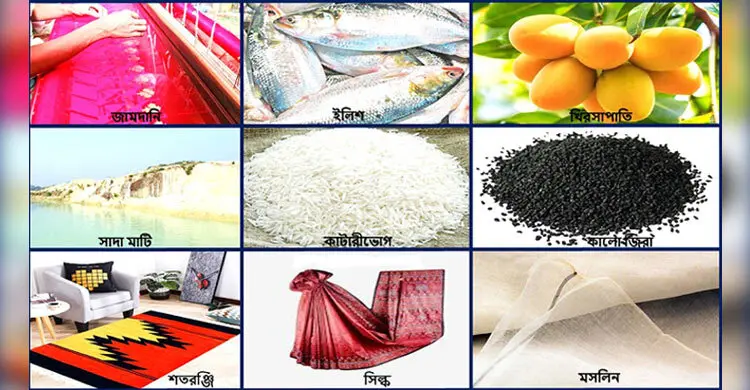
India's certification of the Tangail saree as a geographical indication (GI) has shaken the responsible government officials into action. Within a week, the Department of Patents, Designs and Trademarks (DPDT) under the Ministry of Industries published a journal recognising the Tangail saree as a Bangladeshi GI product. Five days later several more products were recognised as GIs.
Prominent figures have expressed anger at the Tangail saree GI going to India. They say that although it is a Bangladeshi product, the indifference of the proper government authority created room for confusion, and the DPDT delayed GI recognition. Economists and GI experts urge that products shared with other countries be brought under GI certification as quickly as possible.
India applied to register the Tangail saree as a GI in 2020, and the work went on for four years, with the information available on the website. Yet the DPDT took no initiative all that time, the Ministry of Textiles and Jute did not press it, and the Tangail district administration never applied for the saree's GI in Bangladesh. Not only the government but no business group raised the question either. Everyone seems to have woken up only after India's announcement.
Warnings against haste
Many say that after staying silent so long, mistakes made in a hurry to secure GIs could cause problems, and the GI could even be lost, because a GI requires following a number of rules and supplying data. If these are not provided properly, it could backfire, so Bangladesh must proceed carefully.
Dr Debapriya Bhattacharya, special fellow of the private research organisation Centre for Policy Dialogue (CPD), commented: "Now there is so much rush over GI. What did our relevant offices do all this time? Not only the government, no business group raised any question. This is our ignorance and failure. But the claim now being made that the GI has been done in such a hurry is baseless. In such haste we may make mistakes again."
GI experts, lawyers and rights activists say the Tangail saree is Bangladesh's own product and there is no area called 'Tangail' in India, so India's move is unfair.
They say India claims that after Partition, Hindu weavers from Tangail fled to India and wove Tangail sarees in West Bengal. That is not correct: in the Tangail region, not only Hindus but Muslims too have woven this saree for a long time. So the reasoning on which India registered the GI is wrong. When weavers move from one country to another, the saree's geographical identity is not erased.
What matters for GI recognition is to present Bangladesh's arguments and data. If a dispute arises with India or another country, it should be resolved through talks, and if it cannot be settled bilaterally, Bangladesh will have to go to international forums.
CPD distinguished fellow Debapriya Bhattacharya said: "Under India's GI law, any objection must be made within three months. Bangladesh should now go to court in India, and that must be done within three months. The arguments on which India has registered the Tangail saree as a GI are not based on facts and will not stand. Bangladesh has the stronger case here, but it has to make use of it."
"Not the Tangail saree"
Abu Sayeed Khan, convener of the Medhasampad Surakkha Mancha (Medhasum), told Jagonews: "By registering handloom cloth produced in the Nadia and Purba Bardhaman regions of West Bengal as 'Tangail saree', not only the 'Tangail saree' but the geographical indication of those regions' own weaving heritage has been disregarded."
"The Tangail saree originated in Bangladesh and has been woven here for several hundred years. For various reasons including Partition, some of the Tangail saree weavers migrated from Tangail in Bangladesh to parts of Nadia and Purba Bardhaman in West Bengal. Those migrant weavers have since been making handloom cloth in India, which reflects the geographical indication of those regions but in no way the Tangail saree."
What a GI is
When a country's soil, water, climate and people's culture play the most important role in producing a product, it is recognised as that country's geographical indication product; that is, the product cannot be produced anywhere other than that area.
A GI usually includes the name of the place of origin (town, region or country). GI stands for geographical indication. WIPO (World Intellectual Property Organization) is the body that recognises GI products: after a country applies for registration, it examines the application and grants the final GI.
GI recognition makes global branding easier, gives the products a special value, and gives the region the right to produce the product commercially and legal protection. If a product receives a GI certificate after scrutiny, it becomes known worldwide as that country's own product, so only Bangladesh will benefit from a product given a GI from Bangladesh.
Around 2012 India moved to list Jamdani saree, mango and hilsa as GI products, although these products exist in Bangladesh too. Bangladesh then had no law for GI registration. The Geographical Indication Products (Registration and Protection) Act was passed quickly in 2013, and two years later the Geographical Indication Products Rules, 2015 were framed. The DPDT is the government-appointed body for this. Initially the deputy commissioner of a district identifies GI products and applies to the DPDT, which has the legal power to examine applications and grant certificates.
A country applies to WIPO for the final GI of a given product. But applying does not mean that country, or that product, will get the certificate; after various tests it is decided which products go on the worldwide GI list.
Bangladesh's GI list
Bangladesh now has 31 approved GI products. Jamdani saree was recognised as the first GI product in 2016. After that, the report says, another 20 products were recognised: Bangladesh hilsa, Chapainawabganj's Khirsapat mango, Bijoypur's white clay, Dinajpur's Kataribhog, Bangladesh black cumin (kalijira), Rangpur's shataranji, Rajshahi silk, Dhakai muslin, Rajshahi-Chapainawabganj's Fazli mango, Bangladesh's bagda shrimp, Bangladesh's shital pati, Bogura's doi, Sherpur's Tulshimala rice, Chapainawabganj's Langra mango, Chapainawabganj's Ashwina mango, Natore's kanchagolla, Bangladesh's Black Bengal goat, Tangail's Porabari chamcham, Cumilla's rasmalai, Kushtia's tiler khaja, Tangail saree, Narsingdi's Amritasagar banana, Gopalganj's rasgolla, Rangpur's Haribhanga mango, Moulvibazar's agar, Moulvibazar's agar attar, Muktagachha's monda, Jashore's date palm molasses, Rajshahi's sweet betel leaf and Jamalpur's nakshi kantha.
Like the Tangail saree, eight products that also exist in Bangladesh have been recognised as GI products in India: Jamdani saree, Fazli mango, Lakshmanbhog mango, Khirsapat mango, nakshi kantha, rasgolla, garad saree and Sundarbans honey.
There are other products that no country has yet registered but which, for geographical reasons, exist in both countries, including various flowers, fruits, fish, Sundarbans trees, tea and jute.
Calls for joint registration
Urging quick thinking on these products, Professor Dr Mohammad Tauhidul Islam of the Department of Law at Dhaka University told Jagonews: "Because of long-standing migration between India and Bangladesh, both neighbouring countries can claim the GI for the same product. For jointly owned products such as mango and nakshi kantha, rather than making it a problem, we can think about how both countries can have the GI, although our law does not yet say anything about this."
"We can make a bilateral agreement with India on such products, and discuss how jointly owned products can be given GIs. Or we can discuss these cross-border products in SAARC, as with other agreements, and set up a platform for joint registration," he said.
At the cabinet meeting last Sunday, Prime Minister Sheikh Hasina directed those concerned to be active on GI recognition for the Tangail saree and other Bangladeshi products. At that meeting the DPDT, the deputy commissioners of 64 districts and the divisional commissioners of eight divisions were asked to take the necessary steps on GI products in each district.
Textiles and Jute Minister Jahangir Kabir Nanak said that even though India had taken the GI certificate, the Tangail saree was ours, is ours and will remain ours, and everything necessary, including going to the international level, would be done.
Source: Jagonews24. First published in Bengali on The Agro News.
Comments
(0)