
Several days of continuous rain sent the rivers of Bangladesh's north-eastern haor basin rising fast in late April 2026, and on the evening of Tuesday 28 April the Meteorological Department and the Flood Forecasting and Warning Centre (FFWC) of the Bangladesh Water Development Board warned that flash floods could follow in the Sylhet region. The rivers had not crossed their danger levels when the notices went out, but the FFWC said they might pass the pre-monsoon danger level within 24 hours, and forecasters expected heavy to very heavy rain to continue for days.
The warning came at a hard moment in the farming year. Boro rice, the main crop of the haors, was still standing in many fields, and water had already reached paddy in parts of Sunamganj and Kishoreganj. For farmers the question on 28 April was how much of the harvest could be cut before the rivers rose further.
What the 28 April notices said
According to the Water Development Board's forecast, water was rising fast in the main rivers of Sylhet, Sunamganj, Moulvibazar and Habiganj districts: the Surma, the Kushiyara, the Manu, the Khowai and the Juri. None had crossed the danger level at the time, but the board feared they could go past the pre-monsoon danger level in the next 24 hours. That, it said, could cause floods in low-lying riverside areas of Sylhet, Moulvibazar and Habiganj districts.
Partha Pratim Barua, the officer in charge at the FFWC, said no river had crossed the danger level up to Tuesday morning, but the water was rising fast and the situation was being watched.
The Dhanu-Baulai and Bhugai-Kangsha rivers could also rise, the centre said, and that could take water to the warning level in some parts of Netrokona and Kishoreganj districts.
The Meteorological Department said heavy to very heavy rain could fall over the north-eastern haor areas in the next three days, and that this rain was driving the rivers up.
Rainfall recorded and the forecast up to 2 May
Up to the morning of 28 April the highest rainfall, 146 millimetres, was recorded at Sreemangal in Moulvibazar district. Sylhet recorded 127.2 millimetres over the same period.
Shah Md Sajib Hossain, assistant meteorologist at the Sylhet weather office, gave the detail for Sylhet: 127.2 millimetres from 6am on Monday to 6am on Tuesday, and a further 1.2 millimetres from 6am to 6pm on Tuesday.
The Sylhet office's latest forecast said the sky over the region could be partly cloudy to temporarily overcast in the next 24 hours, with light to moderate rain or thundershowers, and moderately heavy to very heavy falls in places. Because gusty or stormy winds and lightning could come with the rain, people were advised to stay alert.
In a release on 28 April, meteorologist A K M Nazmul Haque said that until Saturday 2 May parts of Mymensingh and Sylhet divisions could get the following in 24 hours:
- heavy rain of 44 to 88 millimetres;
- very heavy rain of more than 88 millimetres;
- rain and thundershowers over the same period.
How the warnings built up from 21 April
The 28 April notices were not the first. Prothom Alo reported on 21 April that the Water Development Board had advised quick harvesting in the haors because of the risk of an early flood. On Friday 24 April the board's Sunamganj office issued an emergency notice asking farmers to cut, within four days, every field where about 80 per cent of the paddy was ripe. BSS reported that loudspeaker announcements carried the request through the haor areas.
That notice rested on seven-day forecasts from the Meteorological Department and global weather agencies, which pointed to above-normal rain over the north-eastern haor basin and the land upstream. It set out the expected pattern: light to moderate rain on 24 to 26 April, moderate to heavy rain on 27 April, and heavy to very heavy rain on 28 to 30 April. It named the Surma, Kushiyara, Dhanu, Baulai and Kangsha and said that from 28 April some of them might flow above the danger level in places.
The board's executive engineer in Sunamganj told Prothom Alo that rain upstream, in places such as Cherrapunji in India, was a bigger threat to haor rice than rain on Sunamganj itself, because it sent water down quickly as hill runoff.
On Monday 27 April the FFWC issued a three-day alert, reported by bdnews24.com, saying heavy to very heavy rain could bring flash floods to low-lying parts of Sylhet, Habiganj and Moulvibazar from Thursday 30 April. It cited upstream runoff and intensifying seasonal rain. The Surma and Kushiyara and the Manu and Khowai were expected to rise, and by the third day the Surma, Kushiyara, Khowai and Juri could climb quickly above their pre-monsoon danger levels. An assistant engineer at the centre expected conditions to improve once the rain eased.
The same day the Sunamganj district disaster management committee held an emergency meeting at noon, chaired by the deputy commissioner and attended by the administration, the Department of Agricultural Extension, the Water Development Board, the army, the police and Border Guard Bangladesh. The deputy commissioner said the haor harvest was the main concern and that a publicity campaign was under way to speed it up.
The FFWC is part of the Bangladesh Water Development Board, which was created in 1972 when the old East Pakistan water and power authority was split up. Banglapedia lists flood and drought forecasting among the board's duties, alongside embankments, regulators and river works, and notes that the centre publishes an annual flood report.
Water already in the paddy in Sunamganj
Sunamganj did not wait for the river forecast to come true. From 9am on Monday to 9am on Tuesday the district recorded 137 millimetres of rain, the highest 24-hour total of the season, and the Surma rose 35 centimetres in 24 hours, Prothom Alo reported from Water Development Board sources.
Two embankments gave way that Tuesday. One was at Chandalipara in Madhyanagar upazila, on the Ikrachhoi haor. The other, the Gujauni embankment, was on the Dekhar haor in Sadar upazila. Local people had repaired both, and neither was under the board's management. In Bishwambarpur upazila, water overtopped the Harimon embankment on the Karchar haor at noon.
Losses were reported from the Hali haor in Jamalganj, Dekhar in Sadar, Pagnar in Dirai, Chhayar in Shalla, Khai and Pakhimara in Shantiganj and Karchar in Bishwambarpur. Paddy stacked on open drying yards, called khola, was lost in Jamalganj, Dirai and other places when water rose overnight. A 60-year-old farmer in Jagannathpur upazila told the paper he had managed to cut only 4 of his 16 bigha.
The deputy commissioner ordered all Project Implementation Committees to post guards on every embankment. The deputy director of the district agriculture office said farmers were still in the fields and that everything now depended on the weather. The general secretary of the Sunamganj Haor and River Protection Movement said even farmers offering half the crop as payment could not find labourers.
The race to cut the boro crop
Boro was the crop at stake. Sunamganj's agriculture office counted 223,511 hectares of it across 137 haors this season, with a production target of about 1.4 million tonnes. By 24 April farmers had cut 53,640 hectares, and by Saturday 25 April 78,228 hectares. By 28 April the office put the figure at 99,483 hectares, about 44 per cent of the haor area, and roughly half of the boro land was still uncut.
Several things slowed the work. Ripening was late, which officials put down to the lack of rain at the start of the season, so about half of the standing paddy was not ready. The district had 602 combine harvesters, but standing water kept many of them out of the fields, and labour was scarce. Without sunshine, cut paddy could not be dried, and lightning made the open haor dangerous. The district agriculture office advised farmers not to wait for machines and to cut once the grain was about 80 per cent ripe, using labourers if need be, then thresh it, dry it and move it to a safe place.

BSS reported on 28 April that boro covered about 277,000 hectares in the Sylhet haors and that about 155,000 hectares had been harvested by that Monday. It said the FFWC had warned that floodwater entering the haors might not recede, since the rain was expected to intensify, and that the Department of Agricultural Extension and local administrations had been alerted so that they could inform farmers. Heavy rain was also forecast for 1 to 3 May.
Further west the water had already arrived. In Kishoreganj, two days of rain to 27 April submerged about 2,000 hectares of ripe boro in parts of Ashtagram, Itna and Mithamain, though the district agriculture office said it had no accurate loss figure yet and a full assessment would take several days. The office reported 104,535 hectares of boro in the district's haors and 48 per cent of the haor paddy cut by Monday afternoon. Its deputy director said silting of the river was causing the waterlogging in Ashtagram, and that the damage would grow if paddy stayed under water for five or six days.
The stakes went beyond the farmers themselves. Prothom Alo reported that Sunamganj needs about 550,000 tonnes of rice a year and produces about 1.15 million tonnes, sending a surplus of about 600,000 tonnes into the national food stock. The value of its boro paddy alone was put at about Tk 5,000 crore.
Earthen embankments under pressure
The haor crop depends on crop-protection embankments of earth. This season the Water Development Board built or repaired 602 kilometres of them in Sunamganj under 710 projects, at an estimated Tk 145 crore. Separately, Tk 308 crore went on about 17 kilometres of permanent embankment in 14 haors, Prothom Alo reported on 16 April.
Since 2017 the work has been done by Project Implementation Committees of farmers and other beneficiaries, not contractors, each handling up to Tk 35 lakh. The rules as The Daily Star described them in 2022 said committees must be formed by 30 November, and that work must start by 15 December and finish by 28 February. In March 2026 the general secretary of the Haor and River Protection Movement said this season's work had not been finished by that deadline, and Prothom Alo reported it as not fully complete.
The board's executive engineer warned in late April that the embankments were earthen, had been weakened by continuous rain and might not all withstand a large upstream flood. Weather had already caused trouble earlier in the season: Prothom Alo reported waterlogging in several haors, about 370 hectares damaged by hail in March, and a break on the Dekhar haor in April that thousands of farmers helped to contain. A professor of water and flood management at BUET told the paper that mud embankments were no lasting fix and recommended sluice gates, drainage and dredging of rivers and haors.
Why water rises so quickly in the north-east
The speed of the rise comes from geography. The Surma-Meghna system, the longest of Bangladesh's three major river systems at 669 kilometres, drains one of the wettest areas in the world. Its main source, the Barak, rises in the hills of north-east India and divides at Amalshid in Sylhet district into the Surma and the Kushiyara.
Banglapedia describes the Surma's tributaries from the Khasi and Jaintia Hills as steep and highly flashy. The Kushiyara's main left-bank tributaries come from the Tripura Hills, the chief of them the Manu, and the Khowai also comes from Tripura; these are less violent but can still cause flash floods. The two main rivers meet at Markuli, and the joined stream is known as the Kalni as far as Bhairab Bazar.
Rainfall does the rest. Sylhet averages 4,180 millimetres a year and the area near Sunamganj 5,330 millimetres, against about 1,500 millimetres in the west-central part of the country. Cherrapunji in Meghalaya, just across the border, records about 10,820 millimetres. The March to May hot season brings about 10 to 25 per cent of the annual total, up to about 800 millimetres in the north-east, where the Meghalaya plateau adds uplift. Much of this pre-monsoon rain comes from the storms known as nor'westers or Kalbaishakhi.
A flash flood, Banglapedia notes, is one in which water rises and falls suddenly, usually in the valleys of hilly areas. It adds that the Sylhet depression fills rapidly early in the monsoon and drains slowly.
The districts and haors in the warning's path
A haor is a large bowl-shaped depression that collects runoff from rivers and canals, becoming a vast sheet of water in the monsoon and mostly drying out afterwards. The word comes from the Sanskrit sagar, meaning sea. The basin lies mainly in greater Sylhet and greater Mymensingh, with about 47 major haors and some 6,300 beels, or wetlands, of which about 3,500 are permanent. As the water recedes, the exposed alluvial soil is planted with rice, particularly boro, and the haors are among the country's important fishing grounds.
All of Sunamganj district, most of Habiganj and parts of Sylhet Sadar and Moulvibazar lie in haor land, according to Banglapedia. Sylhet district covers 3,217.28 square kilometres and has the Surma and Kushiyara among its main rivers. Moulvibazar, with the Manu, Dhalai and Juri, holds the Hakaluki, Hail and Kawadighi haors. Hakaluki, on the Assam border, is the country's largest haor and was declared an Ecologically Critical Area in 1999; the Juri is among the rivers that feed it. Habiganj's rivers include the Kushiyara, Kalni and Khowai. Sreemangal, which recorded the highest rain on 28 April, is the Moulvibazar upazila known for tea and for the Hail Haor.

Earlier April floods in the haors
Haor farmers had reason to fear April. Floods in the region usually come in mid-May, after the spring crop is in, Scroll.in reported in 2017, citing a World Bank specialist. When they come earlier they catch the rice in the field. A study of Sunamganj's haors put the damage at 70 to 90 per cent in an April flood, against 15 to 40 per cent in May.
The 2017 flood is the one most often recalled. The Department of Agricultural Extension said on 23 April that year that about 114,000 hectares of standing boro had gone under in the four districts of Sylhet division, with Sunamganj the worst hit at 57,289 hectares, and that more than 341,000 farmers were affected. A later peer-reviewed study put the affected boro land in Sunamganj's haors at 149,224 hectares, with 393,855 tonnes of rice damaged and 315,084 farmers affected. Prothom Alo recalled in April 2026 that embankments breached in that flood, that rice prices rose nationally, and that about 200,000 farm families in the district received food aid for a year.
In April 2022 another early flood struck. The Daily Star reported that the first flash flood reached Sunamganj on 1 April after heavy rain in Meghalaya, and that about 7,083 hectares of boro had been submerged in the north by the time of its report, 4,900 of them in Sunamganj, with levees broken at Chandra Shonar Thal in Dharmapasha and Chaptir Haor in Derai.

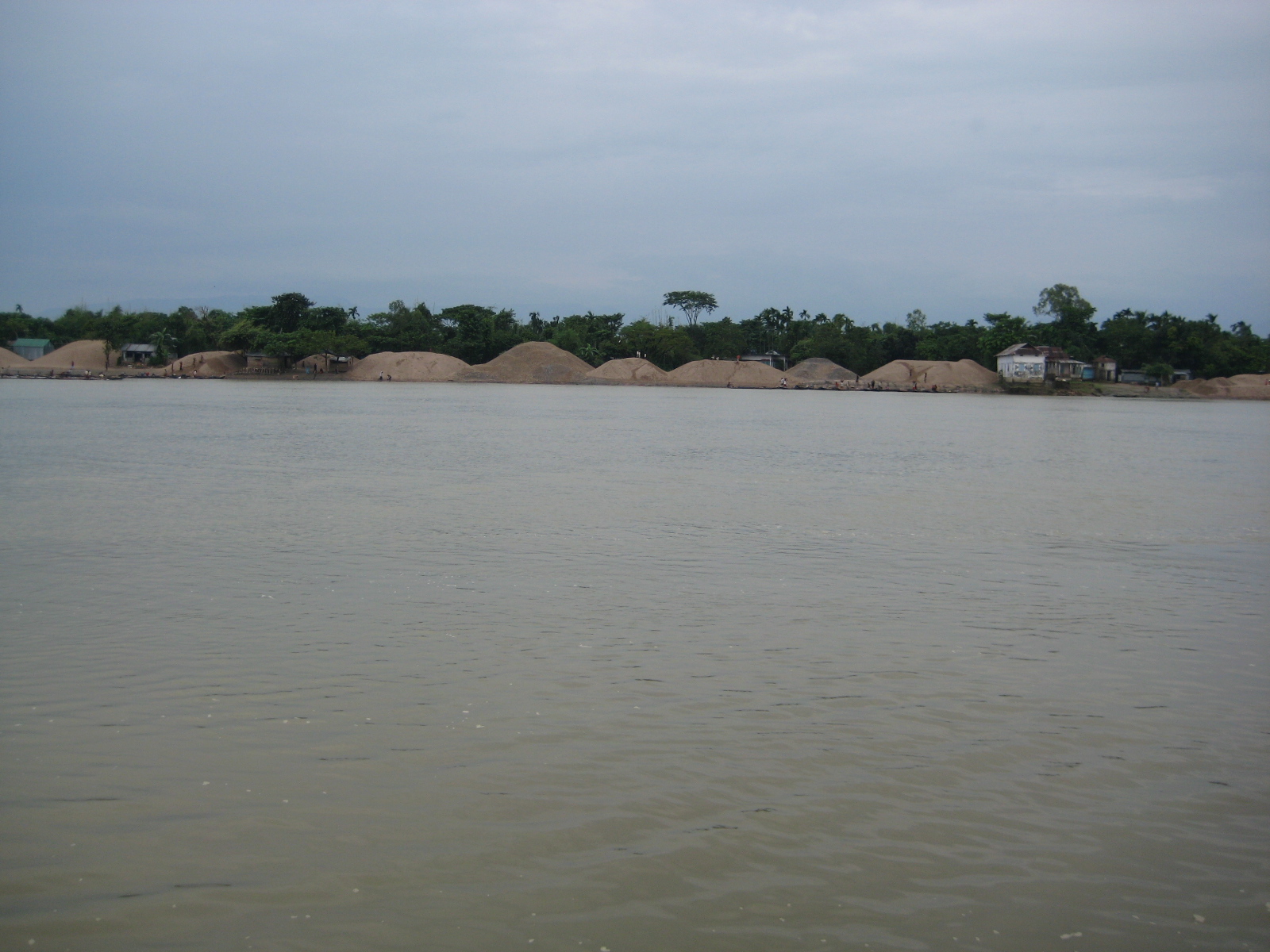
Photo: Belayet / Wikimedia Commons (CC BY 3.0). The top picture shows the Surma River in Sunamganj, as background.
Sources: Jagonews24, bdnews24.com, The Financial Express, BSS, Prothom Alo, The Daily Star, Dhaka Tribune, Scroll.in, Journal of Environmental Science and Natural Resources, Banglapedia


Comments
(0)