
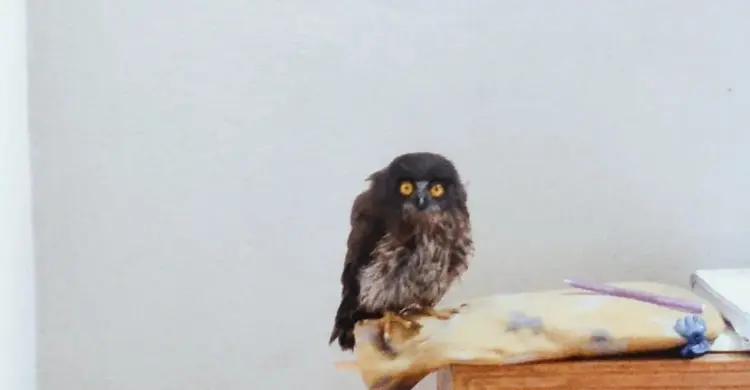
Animals and birds in Sylhet have not escaped the flood. To save its life during a violent storm and heavy rain, a lakshmi pencha owl took shelter in the home of a teacher in the city.
Rather than chase away the rare, distressed owl, Nasrin Jahan Madhuri, a lecturer in the zoology department of Scholars Home in Sylhet, and her daughter nursed it back to health. Thanks to their care, the bird recovered and returned to its nest the next day.
Madhuri's daughter, Tahsin Tarannum Prottasha, works as a visa consultant in the Sobhanighat area of the city. Madhuri, who lives in the house Anamika 14/A next to a tea garden in the Shahi Eidgah area, posted a photo of the owl on her Facebook wall on Thursday night: "Today the city is drowned in pouring rain. The familiar face of Asharh. Just when the mind, soaked in rain and kadam and keya flowers, seeks warmth under a quilt, at dusk a lakshmi pencha came and took shelter in my home."
She added: "Since evening, mother and daughter have been busy with the owl. What food can we give it? How can we make it comfortable? Whenever we go into that room, it stares with round eyes. It looks frightening, but the bird is completely harmless." She also wrote: "Wikipedia calls it the brown boobook. It mainly eats insects, so I am wondering what to feed it. I have given it water, though it is not drinking."
"We did not chase it away"
Madhuri told Jagonews that the owl came into their house because of the fierce storm and rain. Instead of driving it out, she and her daughter kept it in a separate room so it could settle down. They left some food for it and kept it in an open room without caging it. On Friday afternoon, the owl flew off to its nest.
About the bird
Abdul Karim Kim, general secretary of the Sylhet committee of Bangladesh Poribesh Andolon (BAPA), told Jagonews that the lakshmi pencha is a nocturnal bird and a useful creature. There are 16 species of owl in the country, and of these the lakshmi pencha is attractive to look at.
Its face is large for its body. Its most striking features are its big round eyes and sharp sight. It can turn its head to look almost directly behind, and its keen eyesight lets it catch prey even in the dark of night. That is why it can sit quietly in one place and keep watch all around.
Kim said the bird's eyes are entirely yellow, and its irises and feet are yellow. Its back is dark brown and its breast has many white spots. The birds like to stay in pairs in one place, and their call is heard at dusk or at night. They can locate prey just by hearing movement in the dark.
Most owls have long, sharp claws, he said, and seize prey in their curved talons. They live on small rats, caterpillars, small birds, lizards, dhora snakes and frogs. They cannot tolerate daylight at all, so they hide in the hollows of big trees, in forests, in gaps in buildings or behind dense foliage.
Beliefs about the owl
Kim said that for followers of the Sanatan (Hindu) faith, the lakshmi pencha is the mount of the goddess Lakshmi. Many households therefore try to stop the owl from flying away if it enters the house, believing its presence will fill the home with wealth. In some areas, however, the owl's deep call is considered a bad omen, and water is poured on the steps into the house when an owl calls, in the belief that this wards off all misfortune.
According to Wikipedia, 170 species of owl are found worldwide, 16 of them in Bangladesh, of which the lakshmi pencha is the most attractive. Of the 28 identified subspecies of the lakshmi pencha worldwide, three are found in Bangladesh: the Australasian grass-owl, the lakshmi pencha and the Oriental bay-owl.
Source: Jagonews24. First published in Bengali on The Agro News.

Comments
(0)