
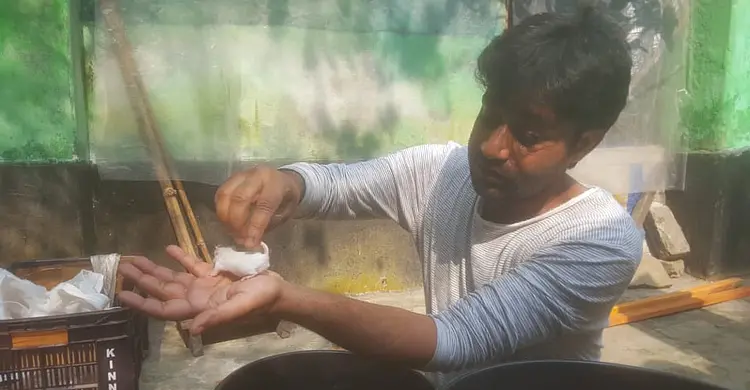
Swami Vivekananda said: "Whoever loves living beings serves God." Salauddin Mamun, a lab assistant in the Department of Zoology at Rajshahi University (RU), fits those words. He has a great love for every animal, from dogs and cats onwards, and in his own area he is well known as Mamun the animal lover.
Another example of that love at RU's zoology department made him known in Rajshahi as an unusual entrepreneur. People now know him less as the animal lover and more as "Mamun the mouse farmer".
How it began
It was late November 2017. Mamun and his colleague Masud were sitting in front of the lab when a botany PhD researcher gave Masud four baby Swiss albino mice and asked him to let them go.
Mamun felt sorry for the tiny pups. He thought that if he kept them for a while and released them once they were bigger they might survive; otherwise wild predators would kill them. Out of pity and as a hobby he took them home and made a bed for them in a shoebox lined with cloth.
At first he knew nothing about caring for mice and fed them rice and wheat. Later he learned how to look after Swiss albino mice by watching YouTube.
About a month later the mice had young. When those grew, an RU teacher bought 20 of them for research. Mamun was astonished at the unexpected gain and saw a new door open. Later he received orders from various universities and pharmaceutical labs, and his life took a new turn. Those four mice changed his fortune.
Mamun said that with regular care one mouse gave birth to 10 pups after 28 days. "At night I shone my mobile phone's light to look at the pups and saw the mother suckling them. I was amazed." A week later another mouse gave birth to 10 pups. Delighted, he told the teachers and staff of his department, and soon almost everyone on campus knew he was rearing Swiss albino mice.
First sales
Describing how a hobby became a farm, Mamun said a researcher from Germany was working on taxidermy at the zoology department's museum and asked him for the mice. He refused at first because the mice would die in the research, but museum curator Anjum Ara explained it to him, and he then gave 20 mice. The researcher gave him Tk 1,000, which surprised him.
Some days later Professor Abu Reza of the Genetic Engineering department in Rajshahi phoned for 20 mice. Not knowing the price, Mamun asked him to pay whatever he liked, and he paid Tk 40 per mouse plus extra, Tk 1,000 in total. The report calls this his first commercial sale of mice. "After that I really became interested in rearing mice, though I spent the first money on snacks for the staff," Mamun said.
Mamun said it was Professor Abu Reza who advised him to look after the mice well and to rear them commercially. Hearing from him about the commercial demand for Swiss albino mice and the shortage, his interest grew, and he focused on more careful husbandry. He now keeps the mice at his home in a cleaned-out cowshed, where they live freely.
Once during the monsoon a cobra got in and ate a number of mice, so the room has been netted on all sides to protect them from snakes, mongooses, cats and other animals.
The farm today
Mamun said his farm now has 140 mice: 60 females, 40 males and 40 young. Each female gives birth to 8 to 10 pups every one to one and a half months, and as many as 14. He feeds them rice, wheat, maize, pulses and poultry feed.
Feeding 100 mice costs about Tk 3,000 a month, and boxes, paper and sawdust are also needed. Their housing has to be cleaned every day or two, and the mice need clean water 24 hours a day, supplied through poultry drinker jars.
He has sold about 5,000 mice so far. Three years ago he sold them at Tk 40 each and until recently at Tk 70; now he charges Tk 100. At first only RU teachers and students bought mice for research. Now, besides RU, private universities and several pharmaceutical companies and laboratories in Dhaka buy from him, and he gets calls every day from across the country.
"On average three calls a day come to buy mice, and 5 to 10 from people wanting to learn to rear them," he said. "To farm mice on a large scale I stopped sales from 1 February and will start again from 1 April." He is trying to set up another large farm on several thousand square feet on top of a two-storey building at Tangon on the city's outskirts.
He also recalled the trouble the mice brought him during the coronavirus pandemic. With no sales, he ran short of money and could not pay for daily feed, so about 500 mice had to be fed to his pet cat, which pained him greatly.
Demand in research
RU researchers said Swiss albino mice originally come from Switzerland. Because mouse genes closely resemble human genes, albino mice are in great demand for the first stage of laboratory research. Unlike other mice they are not aggressive or destructive, and they are used for initial tests in any research in the biological and biomedical sciences.
They said that in Bangladesh mice are bred only at ICDDR,B and Jahangirnagar University, far fewer than needed. Government training for individuals interested in rearing mice would enrich the country's research sector, they said.
Professor Jahangir Alam Saud of RU's Department of Biochemistry and Molecular Biology, who works on mouse breeding, called Mamun's commercial rearing of Swiss albinos in Rajshahi a commendable and unusual initiative. But since Mamun plans to rear mice commercially, he must follow housing, care, feed and temperature more scientifically, he said, adding that he was ready to help if needed.
He cautioned that demand for Swiss albino mice is limited to education and a small number of laboratories, so entrepreneurs could suffer losses if rearing began in Rajshahi or all over the country. The mice are highly productive, and if they somehow adjusted to the outside environment they could also harm it.
Salauddin Mamun said he wants to supply mice not just to RU but to every university and research laboratory in Bangladesh. "I have already built a large room where I will rear mice scientifically," he said.
Source: Jagonews24. First published in Bengali on The Agro News.


Comments
(0)