

The balance of the ecosystem in the Sundarbans is being disrupted. Climate change, food shortage and poachers have put the endangered tiger under threat. Alongside the shrinking of its natural habitat, the lack of food has put the tiger's existence at serious risk, raising fresh concern over its survival.
According to wildlife experts and environmentalists, about 78 percent of the tiger's food needs are met by hunting deer, yet deer themselves are not safe in the Sundarbans. Climate change is bringing repeated tidal surges and rising salinity, leaving the forest's ponds and water bodies short of fresh water. This is disrupting the food chain, and deer, wild boar, monkeys and other animals that depend on the ecosystem are declining.
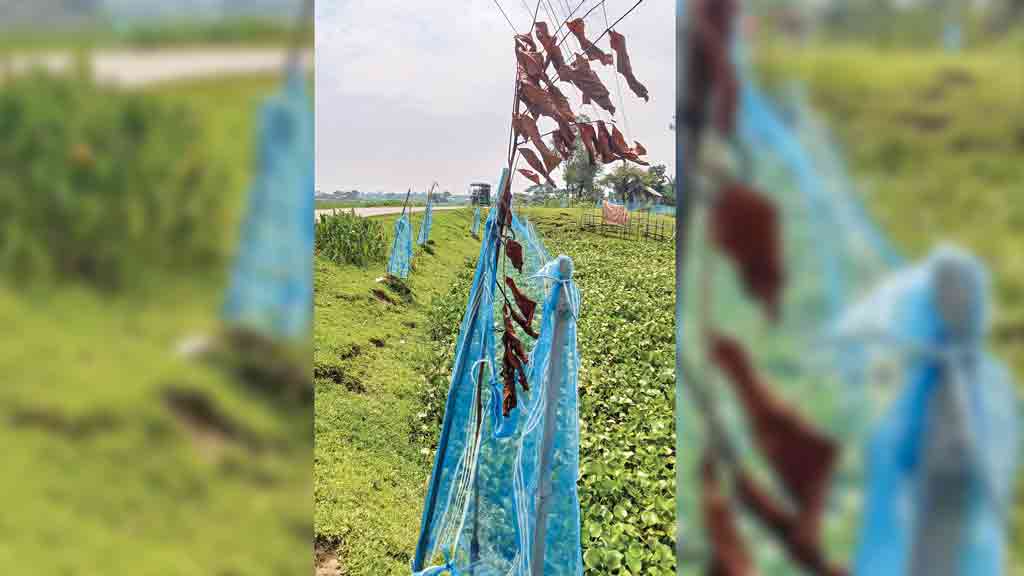
Traps seized in the forest
Most recently, on the afternoon of Sunday, 27 July, the forest department rescued a deer caught in a trap and seized a large number of deer traps. The special protection and response SPART team of Chandpai range, Sundarbans East Forest Division, rescued the deer and burnt more than a kilometre of traps.
According to the latest forest department data, about 4,500 poachers' traps have been recovered in Sundarbans East Forest Division over the past three months. Three deer were also rescued and released elsewhere in the forest during this time.
Md Rezaul Karim Chowdhury, forest officer of Sundarbans East Forest Division, told Jago News that deer are being poached in the Sundarbans all the time, and attempts are also made to poach tigers. "We have seen that some of the traps were meant for tigers. Our team is recovering these traps by walking through the forest at risk. We are trying," he said.
He said deer breed well, and if they can be given a safe habitat, the tiger's food supply will be secured and nature will survive. "But our people are not good. People want to eat venison and demand is rising. And poachers sneak in secretly to commit these crimes."
Deer numbers and fresh water
Experts say the number of deer in the forest is also falling, intensifying the tiger's food shortage.
Professor Dr M A Aziz of the Department of Zoology, Jahangirnagar University, said the bulk of what tigers eat comes from spotted deer. "If this animal declines, the crisis will deepen. So we must stress deer conservation."
M A Aziz said a 2023 study of theirs estimated the number of spotted deer in the Sundarbans at 1,36,604, and wild boar, the tiger's second main food, at 47,515. However, people regularly hunt deer there.
Climate change is raising sea levels, which increases salinity inside the Sundarbans. With river flows falling, fresh water is scarce, and trees are dying in many parts of the forest. This is reducing the numbers of deer and other wildlife, the tiger's main food.
Professor Aziz said upstream water is falling. With less water in the Ganges, the flow of fresh water into the Sundarbans is declining day by day, reducing the forest's diversity. Climate change is also bringing negative changes, and changes are coming to the tiger's habitat. Tigers and deer face great danger during tidal surges or cyclones. The forest department has built raised mounds and ponds for this, but it is hard to say how effective they are compared with the need.
The forest department says it has taken some steps to protect wildlife. According to the department, 12 tiger killas (raised shelters) have been built, three each in the Chandpai, Sharankhola, Khulna and Satkhira ranges. The Sundarbans also has 115 ponds as fresh water reservoirs: 35 small ponds for various animals and 80 for both people and animals. Some ponds, however, were submerged by salt water in the tidal surge of Cyclone Remal.
Poaching gangs by sea
Rajib Hossain, member secretary of the Sundarbans Rokkha Committee for the Satkhira region, told Jago News that most deer are poached in the Bagerhat range. "Most of the poaching gangs are from Patharghata in Barguna. They enter the Sundarbans by sea on big fishing trawlers, on the side where there are no forest department patrols at all. They cut sundari trees. Not one or two, they slaughter hundreds of deer and bring the trees and deer back together. They enter recklessly from that side, where there is no coast guard."
He said deer gather where keora trees are dense, because they live on keora leaves. Poachers exploit this behaviour by setting traps in those areas. Monkeys, meanwhile, pick leaves and fruit for the deer. "Monkeys are linked to deer, and deer are linked to tigers."
"One of the crises in the Sundarbans is the tendency to use poison to catch fish. Many fishermen poison canals to catch fish, which harms not only fish but other wildlife too. Many small animals on the tiger's menu are dying or weakening from poisoning, which indirectly affects the tiger's food supply," Rajib Hossain added.
Pavel Partha, director of Bangladesh Resource Centre for Indigenous Knowledge (BARCIK) and a wildlife researcher, said tiger conservation is not possible without protecting the ecosystem. "Tigers, deer, monkeys and other animals are closely linked. Harm to one means danger for another."
"Our increase is negligible"
According to the forest department's latest 2024 report, there are now only 125 Royal Bengal Tigers in the Sundarbans. There are also tigers in the Chittagong Hill Tracts, but they have not been counted, the department said.
Professor Dr M. Monirul H. Khan, chairman in biological sciences at Jahangirnagar University, told Jago News: "The tiger count is now 125. But that is not the real number; it could be lower or higher. We had hoped the number would be higher, but that did not happen. Our neighbours India, Nepal and Bhutan have gone much further in tiger conservation, and we are far behind them."
He said a goal of doubling tiger numbers was set at a tiger summit in Russia in 2010. Neighbouring countries have got fairly close to doubling, even if they have not done so, but Bangladesh has not managed it. "Our increase is negligible. But given the size of the Sundarbans, there is scope for tiger numbers to grow here."
If tiger and deer poaching can be stopped, tiger numbers will increase, he said. Tigers are also poached, but such news does not always reach the media, the professor added.
Imran Ahmed, conservator of forests for the Khulna region of the Forest Department, told Jago News: "We carry out security patrols and recover traps. We also build raised mounds and ponds for use during tidal surges. Someone or other is behind those who poach. But we are constantly trying to prevent it, and our team is working. We have a tiger conservation project, under which we monitor crime-prone areas for tiger and deer poaching with cameras and drones."
He said: "Some crime-prone areas have been identified. We will carry out camera trapping in those through the project."
Source: Jagonews24. First published in Bengali on The Agro News.

Comments
(0)