
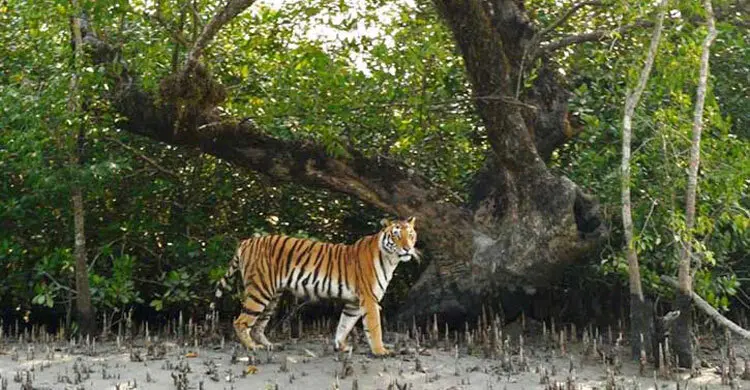
The camera-trap tiger census has been completed in both divisions of the Sundarbans and is now being reviewed. The review has to be done online, but disruption to internet services over the past few days held up the work, so the announcement of the result has been postponed. According to the Forest Department, the census result will be published at some point next month.
The Forest Department says more tiger photos were captured by the camera traps this time, which suggests the number of tigers has risen.
How the census was done
According to relevant sources, the 2018 survey identified 114 tigers in the Bangladesh part of the Sundarbans. Camera trapping for the tiger survey finished in the western Sundarbans in March 2023. In the eastern part, camera trapping began in November and ended in early 2024. The survey data are now being reviewed.
Past counts
Forest Department data show that the 1975 survey after independence put the number of tigers in the Sundarbans at 350. The 1982 survey raised the figure to 425. In 1984 a survey of 110 square kilometres of the Sundarbans South Wildlife Sanctuary reported 430 to 450 tigers. In 1992 the Forest Department reported 359 tigers. In 1993 a pugmark survey was carried out on 350 square kilometres of the forest, which found 362 tigers in the Sundarbans.
A 2004 survey put the number of tigers at 440. The 1996-97 survey gave a figure of 350 to 400; tigers were then counted by the footprint method. The first camera-trap survey in 2015 put the number in the Bangladesh part of the Sundarbans at 106. The second camera-trap survey in 2018 found 114 tigers.
The data also show that 50 tigers died between 2001 and 2018. Of these, 10 died naturally, 14 were beaten to death and one died in Cyclone Sidr in 2007. The remaining 25 were killed by poachers.
More cubs than ever
Dr Abu Naser Mohsin Hossain, director of the tiger conservation project and divisional forest officer of the Sundarbans West Forest Division, said about 7,500 tiger photos had been captured. The same tiger was photographed many times, so each tiger has been given a "unique ID" by scientific method. The photos have been sent to experts, who are analysing them.
He said many tiger photos were captured in Khulna range this time, as in the other three ranges of the Sundarbans. For the first time, the largest number of photos of tiger cubs was captured. "From this we believe tigers have increased compared with before, but it will take a few days to tell the number," he said.
"The census data were due to be published on this year's Tiger Day (29 July). But because of the current situation in the country, all the work could not be completed. So the result will be announced next month," added the divisional forest officer, Dr Abu Naser Mohsin Hossain.
Source: Jagonews24. First published in Bengali on The Agro News.
Comments
(0)