
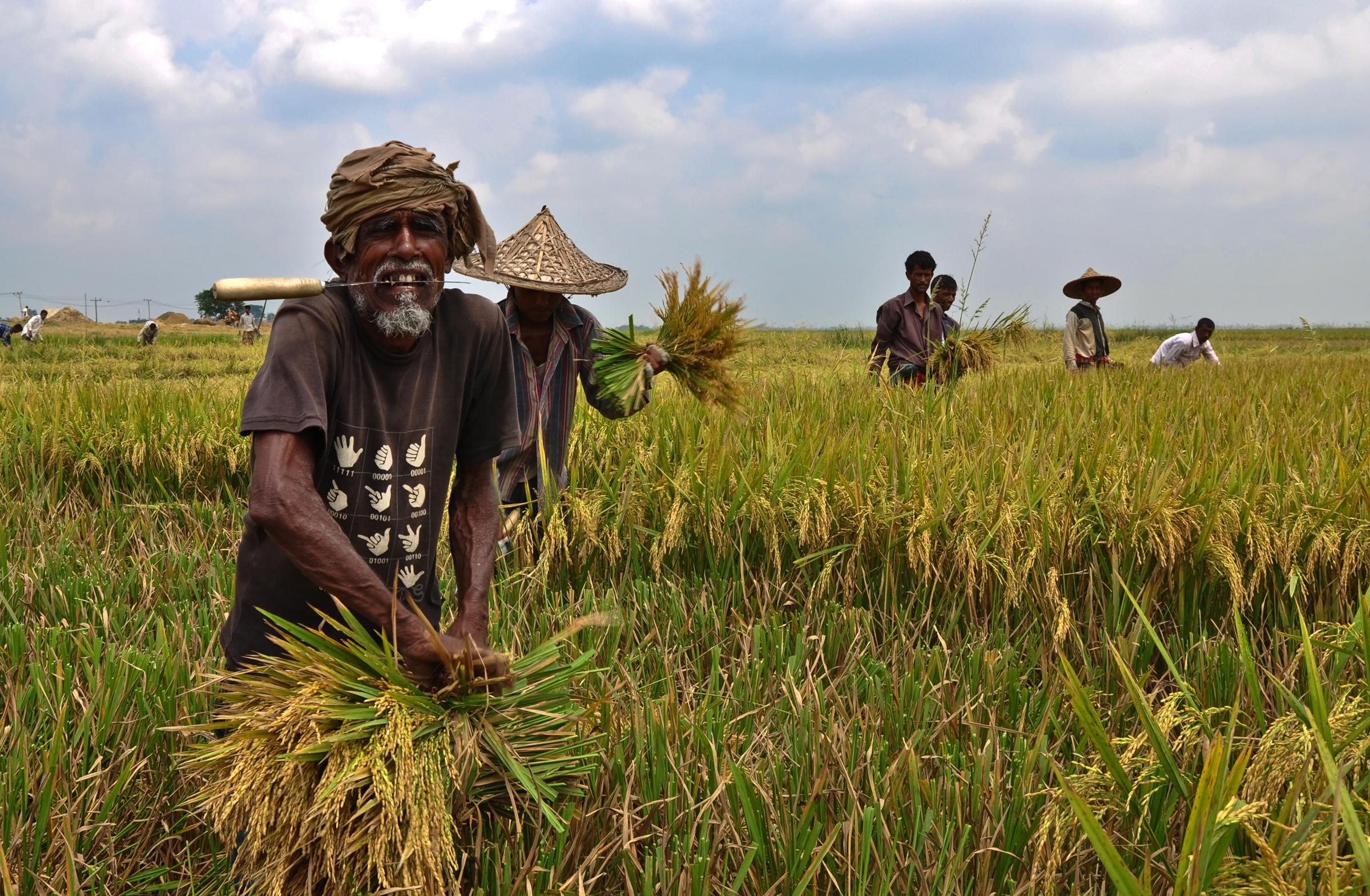
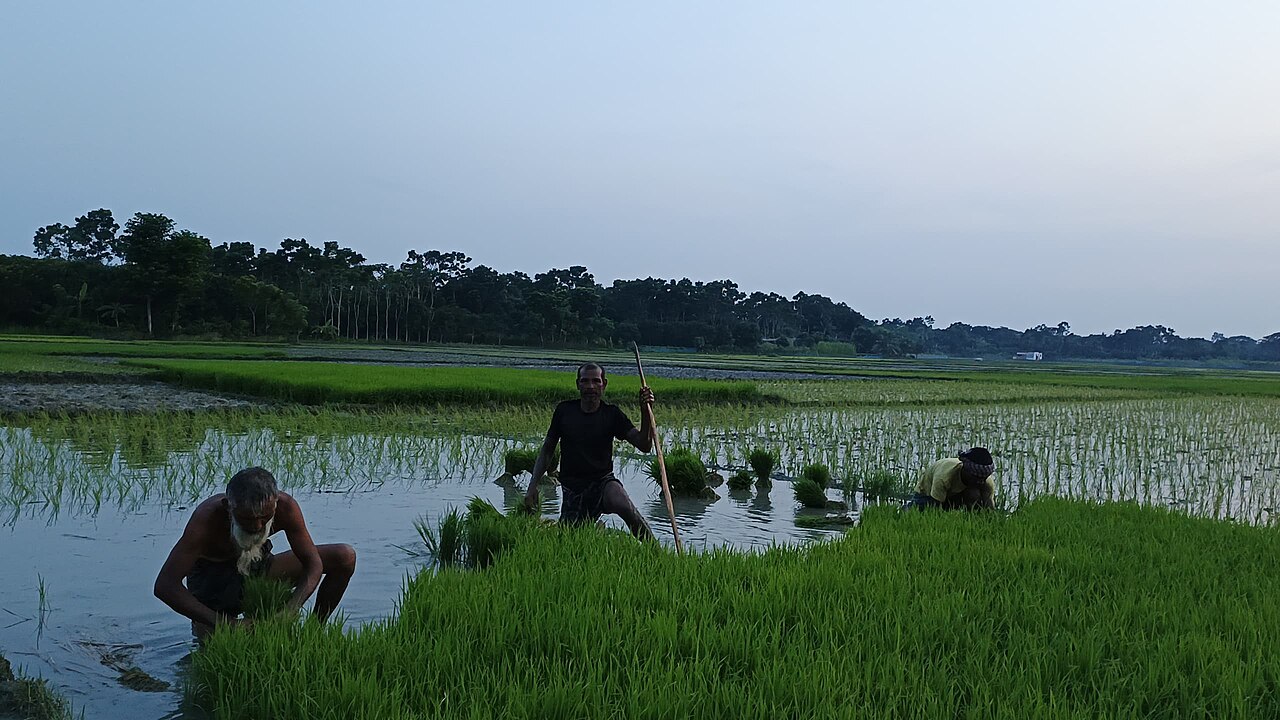
On Wednesday, 22 April 2026, farmers in the haor wetlands of Sunamganj in north-eastern Bangladesh were cutting boro paddy that had not yet fully ripened and carrying it home, for fear that an early flood would take the crop before it matured. Jagonews24's Sunamganj correspondent reported that day that the district's rivers were rising fast with local rain and hill runoff from upstream in India, and the local office of the Bangladesh Water Development Board (BWDB) warned that an early flood could follow within days.
For the district's farmers the season had brought one setback after another. Heavy rain had already left water standing in low-lying parts of the haors, and harvesting was set back further after lightning killed five people in Sunamganj on 18 April, four of them while cutting paddy in the haors. Before that shock had passed, the main rivers, among them the Surma, the Kushiyara and the Baulai, began to rise, and fear of a flood spread across the haors.
The Surma two centimetres below its danger level
The BWDB's Sunamganj office said 34 millimetres of rain had been recorded in the district in the previous 24 hours. With heavy rain continuing at Cherrapunji in India, hill runoff from upstream had raised the Surma by 54 centimetres, and the river was flowing just 2 centimetres below its danger mark.
A special BWDB notice said rivers in the north-east could rise faster over the next few days, which could cause an early flood in the haors.
The notice followed another issued a day earlier. On the afternoon of Tuesday, 21 April, the BWDB's Sunamganj office issued a notice signed by its executive engineer, Mamun Howlader, advising farmers to cut their boro as soon as about 80 percent of the grain had ripened, to reduce damage from a possible flood and from waterlogging, bdnews24.com reported. Citing data from the Meteorological Department and the BWDB, the notice said rainfall had increased in the north-east, especially upstream of the Surma, the Kushiyara and the Baulai in Sunamganj, and that river levels could keep rising in the coming days. Mr Howlader told bdnews24.com that farmers had been advised to cut ripe paddy quickly as an early precaution, and that some low parts of the haors were already waterlogged, which raised the risk of losing the crop.
Speaking to Jagonews24 on 22 April, he repeated the advice: farmers had been asked to cut haor paddy as soon as 80 percent of it ripened, because hill runoff could bring a flood to the district.
How much of the crop was still in the fields
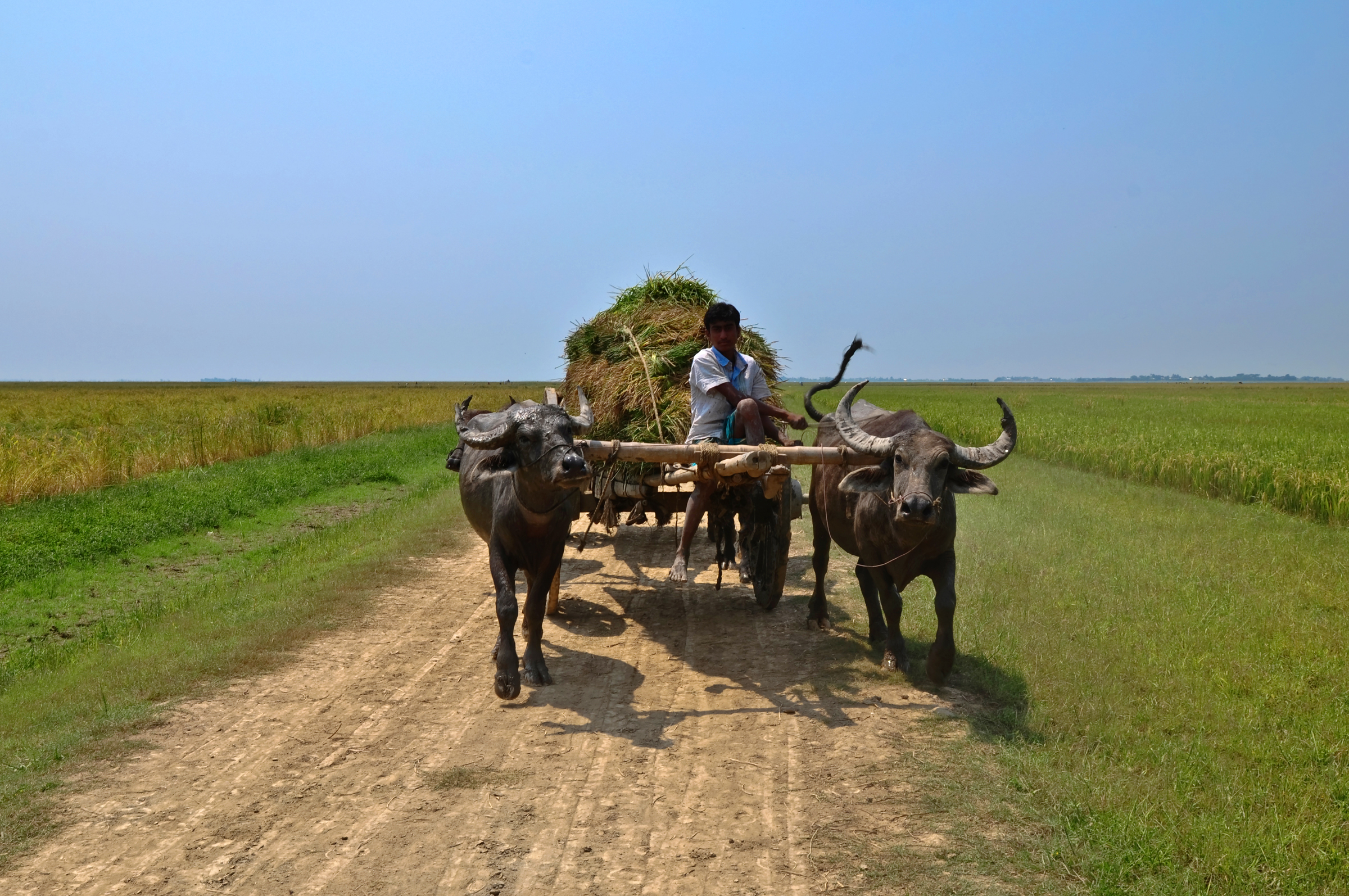
According to the district agriculture office, boro paddy had been grown on 223,100 hectares in Sunamganj that season, but by 22 April farmers had harvested only 28,000 hectares. Omar Faruk, deputy director of the Department of Agricultural Extension (DAE) in Sunamganj, told Jagonews24 that paddy on 28,000 hectares of haor land had been cut and that all of the department's officers were working in the field to help farmers.
Other reports from the same weeks give slightly different area figures. On 10 April ATN News, citing the DAE, reported that boro had been sown on 223,511 hectares in the district with a production target of about 1.4 million tonnes of paddy. By then about 114 hectares had been cut, including the early variety BRRI dhan96, with the early harvest under way mainly in the haors of Madhyanagar, Jamalganj, Shantiganj and Bishwambharpur upazilas. The report said 577 combine harvesters and more than 6,000 labourers were working on the harvest and that 50 more harvesters were to be brought in. The DAE told ATN News that fuel and harvesters were adequate, that it had advised farmers to harvest at the right time, and that it had written to the authorities seeking incentives for farmers whose land was waterlogged.
On 21 April, bdnews24.com reported, the district DAE put the area harvested in the haors at 21,496 hectares. The same report said that although early-sown fields were being cut, most of the paddy had not yet fully ripened, and farmers expected the full harvest to begin in the second week of Boishakh, the first month of the Bengali year.
Farmers who spoke to ATN News on 10 April described both sides of the season. Abdul Ahad of Jamalganj said BRRI dhan96 had given farmers a good profit. Gafur Mia, who farms in Karchar haor in Bishwambharpur, had grown BRRI dhan96 on 10 kear and expected 18 maunds of paddy per kear. Saiful, also of Jamalganj, had planted boro on 80 kear, but 15 kear were under water because of waterlogging, and he was harvesting what he could. ATN News reported that waterlogging after hill runoff and heavy rain had already pushed some farmers to cut partly ripe paddy.
Farmers racing the water
Haor farmers Junab Ali and Shukur Ali told Jagonews24 that most of their paddy had not yet fully ripened, but with the river rising the way it was, they were forced to cut it half-ripe for fear that the crop would go under.
Farmer Salman Mia said: "The paddy is still half-green, but we are cutting it out of fear of flooding. If everything goes under now, we farmers will be completely finished."
For many haor households the boro harvest is the year's only crop. On 11 April The Daily Ittefaq called boro the "only crop" of Dekhar haor, one of the district's largest, and reported that farmers there had spent the whole previous week anxious about it. Banglapedia notes that the haor plains stay flooded for about seven to eight months of the year, which leaves the dry months for the boro crop.
A breached embankment and deadly lightning
The fear in the fields had been building for weeks. On Saturday, 11 April, the Gujauni embankment of Dekhar haor broke suddenly and water began pouring into the haor, The Daily Ittefaq reported. Thousands of farmers from nearby villages gathered with bamboo, sacks of earth and other materials and closed the breach after about two hours, but some low-lying land went under in that time, and farmers feared for boro on about 9,000 hectares. According to the paper, Dekhar haor covers more than 45,000 hectares, 24,214 hectares of it were cultivated that season, and people from three upazilas, including Sadar, own land in it.
Farmers told Ittefaq that the nearby Utaria embankment had been built without proper planning and that, in their view, it had caused crops in the Dariabaj part of the haor to go under. The deputy commissioner, Dr Mohammad Ilias Mia, told the paper that the broken embankment was not among the BWDB's crop-protection embankments, and that the farmers had not informed the administration beforehand; had they done so, he said, action could have been taken.
A week later came lightning. On 18 April lightning strikes killed 13 people in Bangladesh, five of them in Sunamganj, The Daily Star reported that day. Four of the Sunamganj victims were struck while harvesting boro in the haors: in Togar haor in Dharmapasha upazila, in Pagnar haor in Jamalganj, in Matian haor in Tahirpur and in Kaliagota haor in Derai. The fifth was killed while drying paddy beside his house in Dharmapasha. Others were injured.
Lightning is a known danger at harvest time. Mongabay reported in March 2024 that, according to the Department of Disaster Management, lightning killed 2,164 people in Bangladesh between 2011 and 2020, and that most deaths come in March, April and May, the season of the kalbaishakhi storms. Farmers and fishers working in open fields are most at risk, and the government declared lightning a natural disaster in 2016. Its responses included planting about 5 million palm trees along roads and plans for lightning arresters and shelters in open fields. Disaster management expert Gawher Nayeem Wahra told Mongabay that the lack of large trees in the haor basin was linked to the rising number of strikes there.
Why rain at Cherrapunji raises the Surma
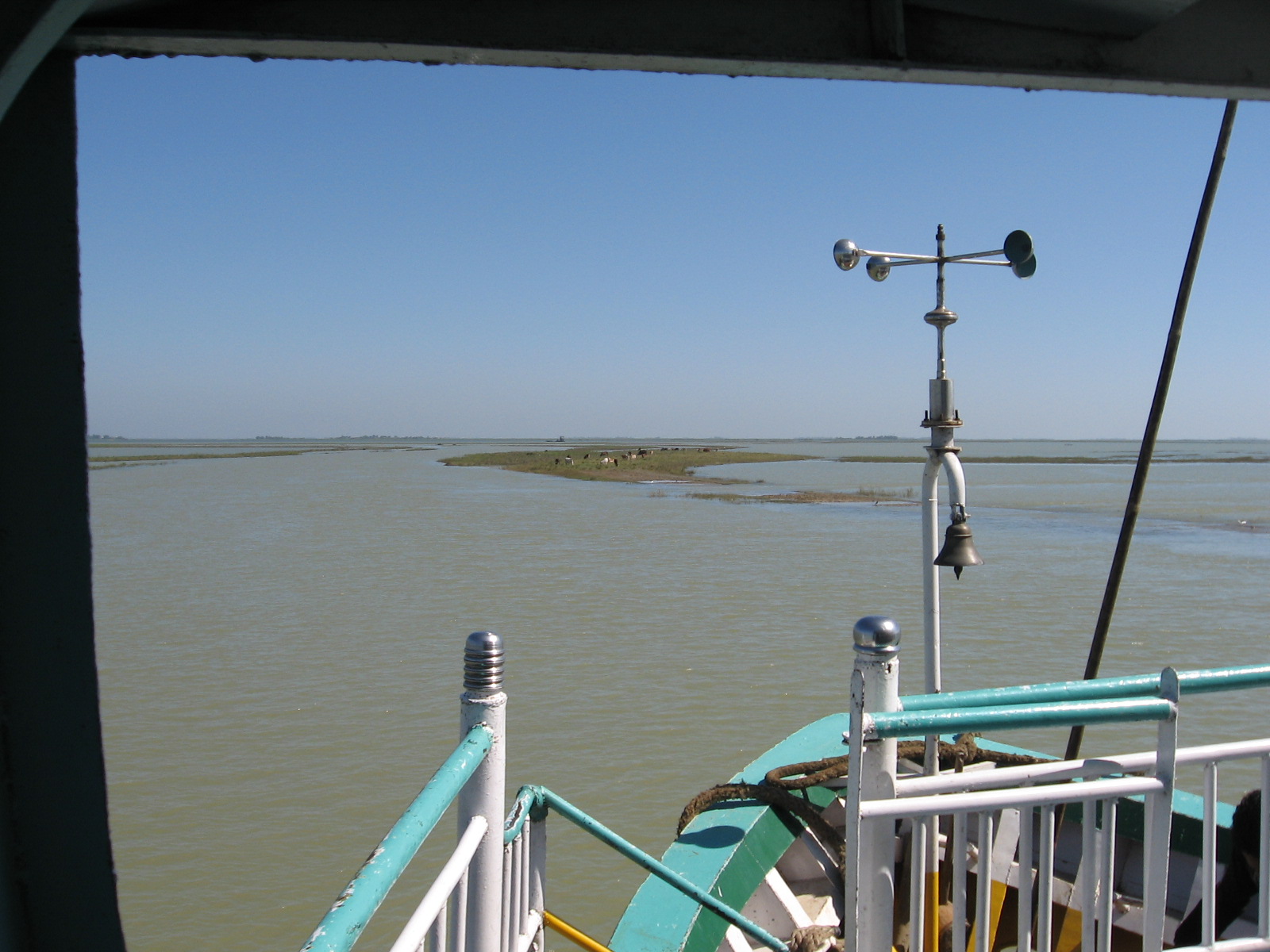
The rivers that threatened the crop rise far beyond the district. Banglapedia, the national encyclopaedia of Bangladesh, describes the Surma as the northern branch of the Barak, which rises on the southern slopes of the Naga-Manipur watershed in India. From the point where the Barak splits, the Surma flows west and south-west to Sylhet town, then turns north-west and west to Sunamganj town. On the way it receives a string of streams flowing south from the Meghalaya plateau, among them the Lubha, the Piyain, the Jadukata and the Someshwari, and much of the system drains into the haor basin, where rivers overflow and flood the haors early in the rainy season.
The Kushiyara is the south-western arm of the Barak, about 161 kilometres long; it rejoins the Surma at Markuli in Ajmiriganj upazila, and the combined flow, through the Kalni and the Dhanu, becomes the Meghna, according to Banglapedia. The encyclopaedia dates the Surma's usual flood season from about the last week of May to mid-October, so a rise in late April threatens the boro crop before the monsoon proper begins. It describes the hill catchments draining into the north-east as subject to flash floods, in which water rises and falls suddenly; such floods are mostly short but unpredictable in frequency and intensity.
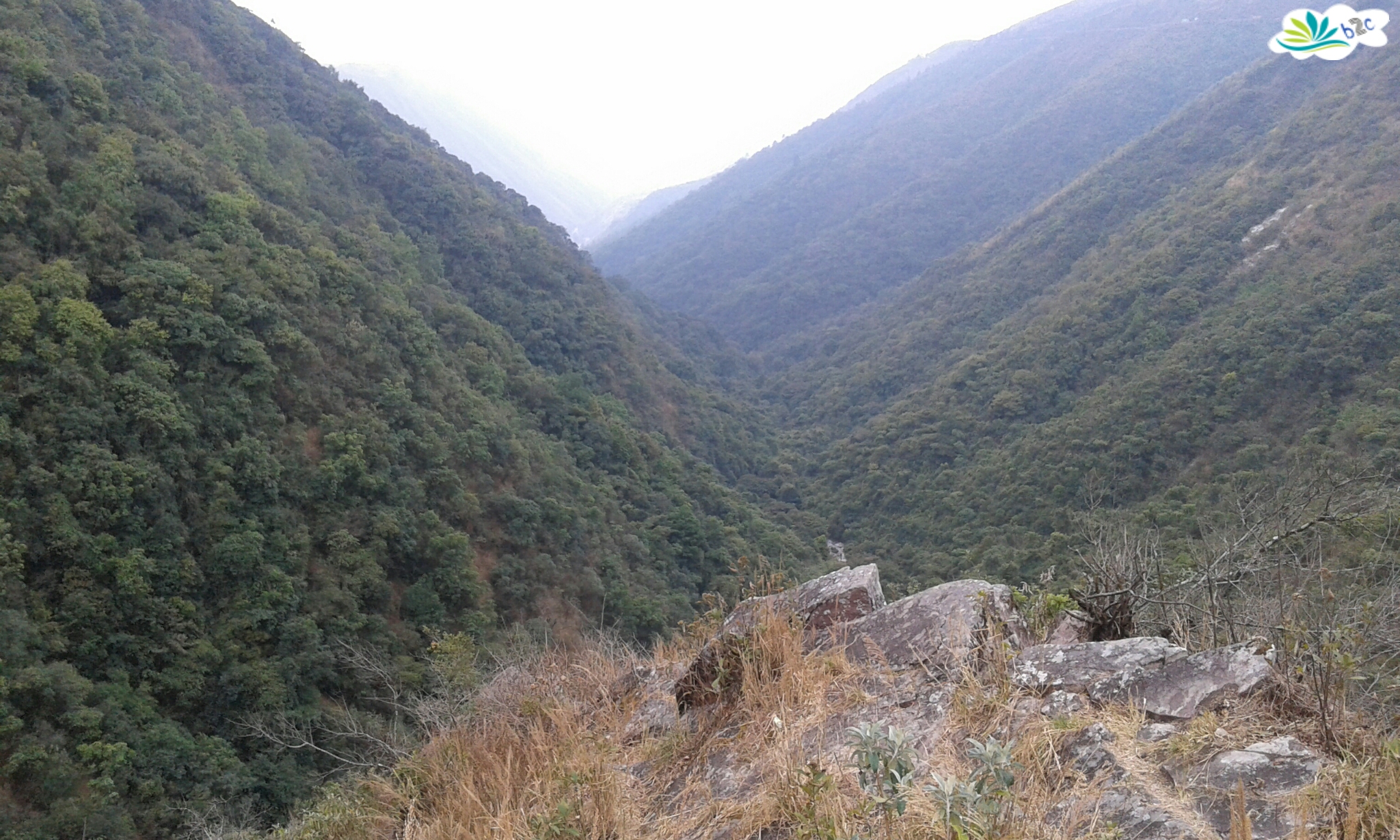
Cherrapunji, also called Sohra, is a town in the East Khasi Hills district of the Indian state of Meghalaya, on a plateau at about 1,430 metres that faces the plains of Bangladesh. It has often been called the wettest place on Earth, a title now held by nearby Mawsynram, and it holds the records for the most rain in a calendar month, 9,300 millimetres in July 1861, and in a year, between August 1860 and July 1861. The BWDB linked the 54-centimetre rise of the Surma on 22 April to the rain continuing there.
River levels and flood warnings in Bangladesh are the work of the Flood Forecasting and Warning Centre, set up in 1972 under the BWDB, which works under the Ministry of Water Resources.
Sunamganj, a district of haors
A haor is a large, bowl-shaped depression of tectonic origin that takes in runoff from rivers and canals, becomes a vast sheet of water in the monsoon and mostly dries out after it, Banglapedia explains. The haor basin holds about 47 major haors and some 6,300 beels, of which about 3,500 are permanent, and it covers the whole of Sunamganj district, most of Habiganj, parts of Sylhet Sadar upazila and Moulvibazar. Among the haors Banglapedia names in greater Sylhet are Dekar (Dekhar), Saneer, Hail, Hakaluki, Maker, Chayer, Tanguar and Kawadighi. As the population grew, the encyclopaedia notes, boro cultivation spread onto the marginal rim lands of the haors and large areas were drained, which now threatens the wetlands themselves. The haors are also among the country's most important fishing grounds.
Sunamganj district, in Sylhet division, covers about 3,747 square kilometres and had a population of 2,695,496 at the 2022 census. Its main rivers include the Surma, the Kushiyara, the Jadukata and the Dhamalia, and Banglapedia records that about two-thirds of its people, 66.99 percent, depend on agriculture as their main source of income.
The district's best-known wetland is Tanguar haor, in Dharmapasha and Tahirpur upazilas, declared a Ramsar wetland of international importance on 10 June 2000. About 46 villages lie within it, and it supports the livelihoods of more than 40,000 people, with more than 140 species of freshwater fish and about 200 kinds of migratory birds that visit each winter. In August 2025, the Dhaka Tribune reported, a meeting of the National Water Resources Council's executive committee took up the first Haor Environment Protection Order, issued under sections 22 and 27 of the Water Act 2013 to protect Tanguar and Hakaluki haors, and the same month the government invited public comment on a draft evaluation and update of the Haor Master Plan prepared by the Department of Bangladesh Haor and Wetland Development.
Boro, the country's largest rice crop
What was at stake in Sunamganj was part of the country's main rice harvest. In its Grain and Feed Annual report of 7 April 2026, the U.S. Department of Agriculture's office in Dhaka explained that boro rice is transplanted in December and January and harvested in April and May, that it depends heavily on irrigation, and that it makes up more than half of Bangladesh's annual rice production. Based on DAE data, the report estimated boro for the 2025/26 marketing year at 4.9 million hectares and 20.5 million tonnes of rice, and forecast 20.2 million tonnes for the crop then being harvested, citing disruptions to irrigation and fertiliser application from fuel and fertiliser shortages.
The same report noted that the DAE was encouraging short-duration varieties in the haor areas of Mymensingh and Sylhet divisions, where boro is particularly vulnerable to flash floods, because heavy rain in the Indian hills along the border can trigger floods downstream that sometimes destroy entire rice crops. Varieties that mature 10 to 15 days earlier can significantly reduce such losses, it said, naming BRRI dhan84, BRRI dhan86, BRRI dhan101 and BRRI hybrid dhan5. The report also recorded that farmers expected higher wages at the boro harvest because of a shortage of labour, and that government rice stocks stood at 1.56 million tonnes in March 2026.
The labour shortage was felt across the haors. From neighbouring Netrokona, Desh Rupantor reported on 18 April that workers who once came to the haors at harvest time from Dinajpur, Jessore, Bogura and other northern districts were arriving in far smaller numbers because of higher travel costs and other work, and that some combine harvesters had stalled in remote haors for want of diesel.
Memories of 2017 and later years
Haor farmers' fear of an early flood rests on experience. In 2017 flood water entered the Sunamganj haors from 28 March, and by 8 April at least 27,000 hectares in the district were under water, the Dhaka Tribune reported at the time. The BWDB had been given Tk 55 crore in the 2016-17 fiscal year to repair and build crop-protection embankments in 48 haors of the district, but the work, due to start in December, began in February, and most embankments were unfinished when the water came. Farmers alleged irregularities and delays in the board's work and blamed them for their losses.
The Food and Agriculture Organization's GIEWS country brief of 10 May 2017 recorded that excess rain in late March and early April that year had flooded north-eastern producing areas just before harvest, affecting Sylhet, Dhaka and Mymensingh divisions in particular. FAO's brief of February 2018 put Bangladesh's 2017 paddy production at 50.8 million tonnes, slightly below the five-year average, because of three episodes of severe flash floods between April and August 2017, and said rice prices in Dhaka were more than 20 percent higher than a year earlier, mostly as a result of those losses.
Half-ripe harvests have been seen before. In April 2020 farmers in Bishwambharpur upazila of Sunamganj cut half-ripe paddy after incessant rain and upstream water left the haors waterlogged, the Dhaka Tribune reported on 25 April 2020; the upazila agriculture officer said 1,620 of 1,820 hectares had been harvested, and farmers said few labourers would work all day waist-deep in water. In Netrokona, Desh Rupantor wrote on 18 April 2026, the early hill floods of 2017, 2020 and 2022 were still fresh in farmers' minds.
Much of the haor crop is guarded by earthen submersible embankments built each dry season through local project implementation committees (PICs). In March 2021, for example, the Dhaka Tribune reported that 620 kilometres of embankment were being built in Sunamganj through 809 PICs at a cost of Tk 125.74 crore, and that the campaign group Haor Bachao Andolan said almost half of the work in the district was unfinished as the deadline passed. For the 2026 season, Desh Rupantor reported that the BWDB in Netrokona had repaired and built 146 kilometres of submersible embankment through 191 PICs at a cost of about Tk 31.5 crore, and that officials hoped they would hold back hill water at least until the end of April. Environmentalists quoted in the same report said that taking soil from river and canal banks every year to build embankments was silting the riverbeds, so that even modest rain could cause flooding.
Photo: Balaram Mahalder / Wikimedia Commons (CC BY-SA 3.0)
Sources: Jagonews24, bdnews24.com, ATN News, The Daily Ittefaq, The Daily Star, Desh Rupantor, Dhaka Tribune, Mongabay, U.S. Department of Agriculture (Foreign Agricultural Service), FAO GIEWS, Banglapedia, Wikipedia
Comments
(0)