
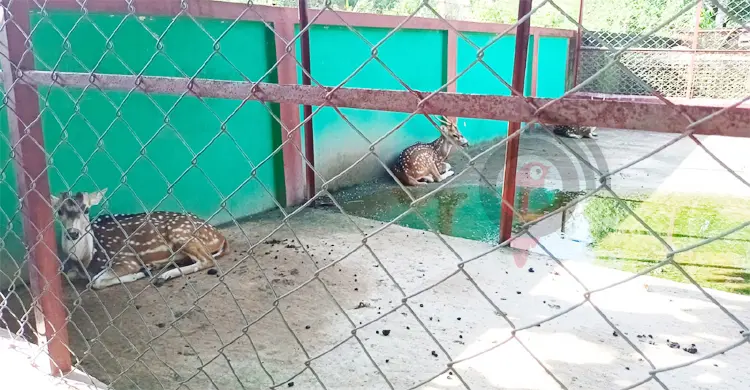
Sitesh Ranjan Deb's father, Shrish Deb, began working with wild animals as a hobby in 1962, catching animals and caring for them at home. Watching his father's skill in catching animals and his affection for them, Sitesh Deb learnt the same and grew to love animals too, caring for them alongside his father. They set up a shelter for animals and birds at their home in Sreemangal upazila, Moulvibazar.
In this age of deforestation and unplanned industrial growth, as scrubland disappears, animals wander into human settlements and face death. Sitesh Deb catches them, treats them and releases them into the forest, and raises newborn animals before freeing them. The shelter, known as 'Sitesh Babu's zoo', has cared for animals for about 50 years with public help and at his own expense, but it now faces closure.
A shelter since 1971
Sitesh Ranjan Deb's animal shelter was formally established in 1971. Deer, bears, langurs, monkeys and other wild animals are cared for there, along with many species of birds, and it became known by word of mouth as 'Sitesh Babu's zoo'. As the shelter inside his home grew, Sitesh Babu struggled to feed the animals. Every day he had to catch insects and rats for food, and his only source of income for the fruit-eating, vegetable-eating and carnivorous animals was his poultry and fish farm.
In 1991, while protecting indigenous people's crops from wild boar, Sitesh Ranjan Deb was attacked by a bear and badly injured in one eye, his face and nose. After he fell ill, his sons could not afford to feed the animals and wanted to close the shelter. But when the media reported the closure, wealthy local people helped. In 2009 the shelter moved to 'Rupashpur Khamarbari', Sitesh Ranjan Deb's fish farm about a kilometre from town, where 'Sitesh Babu's zoo' now covers 1.80 acres.
Having survived near death, Sitesh Ranjan kept caring for wildlife, but money worries grew. Former Bangladesh Bank governor Dr Atiur Rahman learnt of the mini zoo and in 2011 set up a wildlife care foundation for him, and Bangladesh Bank built a boundary wall. Rescue and care work increased, and so did the workload. After years of this work, 74-year-old Sitesh Babu is now worn out by age, and the shelter is run by his two sons, Swapan Deb Swajal and Sanjit Deb. His wife and daughters also care for the animals with great affection.
Rescues and releases
His son Sanjit Deb told Jagonews: "We have become part of the wildlife. When people see a wild animal or a venomous snake in the area, many call us instead of the Forest Department, at any hour, morning, evening or night. We catch the animal, bring it here and inform the Forest Department."
According to the Wildlife Care Foundation, the shelter now has about 33 species of wildlife, including spotted deer, barking deer, golden cats, fishing cats, bears, langurs, monkeys and snakes. From June 2012 to June 2022, 486 wild animals were released into the forest from the shelter. Ministers, senior government officials, teachers and military and civilian figures have attended the releases at various times.
The zoo has many rare and endangered species, and many animals have bred there. After treatment and care they recover and return to the forest to help maintain the balance of nature.
Sitesh Ranjan Deb told Jagonews that animals are usually injured when someone catches them. "We first treat them here. After a month or so of care, once they are fully fit, we release them back into the forest through the district council."
Rising costs
The shelter needs infrastructure development and staff to protect its animals, and regular treatment and feeding require large sums. It is open from noon to 5pm every day, with tickets at Tk 20, and receives an average of 100 visitors a day. Monthly costs are about Tk 1.5 lakh to Tk 2 lakh. Occasional government and private donations and ticket sales cover a third of the cost; the rest is borne by Sitesh Ranjan Deb's family. Sitesh Ranjan Deb and his two sons fear for the shelter's future.
Sanjit Deb told Jagonews: "We get no annual grant. The shelter runs on people's voluntary donations and our own money. It costs at least Tk 1.5 lakh a month, and our family pays two-thirds. We will run it as long as we can. When we can't, we will have to close it."
His son Swapan Deb Sajal now does most of the elderly Sitesh Ranjan Deb's work, including catching animals. On the risks, he told Jagonews: "There are many snakes in our area, and we often have to go and catch them. But there is no snake antivenom in the district. If there is an accident, there will be no way to survive."
On the future of the shelter his father built, he said: "I have been caring for animals for 20 years. Now we are struggling. Money is the biggest problem. We will run it as long as we can, but how long will people keep giving? Without financial help from the government it cannot be run."
Besides running the shelter, Sitesh Ranjan Deb is chairman of the Wildlife Care Foundation.
Sitesh Babu told Jagonews that animals were once hunted in the area with permission; with Forest Department permission a person could shoot 15 birds. "Gradually the population has grown, the forest has shrunk and the animals have declined. The balance of nature is being destroyed, so conservation is needed now. But we cannot conserve them. There is no food for the animals, and animals need more food than people."
He said the shelter's costs had risen a lot. "We get some help from people, but with everything more expensive it is no longer enough. Without permanent help or a grant, I see no future for the shelter. There is no option but to release the animals into the forest with the Forest Department."
Source: Jagonews24. First published in Bengali on The Agro News.

Comments
(0)