
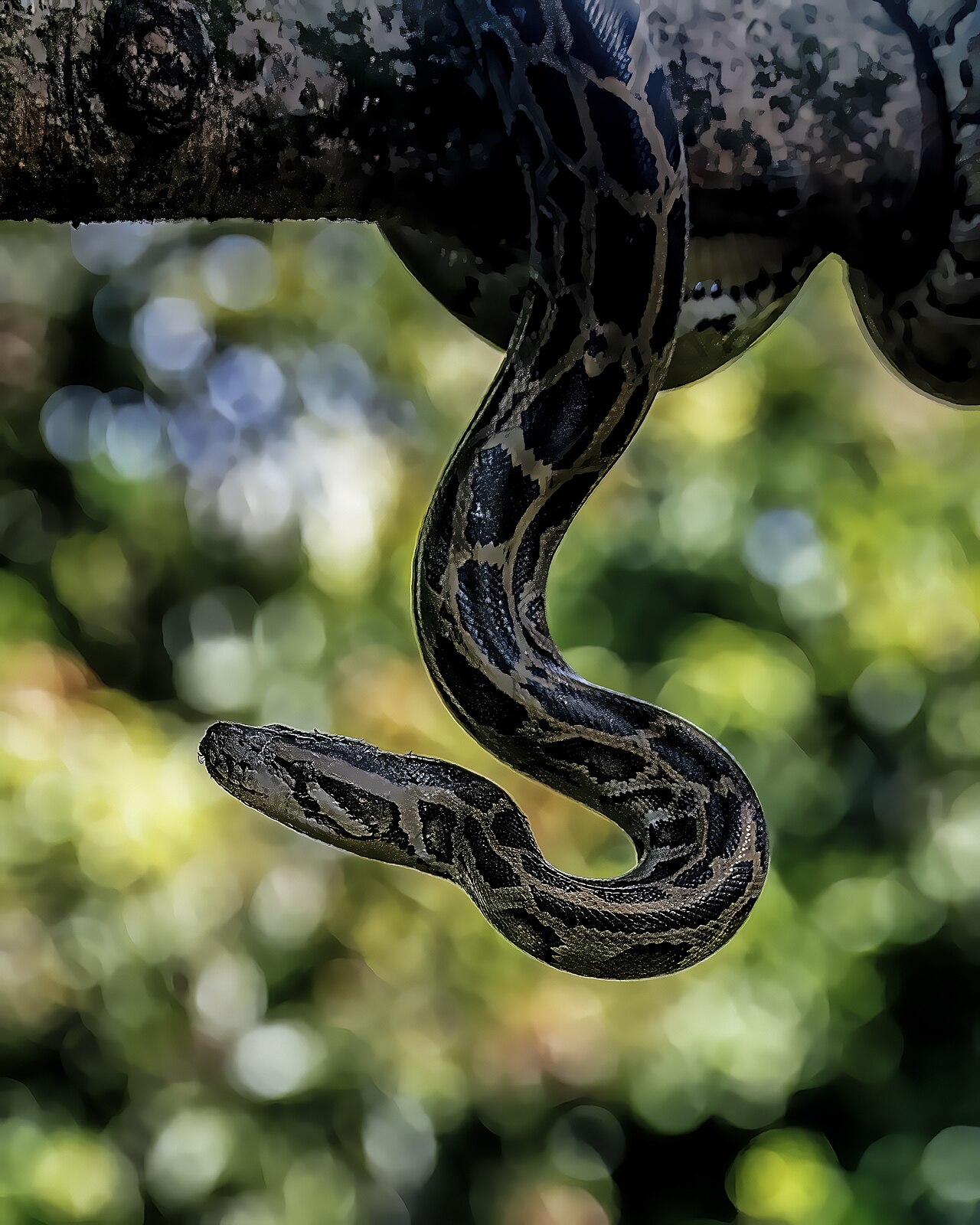
A python weighing about 20 kilograms was rescued unharmed from a residential area of Sreemangal upazila in Moulvibazar district on Monday, 24 November 2025. Members of the Bangladesh Wildlife Service Foundation and the forest department took the snake from the Ichhabpur area of the upazila, Jagonews24 reported that evening. The python was then handed over to the Sreemangal range office of the forest department, which passed it to the beat officer to be released in Lawachara forest.
According to local people, labourers who were clearing bushes in Ichhabpur saw the python on top of a wall. The sight of the large snake frightened them, and the Bangladesh Wildlife Service Foundation was informed. A team led by the foundation's director, Swapan Deb Sajal, came to the spot and rescued the snake without injury. It was later handed over to the Sreemangal range office.
How the Ichhabpur rescue unfolded
The report describes a short chain of events. The python was spotted during routine bush clearing, not during any search for wildlife. The workers did not try to deal with the snake themselves; word went to the wildlife rescue group, whose team came, took the snake and passed it to the government forest office. Sreemangal Range Officer Nazmul Islam confirmed the rescue to the newspaper. He said the python had been given to the beat officer so that it could be released in the Lawachara forest.
Jagonews24 gave the snake's weight as about 20 kilograms. The report did not give its length or name the species, and the rescuers were not quoted on its sex or age. What the report does make clear is the procedure that was followed: a call to a rescue group, a rescue without harm to the animal, a handover to the forest department, and release into a protected forest rather than at the spot where the snake was found.
Such rescues were not new for Sreemangal. On 5 October 2025, Desh Rupantor reported that the same foundation had rescued a python about 12 feet long and weighing 21 kilograms from beside a lake in the Khaichhara tea garden of Sreemangal. In that case tea workers saw the snake around midday and told the garden management, managers of the tea company informed the foundation, and its director, Swapan Deb Sajal, came with an environment worker and took the python away. That snake, too, was handed over to the Sreemangal range office of the forest department, the director told the paper.
Sreemangal: tea gardens, forest and villages side by side
Sreemangal is one of the seven upazilas of Moulvibazar district in Sylhet division. According to Banglapedia, the national encyclopedia, the upazila covers 450.73 square kilometres. It is bounded by Moulvibazar Sadar upazila on the north, the Indian state of Tripura on the south, Kamalganj upazila on the east, and Chunarughat, Bahubal and Nabiganj upazilas on the west. Sreemangal thana was formed in 1912 and the municipality in 1935. The 2011 census recorded a population of 318,025 in the upazila, spread over one municipality, nine unions and 208 villages.
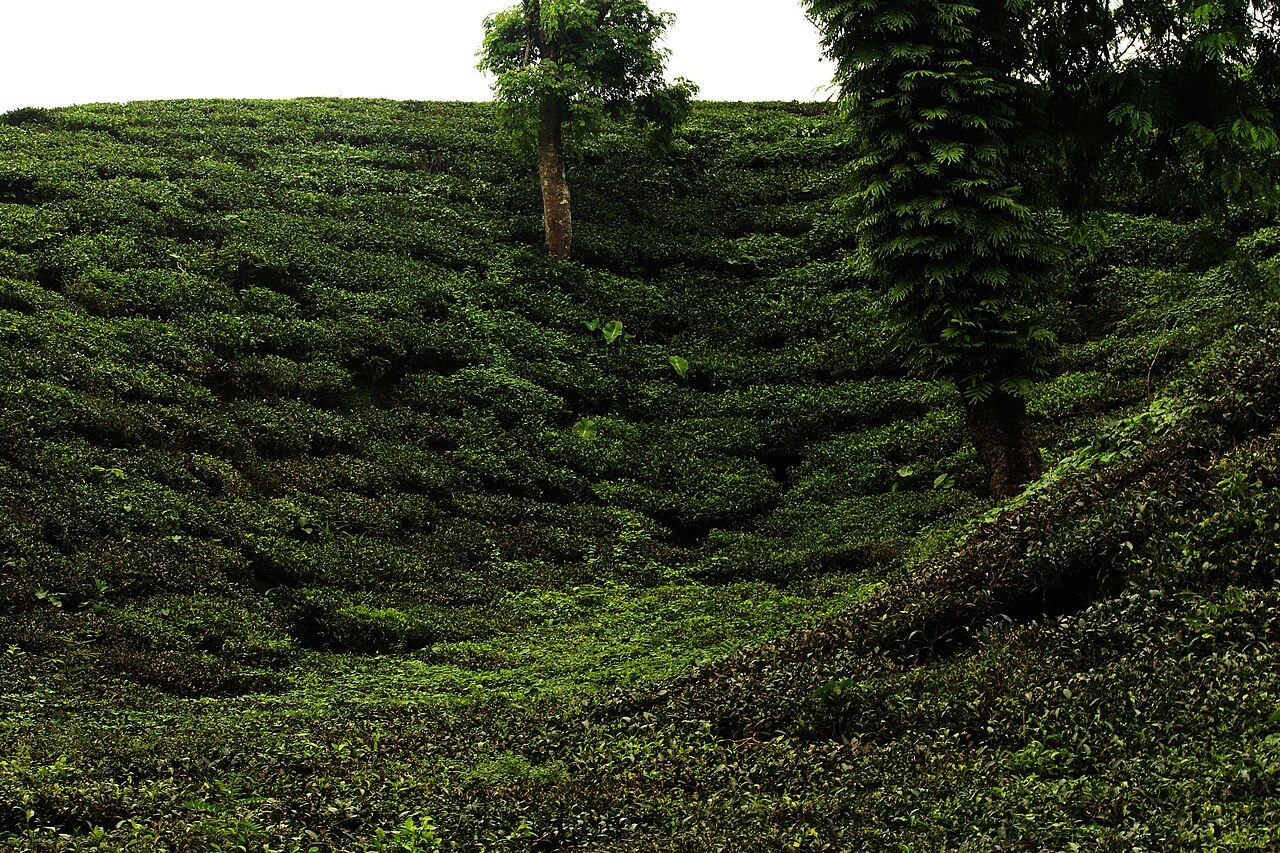
Tea defines the area. Banglapedia lists tea, paddy, betel leaf, rubber, potato and vegetables as the main crops of Sreemangal, pineapple, jackfruit and lemon as the main fruits, and tea, pineapple, lemon and betel leaf as the main exports. It counts 15 tea factories and two rubber processing plants in the upazila. The Bangladesh Tea Research Institute, an autonomous body under the Bangladesh Tea Board, has stood at Sreemangal since 28 February 1957, when it opened as the Pakistan Tea Research Station; it took its present name in 1973 and lies about 3.2 kilometres from the town.
The landscape mixes tea estates with forest and wetland. The upazila's rivers include the Bilash (Gopla), Gopbia, Phulchhari, Udnachhari and Barmachhari, and the Hail Haor wetland is the best known of its water bodies. Lawachara National Park, the Bangladesh Tea Research Institute and Hail Haor are among the tourist spots Banglapedia names for the upazila. Moulvibazar district as a whole covers 2,799.38 square kilometres and borders the Indian states of Assam and Tripura; Manipuri, Khasia, Tripura and Halam communities live in the district. Where gardens, hills, forest and villages meet so closely, wild animals and people share much of the same ground.
The pythons of Bangladesh
Pythons are large, non-venomous snakes. Banglapedia describes the python, called ajagar in Bengali, as a snake of the family Boidae, massively built, with a girth relative to its length greater than that of almost any other snake. Its scales are smooth and look glossy when the snake is in good condition. The teeth are powerful, but there is no venom apparatus. The neck is distinct and the head flattened, with a long snout. The Bengali name, the encyclopedia notes, comes from the snake's habit of preying on goats and similar animals.
Two python species live in Bangladesh. Banglapedia, using the older naming, lists them as the rock python, Python molurus, and the reticulated python. A 2024 note in the peer-reviewed journal Reptiles & Amphibians, by researchers working in Bangladesh, names the country's only two pythons as the Burmese python, Python bivittatus, and the reticulated python, Malayopython reticulatus. The Smithsonian's National Zoo explains that the Burmese python was once considered a subspecies of the Indian python, Python molurus, and is now recognised by most authorities as a distinct species.
The 2024 note adds that Burmese pythons exist in all divisions of Bangladesh, citing a 2018 photographic guide to the country's wildlife, whereas reticulated pythons have been recorded only from Sylhet and Chittagong divisions. Citing the IUCN Bangladesh Red List of 2015, it says both species are seen occasionally in forests but also in gardens, farms and other habitats modified by people. Banglapedia places both snakes in the mixed evergreen forests of the north-east and south-east of the country, and the rock python also in the Sundarbans.
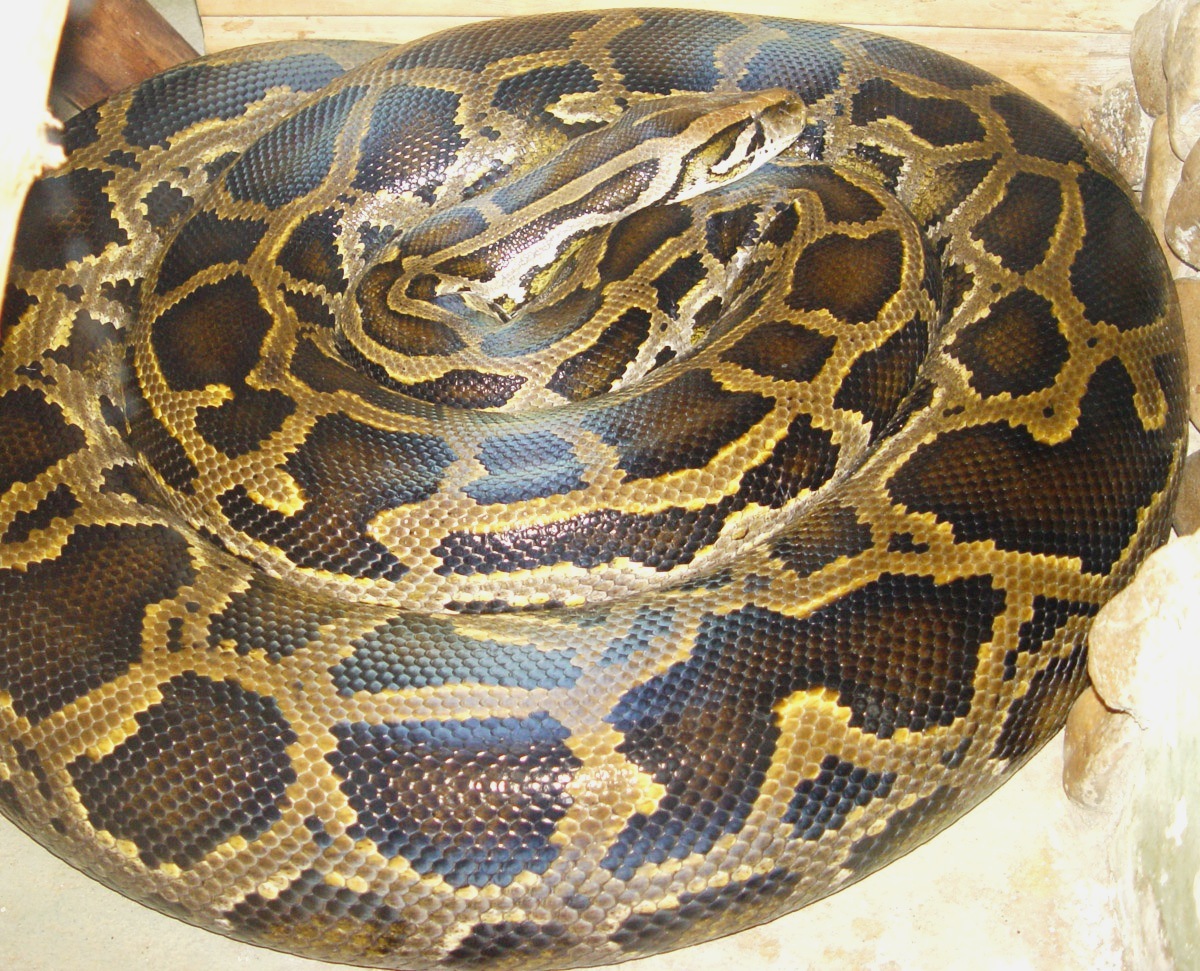
Burmese pythons are among the largest snakes in the world. The Smithsonian's National Zoo gives their average length as 3 to 4.9 metres and says lengths of over 4.6 metres are common; females tend to be the larger sex. Banglapedia calls the rock python the largest snake of Bangladesh, able to reach about 5.7 metres. The body colour can be pale tan, yellowish brown or grey, with large dark brown or olive blotches outlined in cream or gold. As constrictors, pythons have no fangs, but they do have many back-curving teeth that grab and hold prey.
How a python lives, hunts and breeds
Most pythons are semi-arboreal and live in forest, but Banglapedia notes they are also found in rivers, haors and jheels. They are at home in water, swim strongly when they need to, and usually stay near the bank, partly or wholly submerged except for the tip of the snout. A 2020 paper in Reptiles & Amphibians on Burmese pythons in India describes them as mostly nocturnal generalist predators, sometimes called semi-aquatic because they are usually found near water, and lists marshes, swamps, grasslands, woodlands, mangroves, coastal plains, rain forests and rocky foothills among their habitats.
Pythons feed on mammals, birds and reptiles but seem to prefer mammals, according to Banglapedia, which names rats, hares, goats, sheep, jackals and deer as common prey. A python kills by constriction, and the prey dies of suffocation. Snakes in general swallow prey whole; the encyclopedia explains that elastic ligaments join the two halves of a snake's jaw so that each half can work independently during swallowing. The Smithsonian adds that in the wild snakes typically do not eat every day, and that Burmese pythons spend their mornings soaking up the sun's warmth, which lets them move about to look for food; after a successful hunt they spend several days or weeks keeping warm enough to digest the meal.
Snakes cannot keep their body temperature constant in the way mammals do. Banglapedia describes them as poikilothermous: their three-chambered heart partly mixes oxygen-rich and oxygen-poor blood, so less energy is available to hold a steady body temperature. Snakes have no external ear opening and pick up vibrations from the ground through the lower jaw. They collect chemical signals with the forked tongue, which carries them to the Jacobson's organ in the upper jaw; this makes up for weak hearing and poor eyesight.
In Bangladesh, Banglapedia records, python breeding starts during December to February and the eggs are laid three to four months later. The female broods the eggs by coiling around them, and the mother takes no care of the young once they hatch. The Smithsonian gives the average Burmese python clutch as 30 to 60 eggs, with up to 100 possible. The female stays coiled around the eggs until they hatch, does not feed during this time, which may last two months or more, and raises the temperature within her coils by twitching her muscles. Hatchlings are about 31 to 46 centimetres long. Burmese pythons reach sexual maturity at four to five years and typically live about 20 to 25 years in human care; their lifespan in the wild is unknown.
Why pythons turn up near homes and farms
Pythons do not need untouched forest to survive. As the 2024 note in Reptiles & Amphibians records, both of Bangladesh's pythons are seen in gardens, farms and other habitats changed by people as well as in forests. The Smithsonian notes that the presence of domestic fowl and pigs attracts Burmese pythons to agricultural developments. Where rats, poultry and other prey gather around farms and homes, a large constrictor may follow.
Snakes also do useful work in farming areas. Banglapedia observes that snakes, by and large, eat a huge number of live animals every year that are usually regarded as crop pests or as dangerous to people. The Smithsonian lists keeping rodent populations in check among the services snakes provide, and calls snakes essential rodent controllers without which many crops are destroyed by mice. Most of Bangladesh's roughly 90 snake species are non-venomous; Banglapedia puts more than three quarters of them in that group and counts the python among the common non-venomous snakes.
In Sreemangal, the October 2025 case at the Khaichhara tea garden and the November 2025 case at Ichhabpur both involved large pythons found by workers going about their jobs, one beside a garden lake and one on a wall during bush clearing. In both cases, according to the reports, the people who found the snake called the rescue foundation instead of acting on their own, and the snake reached the forest department alive.
A threatened species
Globally, the Burmese python is listed as Vulnerable on the IUCN Red List, in the 2012 assessment by Stuart and colleagues. The 2020 Reptiles & Amphibians paper, citing that assessment, names habitat loss and poaching for meat, skins and traditional medicine, together with the international trade in live animals, as the major threats. The Smithsonian's National Zoo notes that Burmese pythons are widespread across their native range but their numbers are diminishing: when people come across them, they are often killed for their skin or meat, or simply because they are snakes, and hundreds of thousands are killed for skins that are made into shoes, belts and other goods. In contrast to these dwindling Asian populations, the species has become invasive in parts of southern Florida.
Within Bangladesh, Banglapedia states that both pythons have become rare and treats the rock python as critically endangered and the reticulated python as endangered in the country. It notes that python skin has commercial value, and, more widely, that tanned snake skins fetch a very high market price. These pressures are part of the reason rescue groups and the forest department release pythons found near homes into protected forest.
What the law said in November 2025
At the time of the Ichhabpur rescue, wildlife in Bangladesh was protected by the Wildlife (Conservation and Security) Act, 2012, dated 10 July 2012, which repealed the Bangladesh Wild Life (Preservation) Order of 1973. In the Act's published English text, section 2(37) defines "hunting" to include killing, capturing or poisoning any wild animal, or any attempt to do so. Section 6(1) says no person shall hunt any wild animal without a licence or a permit under the Act. Section 53 adds that where the Bangla and English texts conflict, the Bangla text prevails.
Section 39 sets the penalty for breaching section 6: imprisonment of up to one year, a fine of up to 50,000 taka, or both. For a repeat offence the limits rise to two years' imprisonment, a fine of up to 100,000 taka, or both. The law therefore did not allow anyone to kill or catch a wild python on their own initiative.
The Act also describes the path the Ichhabpur python followed. Section 9 requires that necessary measures be taken to release any caught, rescued or seized wild animal into a suitable natural habitat when keeping it in a cage or enclosure would put its life at risk. Section 8 gives the Chief Warden, an Additional Chief Warden or a Warden the duty to take measures, including rehabilitation, when a wild animal threatens human life or property. Section 30 allows the government to set up wildlife rescue centres to provide medical care, food, shelter and safety for injured, seized, abandoned or donated wildlife.
For members of the public, the safe course is the one the Ichhabpur workers took: keep away from the snake and inform the forest department or a wildlife rescue team. The Smithsonian's own guidance is that people who see a snake in the wild should leave it alone, should not assume it is venomous, and should not attack it if it does not threaten their safety. Catching or moving a large python is work for trained rescuers acting with the forest department.
Lawachara, the forest chosen for the release
Lawachara National Park lies close to Sreemangal in Kamalganj upazila of Moulvibazar. Prothom Alo reported in May 2021 that the park was established in 1996 with an area of 1,250 hectares of the West Bhanugach reserved forest, under the Sylhet forest division. The Daily Star, in a March 2018 report, likewise recorded that the forest department declared the area a national park in 1996, comprising 1,250 hectares of reserve forest, and noted that about five and a half kilometres of the Kamalganj-Sreemangal road runs through the forest.
The same Prothom Alo report described the reserved forest as a sanctuary for rare animals such as apes, grey langurs, Bengal slow lorises, pangolins, fishing cats, red junglefowl and Indian muntjacs, and for various species of snakes and birds, along with many rare plants, bushes and creeper bamboos. Under the 2012 Act, a national park is an area of outstanding scenic and natural beauty, declared by the government and managed for education, research and recreation and for the conservation of plants, wild animals and their habitat.
For a python found in a Sreemangal neighbourhood, that made Lawachara the nearby protected forest of choice. Range Officer Nazmul Islam's account to Jagonews24 was that the snake had already been handed to the beat officer for release there.
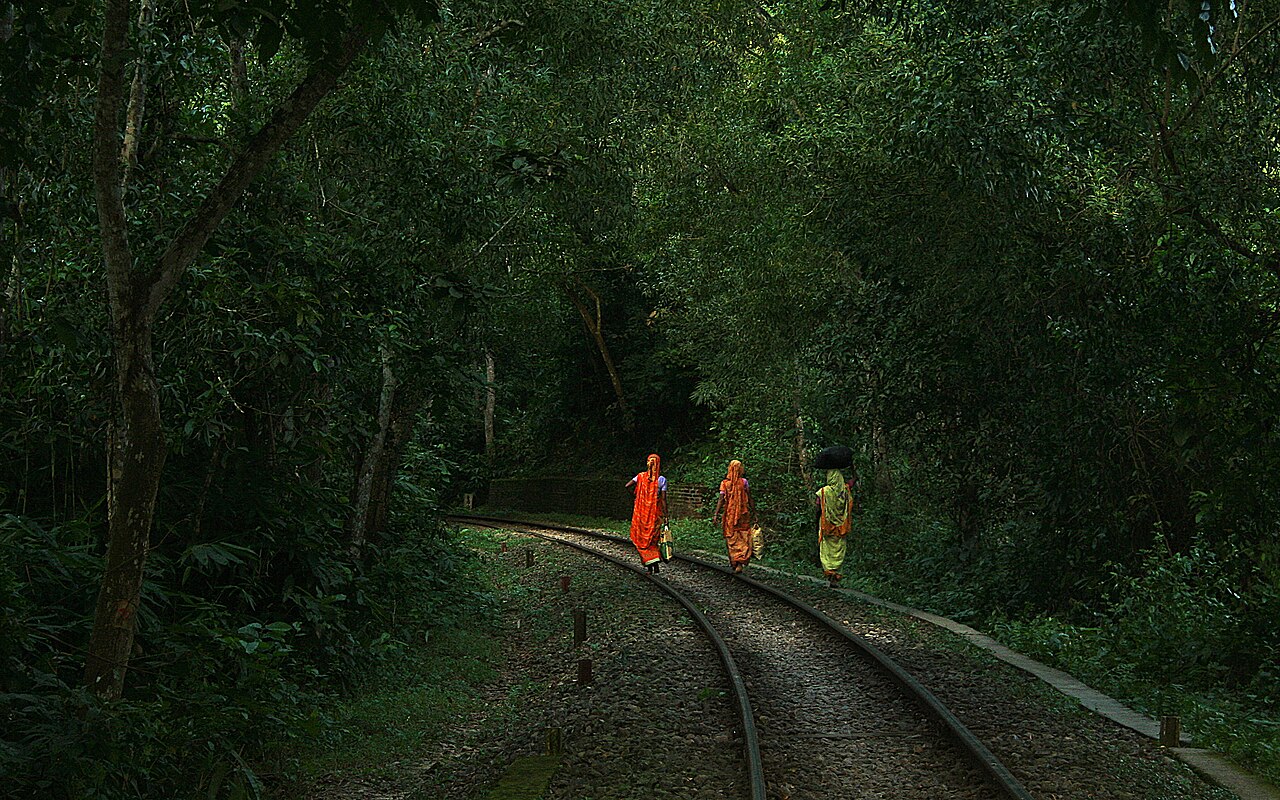
Photo: MD sajjad hossain photography / Wikimedia Commons (CC BY-SA 4.0)
Sources: Jagonews24 (24 November 2025), Desh Rupantor (5 October 2025), Banglapedia (Python, Snake, Sreemangal Upazila, Maulvibazar District, Bangladesh Tea Research Institute), Reptiles & Amphibians (2020 and 2024), Smithsonian's National Zoo and Conservation Biology Institute, Wildlife (Conservation and Security) Act, 2012, Prothom Alo (15 May 2021), The Daily Star (20 March 2018)
Comments
(0)