
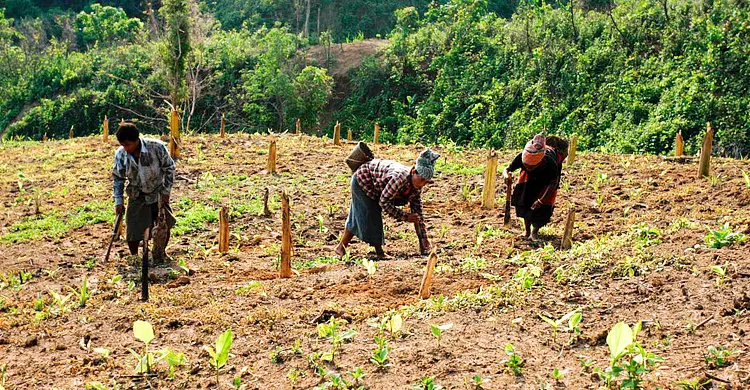
Soils in Bangladesh's hill areas differ from those elsewhere. Their topsoil has relatively little clay and holds much less water. Heavy monsoon rain causes widespread erosion and landslides, reducing the soil's organic matter and nutrients and making slopes steeper: gentle slopes become moderate, and moderate slopes steep. The Soil Resource Development Institute (SRDI) therefore believes research is needed to develop modern technology for managing hill soils. It has asked for Tk 60 lakh for foreign training to learn how to make hill areas fit for farming and to learn modern soil and land management.
The proposal was made under the project 'Application of sustainable soil and land management technology in hill areas and assessment of crop suitability based on soil quality'.
Questions over spending
The SRDI will carry out the project from July 2022 to June 2025. The project's evaluation committee met at the Ministry of Agriculture, chaired by Agriculture Secretary Md Sayedul Islam, and questions were raised about spending on foreign training and other items.
The proposal has already been sent to the Planning Commission. It seeks Tk 90 lakh for a jeep, although under the rules a car for a director (a grade-4 officer) may cost at most Tk 57 lakh.
The SRDI says it will reshape the project's DPP as the Planning Commission advises.
Asked about the foreign training and the Tk 90 lakh jeep, SRDI director general Md Kamaruzzaman told Jagonews that the project was at an early stage. The Planning Commission had given corrections, and they would make them; many costs in the project would be scrutinised.
On the Tk 60 lakh for foreign training, the director general said there was a dollar crisis now, so this item might not remain. It would be corrected.
On the jeep, Md Kamaruzzaman said there was no scope for it under the rules and the cost would be cut; a jeep costing Tk 50 lakh to Tk 55 lakh would be bought. The project paper was still in draft and not final, he said.
The Planning Commission said the detailed budget for printing and publication and for publicity and advertising showed year-by-year spending, but an item-by-item breakdown was required.
For preparing maps and reports under the crop suitability survey, an honorarium of Tk 40,000 per upazila has been set for writers, assistants and editors and for editing at the head office. A total of Tk 20 lakh has been proposed for final crop suitability maps and reports in 50 upazilas, but the officials and staff responsible for the work have not been specified.
The total proposed cost of the project is Tk 47 crore 38 lakh 56 thousand.
Project aims
The main aims are to apply sustainable soil and land management technology in hill areas, assess crop suitability based on soil quality, and apply modern soil and land management technology in 50 upazilas of 11 districts in the hill areas of Chattogram, Mymensingh and Sylhet divisions.
Modern soil and land management technology will cut soil degradation in hill areas by 2 to 3 per cent, and land use in the hill areas of Chattogram, Sylhet and Mymensingh divisions will rise by at least 5 per cent. Laboratories in the project area will be modernised and strengthened, and 972 batches of trained people will be produced, including from the Department of Agricultural Extension, sub-assistant agriculture officers and farmers.
Budget breakdown
The project proposes Tk 2 crore 93 lakh for 22 staff and allowances, Tk 7 crore 46 lakh 54 thousand for domestic training, Tk 25 lakh for honoraria, Tk 6 crore 73 lakh for demonstrations of hill soil management technology and Tk 27 lakh for field days. It also proposes Tk 13 lakh for seminars, Tk 32 lakh for surveys, Tk 3 crore 20 lakh to build 200 water reservoirs for irrigation and Tk 90 lakh for repairs and maintenance, plus Tk 16 crore 80 lakh for laboratory equipment.
The SRDI says the soils of the hill areas covering the 50 upazilas differ from other regions. Heavy monsoon rain causes widespread erosion and landslides, reducing organic matter and nutrients and steepening the slopes.
Research shows that conventional farming in hill areas loses 40 to 80 tonnes of soil per hectare a year, depending on the crop, while farming with the technology developed loses only 8 to 10 tonnes. The project has been proposed to set up trial demonstrations of modern land and soil management technology to reduce soil degradation.
Source: Jagonews24. First published in Bengali on The Agro News.
Comments
(0)