
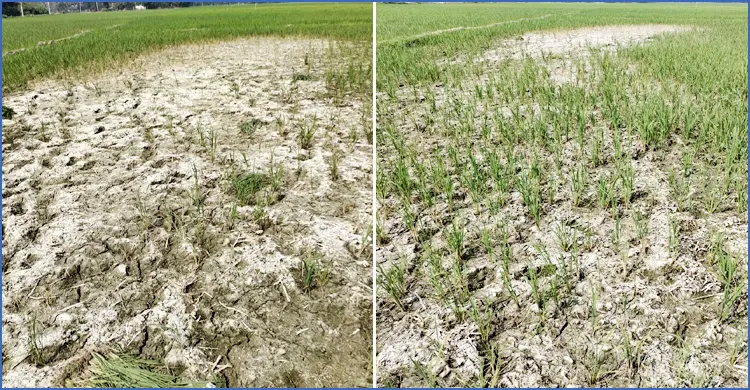
Lack of rain and intense heat during the Boro season have brought life to a standstill in Sonagazi, Feni. Because water cannot be given on time, Boro rice in the fields is burning in the sun, and the soil has cracked for lack of water. Thousands of farmers are worried about their rice.
Farmers say they spent lakhs of taka planting Boro seedlings on the assurance of the agriculture department, but are now in trouble because there is no water in the canals.
Canals without water
Even the huge Muhuri irrigation project is of no use to the farmers. There are more than 50 canals across the upazila's nine unions and one municipality. Although there is fresh water in the Muhuri river and salt water in the Boro and Chhoto Feni rivers, for mysterious reasons no water is reaching the canals. Several regulators stand at the river mouths to hold water in the canals, and the canals have been renovated in recent years at a government cost of hundreds of crores of taka. Still, there is no water in them.
Farmers have got no remedy despite written applications for water to the Upazila Nirbahi Officer, the agriculture officer and Water Development Board officials. Several written complaints have already been made to the relevant government offices on the farmers' behalf. Officials of every office have promised to supply water to the canals, but have not yet done so.
In most areas, farmers bought water from village ponds to irrigate their fields, but with the pond water also running out they are anxious about the rice they had pinned their hopes on.
More Boro than targeted
According to the Upazila Department of Agricultural Extension, the official Boro target in the upazila this season was 1,300 hectares, but 1,800 hectares were planted, 500 hectares more than the target. Of this, 1,500 hectares are high-yielding (HYV) varieties and 300 hectares hybrids. By unofficial estimates, about three thousand hectares of Boro have been planted in Sonagazi. The varieties include BR16, BRRI dhan28, 29, 67, 68, 74, 88, 89 and 92, BINA-10 and 24, and the hybrids BRAC-11, Rupali, Doyel, Sampad, Hira-2, Moyna and Tia.
The country's second-largest rice research institute is in this same upazila, and scientists keep developing new rice varieties. Yet no one seems to see the silent tears of farmers in this coastal upazila.
On a visit to several areas of the upazila, Boro fields were seen cracked for lack of rain. Where there is no water, the soil has hardened, and in many places the rice plants have turned red from the sun. Even with water from other sources, farmers are struggling to protect their crops, and they are waiting for rain to save them from the scorching sun and drought. Many are also praying to Allah for rain to protect their lives, livelihoods and crops.
Farmers' pleas
Sirajul Islam, a farmer of Chargonesh village in the municipality, said he had grown Boro on 70 decimals this time. "The rice plants are burning in the sun for lack of water. If we are not given water, let us be shot dead in our fields."
He said he had planted BR-29 seedlings. With no water in the canal, he had bought water from a distant pond for the field, but that water has also dried up.
Main Uddin, a farmer of Char Sahabhikari, said, "I grew Boro on three acres with great hope, two acres of my own and one acre through a sharecropper. The water crisis has left me and my sharecropper at our wits' end."
Mizanur Rahman, a farmers' representative from Londoni Para in Char Chandia union, said he and fellow farmers had grown Boro with loans from banks and NGOs and by mortgaging their wives' and daughters' gold. "There is a fear that farmers will die along with the rice. We got no remedy despite written applications to various government offices for water. The rice fields have cracked for lack of water."
Officials respond
Sonagazi Upazila Agriculture Officer Sajjad Hossain Mazumder said rainwater is the main source for rice farming in the area. If water cannot be supplied to the canals quickly, the rice will suffer severe damage and farmers will face heavy financial losses, and the Boro target will fail. "We are in regular contact with Water Development Board officials. Farmers hit by the water crisis will lose interest in growing Boro and other crops in future."
Sonagazi Upazila Parishad Chairman Zahir Uddin Mahmud said, "We have heard about the farmers' water problem and are in regular contact with the Water Development Board authorities."
Source: Jagonews24. First published in Bengali on The Agro News.
Comments
(0)