
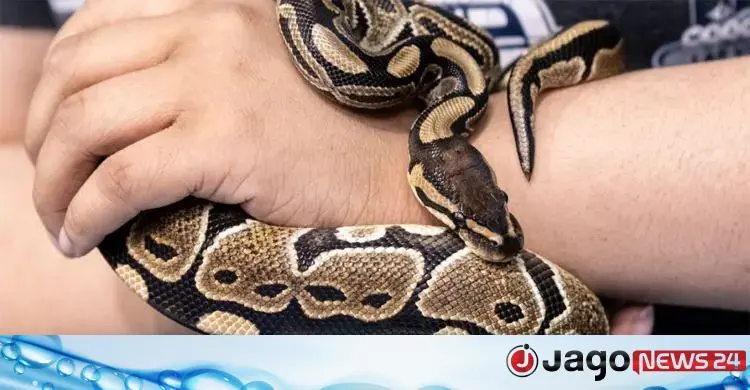
When the monsoon arrives in Bangladesh, nature takes on a new look, but a quiet fear also settles on people in villages and suburbs. The name of that fear is the snake. In the rainy season and autumn, reports of snake sightings rise dramatically across the country, and with them come videos, made-up rumours and blind panic on social media.
In some places snakes are beaten to death on sight; elsewhere completely harmless, non-venomous snakes are killed cruelly because people think they are venomous. Yet the harsh reality is that snakes suffer a hundred times more harm from people than people do from snakes. Because of age-old fear, ancient superstition and a lack of accurate information, countless harmless animals die in this country every year.
Most snakes are not deadly
Wildlife scientists and reptile experts say most snakes found in Bangladesh are not deadly to humans. More than a hundred species of snake occur in the country, of which only a handful are dangerously venomous. The rest are either completely non-venomous or so mildly venomous that they cannot harm people. But ordinary people cannot tell the difference; to them every snake is equally guilty and a messenger of death. Because of this sweeping view, an essential part of nature is now in grave danger.
There are countless misconceptions about snakes in our society. A very common belief in rural areas is that all large snakes are venomous. In reality this has no scientific basis. Many very large snakes, such as the python or the rat snake (darash), are completely non-venomous. They do not kill prey with venom but control it by coiling around it with their muscular bodies. On the other hand, many small, calm-looking snakes, such as the krait (kalach) or the mete snake, can be highly venomous. So judging a snake only by its size or length is extremely dangerous and foolish. Another widespread belief is that snakes chase or follow people.
Zoologists have made it clear that snakes are very shy and generally prefer to avoid people. When a person comes close, most snakes first look for a way to escape. Only when trapped in a confined space, badly frightened, or accidentally stepped on do they act aggressively as a last attempt at self-defence. In most cases, then, a snakebite is not a planned attack but an instant defensive reaction to survive.
Under the influence of folk tales, fairy tales and films, another belief is deeply rooted: that snakes remember people's faces and take revenge later. It has been scientifically established that a snake's brain is not built to remember human features and plan revenge. Snakes have very limited memory and no feeling of revenge at all. Taking the imaginary stories of films and novels as true, people readily make these harmless animals their enemies.
The Russell's viper scare
In recent years another snake has caused great panic and rumours in Bangladesh: the Russell's viper, or chandrabora. Once confined to the Barind region, it is now being seen in river basins across the country. Because of exaggerated coverage in the media and on social media, people are now so frightened that they beat to death ordinary mete snakes or young pythons, thinking they are Russell's vipers. The truth is that this snake is sluggish and never comes after people on its own to bite them. It bites only when someone unknowingly steps on it while it is hiding in grass.
Wrong treatment costs lives
There is no end to mistakes about snakebite treatment in our country either. Many people still waste precious time with snake charmers (ojha), traditional healers (kabiraj) or faith healing. In rural areas, people bitten by non-venomous snakes often recover after an ojha's rituals, simply because the snake had no venom, but people believe the ojha's supernatural powers saved them. Because of this false belief, people go to the ojha even when a venomous snake bites, and the patient dies for want of proper treatment. Primitive methods such as cutting the wound with a blade to draw blood, or tying it tightly with rope or wire, make the patient's condition worse. A tight binding stops blood circulation and the limb can rot, and may later have to be amputated.
Doctors say the first thing to do after a snakebite is to keep the victim calm and ease their fear, because a faster heartbeat from fear spreads venom through the body more quickly. The bitten limb must not be moved at all, kept still the way a broken bone would be. Then the patient should be taken to the nearest government hospital as quickly as possible. Effective snakebite medicine, antivenom, is now available completely free of charge in almost all government hospitals in Bangladesh. If patients reach hospital in time, every one of them can be cured with modern treatment.
Friends of the farmer
Snakes maintain a great balance in nature. Many of us may not know that, by controlling rats in farmland, they are unofficially the farmer's greatest friend. A large snake eats hundreds of rats a year, protecting crops. If snakes disappeared from nature, rat infestations would grow so much that the country's food production would face a serious threat. Snake venom is also used to make many valuable life-saving medicines for heart disease, cancer and pain. The contribution of snakes to advances in medical science is undeniable.
Deforestation, the filling of rivers, overuse of pesticides on cropland and indiscriminate habitat destruction are endangering the snake's natural life cycle. To survive, they are often forced into human settlements or homes. It is wrong to see this as snake aggression; it is really a desperate struggle to survive.
What the law says
Under Bangladesh's wildlife protection law, killing wildlife, including snakes, is a punishable offence. Breaking the law can bring up to seven years in prison and a fine of up to Tk 10 lakh. So when a snake is seen, a responsible citizen should keep a safe distance rather than kill it, and seek help from trained snake rescuers or the Forest Department.
Fear of snakes is natural, as it is a primitive human instinct. But that fear should not turn into blind hatred through ignorance and superstition. Every creature in nature depends on the others. Only by setting aside misconceptions and rumours and embracing science-based knowledge can the conflict between people and snakes be ended. Seeing the snake not as an enemy of nature but as an essential and useful member of the ecosystem can help build a civilised and aware society.
The writer, Abhilash Mahmud, is a poet, news carrier and storyteller.
Source: Jagonews24. First published in Bengali on The Agro News.

Comments
(0)