
Fear of the chandrabora, or Russell's viper, is running high. Although accurate data are lacking, several patients have died of snakebites in various districts over the past few months. But the Directorate General of Health Services has no confirmed data that these deaths were caused by Russell's viper bites.
Amid public concern about Russell's vipers in the media and on social media, Health Minister Dr Samanta Lal Sen has instructed that antivenom injections (used to cure snakebite patients) be supplied to district and upazila hospitals and good treatment ensured.
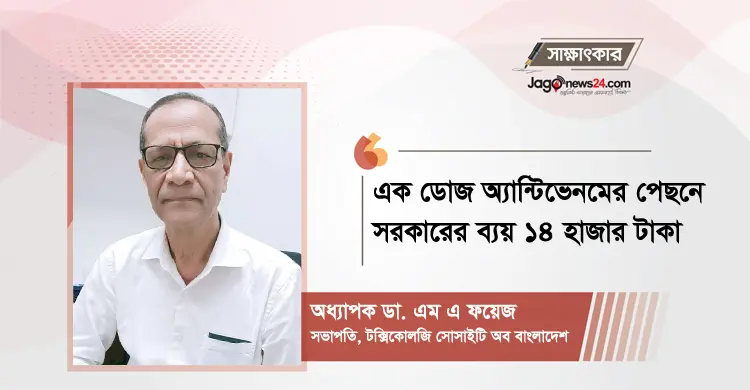
Prof Dr M A Faiz, president of the Toxicology Society of Bangladesh, former director general of the Directorate General of Health Services and professor of medicine, spoke to Jago News about the prevalence of Russell's vipers and other snakes in the country, the need for and availability of antivenom injections, and prevention. The interview was conducted by Jago News planning editor Moniruzzaman Uzzal.
Old snake, new attention
Asked how he sees the recent nationwide fear over snakebites, Prof Faiz said he had also seen various reports and data about the Russell's viper in the media and on social media. Some of the information about the snake is correct, but some misleading information is also spreading.
"The Russell's viper is not a new snake. People involved in farming, homestead gardening, fishing and other occupations know it as chandrabora or ulubora. In past years too, unfortunately, quite a number of people were bitten or killed by it. But it is true that more Russell's viper bites are being heard of this year than in other years," he said.
On whether it is possible to tell which snake caused a death, and where snakes are most common, he said there has been no major snake survey in the country, so it cannot be said for certain how many kinds of snake there are, which snake lives where, or which snake bit whom.
"However, according to the latest national survey, conducted in 2022, an estimated 4 lakh people are bitten by snakes every year in the country and, unfortunately, about 7,500 die," he said. Although there are snakes everywhere, the national survey found snakebites most frequent in Khulna and Barishal divisions, followed by Rajshahi, Chattogram and Dhaka.
Diagnosis and antivenom
On treatment, he said that, for Russell's vipers and any other venomous snake, doctors decide from the symptoms whether a person has been envenomed. For Russell's viper bites, along with the symptoms, doctors use a blood test called 20WBCT (20-minute whole blood clotting test) to decide whether envenoming has occurred.
"If a venomous Russell's viper bites, blood clotting is disrupted and the 20WBCT comes back positive, meaning it is fairly certain a Russell's viper has bitten. The test needs no advanced equipment. Doctors and nurses at upazila hospitals can easily carry it out," he said.
The antivenom used in the country is made from the venom of four species: cobra, krait, saw-scaled viper and Russell's viper. As in India, the same injection is used in Bangladesh for any venomous snakebite (cobra, krait and Russell's viper). There is currently no separate injection for treating Russell's viper bites.
One dose (10 vials) of the antivenom bought by the government costs about Tk 14,000, up from Tk 8,000 to 10,000 a few years ago. So the government spends Tk 14,000 on the injection for each snakebite patient, and it is supplied by the government. Antivenom is bought through the DGHS Non-Communicable Disease Control programme (NCDC) and EDCL (Essential Drugs Company Limited), according to the needs of upazila, district and medical college hospitals.
Prevention
To prevent snakebites, he said government preparations must start from March and April. Snakes enter homes looking for shelter, especially in the rainy season. The good news is that not all snakes are venomous: only 20 to 25 per cent of snakebites in the country are from venomous snakes.
Among the main ways to avoid snakebite are walking carefully (using a light, a stick and boots), sleeping on a bed under a mosquito net, not sleeping on the floor, and not leaving homes, animals and food exposed, because these attract snakes and let them get in.
People should also keep the surroundings of the house clean, take care when guarding crops and fishing, move stacked and stored materials carefully and be careful about putting their hands into holes.
First aid after a bite
"The snakebite patient must be reassured and calmed. If bitten on the leg, they must sit down and not walk. If bitten on the hand, the hand must not be moved. Rings, bangles, amulets and threads must be removed from the bitten limb as quickly as possible," he said.
The bitten limb should be wrapped with cloth and wood or bamboo strips, the way a splint stops movement after a broken bone, so the joints do not move. Moving the joints makes the muscles contract, which can spread the venom quickly through the blood and cause poisoning.
If the bite is bleeding, pressure should be applied. The patient should be sent to hospital by motor vehicle as quickly as possible, kept lying on one side during the journey. If they are not breathing, an airway tube should be used and, if necessary, artificial respiration given.
"Do not kill snakes. Snakes maintain the balance of nature and benefit people. But if someone has killed the snake, they can take it to hospital for identification," he said.
Signs of a venomous bite
According to Prof Faiz, the signs of a venomous snakebite are:
- rapid swelling, blistering, change of skin colour, darkening, pain, rotting or continuous bleeding at the bite
- drowsiness, heavy or closing upper eyelids, inability to move the eyeballs, blurred or double vision
- a thick tongue, difficulty speaking or swallowing, and water coming out of the nose while eating
- difficulty walking, numb hands and feet, a weak neck, dark urine and reduced urine
What not to do
After a snakebite, he said, people should not tie any knot on the bitten limb, cut or pierce the bite with a needle, or apply any coating to it. They should not waste time on treatment by an ojha or baidya or on faith healing. If the patient has difficulty speaking, speaks through the nose or is drooling on the way to hospital, they should not be given anything to eat. No chemicals or alcohol should be put on the bite, no one should try to make the patient vomit by feeding them oil, ghee, chilli or plant juices, and aspirin should not be given for pain.
Source: Jagonews24. First published in Bengali on The Agro News.
Comments
(0)