
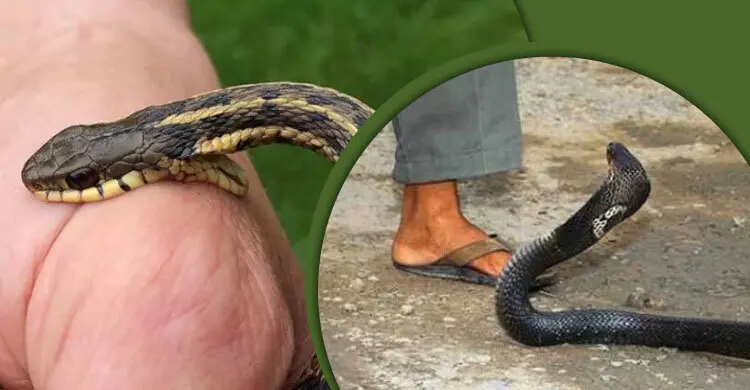
Snakebites killed 38 people across the country between February and 1 July this year, the Directorate General of Health Services (DGHS) said. In those five months, 610 people were bitten by snakes.
The figures were given at a press conference on public awareness about Russell's viper at the DGHS in Mohakhali, Dhaka, on Wednesday (10 July). They were presented by Professor Dr Robed Amin, line director of the DGHS non-communicable disease control unit.
He said that from January until now, 416 snakebite patients had been admitted to Rajshahi Medical College Hospital. Of these, 91 bites were by venomous snakes, 18 of them Russell's vipers (chandraboda). Eleven of the patients died, five of them from Russell's viper bites.
A recognised public health problem
The press conference heard that various theories, claims and rumours about Russell's viper had recently caused fear and panic around the country. Snakebite is officially recognised as an important public health problem in Bangladesh. According to a national survey in 2022, more than four lakh people in Bangladesh are bitten by snakes, of whom about 7,500 sadly die. Although information on snakes is inadequate, the main venomous species include the cobra, the krait (kalach), the Russell's viper (chandraboda) and the green snake. There are also records of bites by some sea snakes.
The Russell's viper is a venomous snake of the viperid group. Its presence in Bangladesh and deaths from its bite have been recognised since 1920. The first report of a Russell's viper bite at Rajshahi Medical College Hospital was recorded in 2013. Although it was initially seen more in Rajshahi and the Barind region, the snake has gradually spread to 27 districts.
Antivenom and the action plan
Dr Robed Amin said antivenom is the recognised treatment for venomous snakebite. It is made by collecting venom from the main venomous snakes, injecting it into horses and processing serum from the horses' blood. Antivenom is not currently made in Bangladesh. The non-communicable disease programme buys antivenom made in India, prepared against four main venomous snakes, and supplies it to government hospitals. Although there is no specific programme for the purchase, distribution, storage, use and post-use monitoring of antivenom, its benefits are evident.
He added that a time-bound action plan (2023-2028) with strategy and funding has been drawn up for snakebite in Bangladesh. Through the snakebite prevention and control programme, the strategy aims to cut deaths and disability by 50 per cent by 2030.
Source: Jagonews24. First published in Bengali on The Agro News.
Comments
(0)