
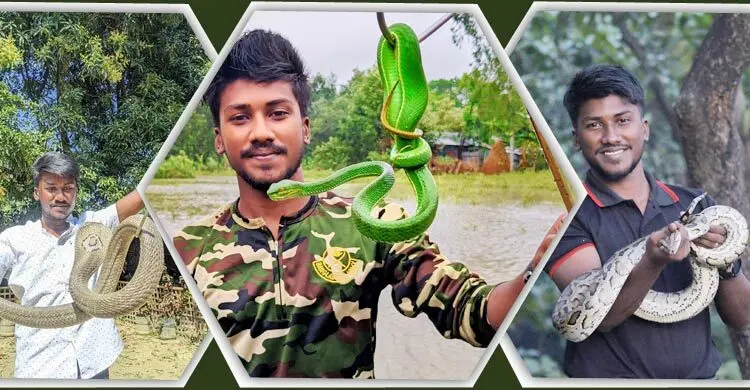
By Muhammad Shafiqur Rahman
There has been no extensive research on snakes in Bangladesh so far. But the country's wildlife and environment expert Md Abu Saeed and Farid Ahsan, a professor in the zoology department of the University of Chittagong, found in their research that Bangladesh has 117 species of snake. Of them, 34 are venomous and the remaining 83 are non-venomous.
In Bangladesh, most deaths from snakebite are caused by cobras (gokhra) and kraits (keute). There are two kinds of gokhra: padma gokhra and khoiya gokhra. Five species of krait are found in Bangladesh, known locally as keute: the common krait, Wall's krait, greater black krait, banded krait (shankhini) and lesser black krait. Of these, people generally know the banded krait, or shankhini, best.
Why snakes increase in the rainy season
When floods submerge homes, people gather on high ground and in shelters, and snakes too move to high places where people are sheltering in order to survive. People are then bitten through carelessness. Venomous snakes also float into Bangladesh from India on floodwater. As a result, people suffer the most snakebites in July and August, the rainy season. The two gokhra species, the five krait species and the chandrabora can all swim.
What to do if you see a snake at home
Do not shout, scream or run about when you see a snake. Move the people in the house to a safe place. At night, turn on the lights and have one person watch where the snake goes. If possible, take a photo on your mobile phone and send it to snake experts. They can identify the species from the photo and advise what to do depending on whether it is venomous or not.
Open the door or window and give the snake a gentle nudge with a long stick, and it will leave. If it is in a hole in the house, on top of a cupboard, behind the fridge or somewhere it cannot be driven out from, call 999 for help, or contact the forest department for help from its trained rescuers. There are also several voluntary organisations in Bangladesh that rescue snakes in parts of the country.
Remember that snakes cannot sense motionless objects. If you stand still on seeing a snake, it may pass by your feet without striking. But if you move or run about, it may strike, taking you for food or an enemy.
First aid for snakebite
On first aid for snakebite, World Health Organization expert physician Dr Ayan Simpsong has said "Do it RIGHT", meaning do the right thing: R for rescue, I for immobilise, GH for go to hospital and T for tell the doctor.
After a snakebite, the patient must be reassured and kept calm. Keep the bitten limb still so the venom does not spread quickly through the body. Most snakes bite the hands or feet, and keeping the bitten limb still slows the spread of venom. If the bite is on the leg, splint it straight with a stick, lay the patient on a stretcher and take them quickly to a health centre.
Remember, though, that no kind of tie can stop snake venom. A tie can cut off blood flow and leave a hand or leg permanently disabled. Ties can do serious harm especially in bites from the chandrabora and sabujbora.
Do not go to an ojha
The quackery of the ojha, or traditional snake healer, has gone on for ages in the Indian subcontinent. In Bangladesh, 80 of every 100 snakebites are from non-venomous snakes. The remaining 20 are from venomous snakes, and 10 of those are dry bites. A snake sometimes strikes so fast that it cannot inject a proper dose of venom into a person or animal; this is called a dry bite. The patient is not poisoned and does not die.
The ojhas essentially use their charms and incantations on the 80 per cent of patients bitten by non-venomous snakes and the 10 per cent with dry bites, and claim to have cured them. This has created a belief that ojhas can cure snakebite patients. The ojhas send the remaining 10 per cent, whom they cannot cure, to hospital.
How to keep snakes away
Snakes' favourite foods are rats and frogs. If there are rats in or around the house, snakes come in to eat them, so get rid of rats inside and around the house. If the house is made of mud, close all holes in and around it. Keep bushes cleared. Spreading bleaching powder, lime or carbolic acid may reduce insects and snakes somewhat, but it cannot keep snakes out.
Superstitions about snakes
Many superstitions about snakes persist: that snakes carry a jewel on their heads, that snakes can fly, that snakes drink cows' milk, that the scent of flowers draws snakes, that there are two-headed snakes, that snakes have legs, that snakes dance to the tune of a flute, that a snake's name must not be spoken at night, that the darash snake has a thorn in its tail, and that a snake that is struck will come to the house and bite.
Awareness is the only way
All of us can make people in our own areas aware of snakes: what to follow to avoid being bitten, what to do after a bite and where to get treatment. People must be made to understand that 90 of every 100 snakebites are from non-venomous snakes, so a snakebite does not mean death. People must be taught to tell venomous from non-venomous snakes and told how snakes benefit us.
Wide campaigns are needed in schools, colleges, madrasas and among ordinary people in rural areas so that snakes are not killed needlessly on sight. The public must also be told that catching or killing any wild animal, including snakes, is a punishable offence under the law.
The writer is assistant manager, sales operations, Fair Distribution Limited.
Source: Jagonews24. First published in Bengali on The Agro News.
Comments
(0)