
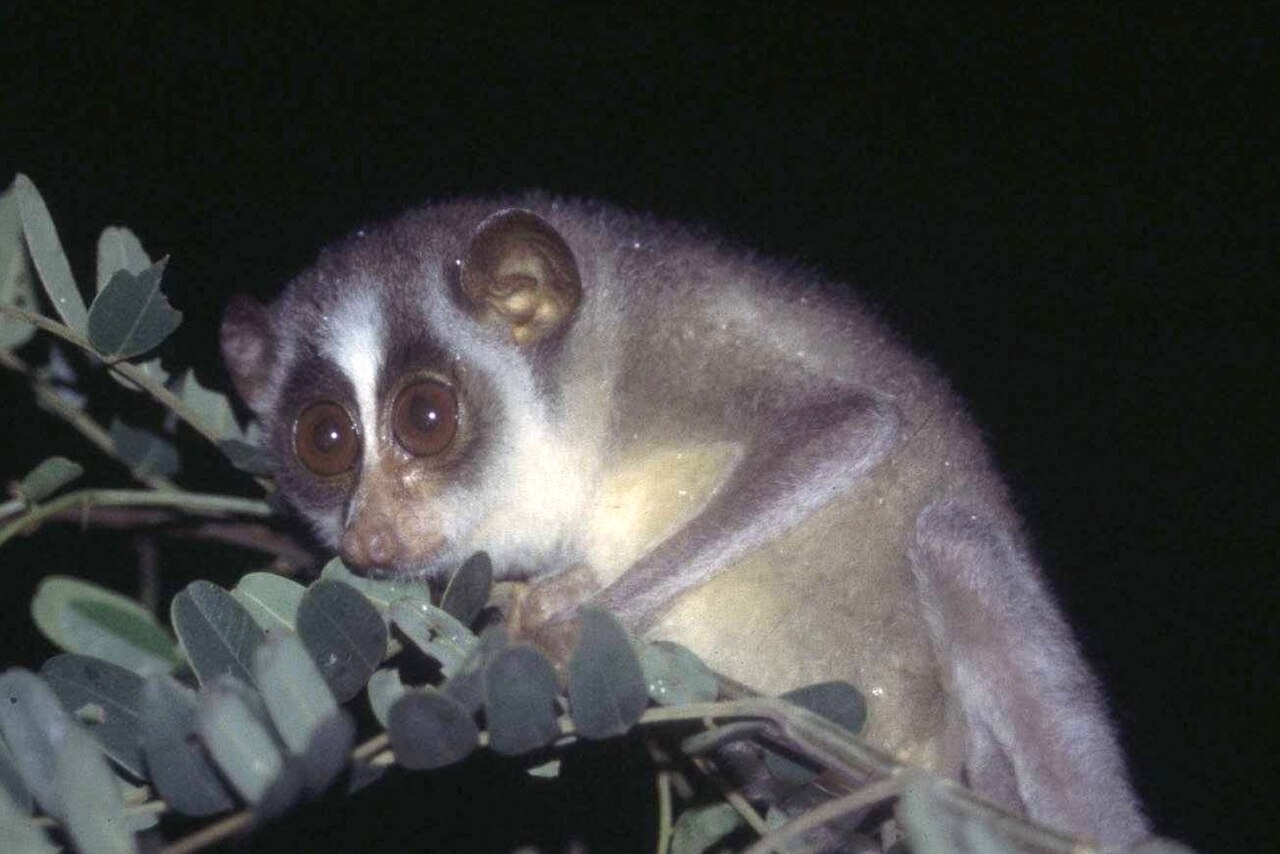
The slender loris, a small nocturnal primate called kaadu papa, or "forest baby", in Kannada and thevangu in Tamil, is losing the connected forest canopy it depends on, Mongabay India reports in its Species File series.
The loris hides in the canopy by day and hunts by night, using its large, saucer-like eyes to find ants, termites and small vertebrates. Its long, thin limbs are poor for leaping, so it needs trees that touch to move about; it rarely comes to the ground, lives mostly alone and communicates with screeches, whistles and clicks.
There are two species. The grey slender loris (Loris lydekkerianus) lives in southern India and Sri Lanka, and the red slender loris (Loris tardigradus) only in Sri Lanka. India has two of the grey loris's four subspecies: the Malabar grey slender loris in the wet evergreen forests of the Western Ghats, and the brownish-grey Mysore grey slender loris in the drier forests and scrub of Karnataka, Tamil Nadu and Andhra Pradesh. A few survive in cities such as Bengaluru, isolated in small parks and campuses.
India's first sanctuary for the species, Kadavur Slender Loris Sanctuary, was set up in 2022 across 118 square kilometres of Karur and Dindigul districts in Tamil Nadu. A 2022 study estimated 8,844 grey slender lorises in the Karur forests and 8,412 in Dindigul. The IUCN Red List classes the species as near threatened; in India it has the highest legal protection under Schedule I of the Wildlife (Protection) Act, 1972, and it is listed in Appendix II of CITES.
Forest degradation from sand mining, illegal red soil mining, logging and agriculture cuts lorises off from each other and forces them to shelter in hedge plants and farm trees. They are killed on roads while crossing broken landscapes and trafficked for the exotic pet trade, meat and traditional medicine. "Large areas of slender loris habitat are lost, forcing them to live in high density as refugees in remnant forests and agricultural hedges," Honnavalli N. Kumara, principal scientist at the Salim Ali Centre for Ornithology and Natural History, told Mongabay India in 2025.
Photo: Dr. K.A.I. Nekaris / Wikimedia Commons (CC BY-SA 4.0)
Source: Mongabay India


Comments
(0)