
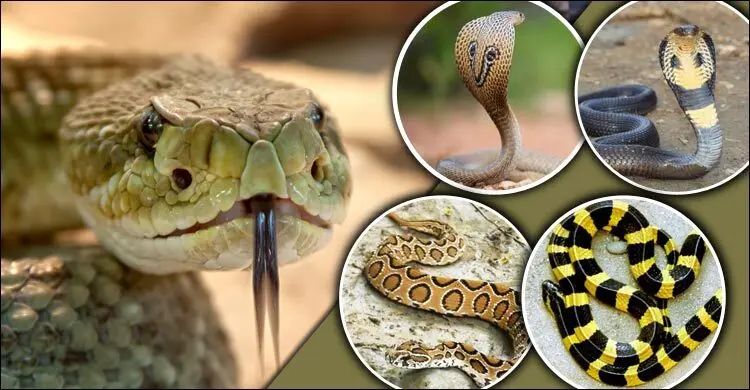
The whole country is gripped by fear of one snake. The venomous Russell's viper is being seen in various parts of the country, and several people have reportedly already died from its bite. But the Russell's viper is not the only venomous snake in Bangladesh; there are several others.
Bites from these snakes can kill people immediately. But not all of the country's snakes are venomous, so not every snakebite is fatal. Some 80 species of snakes live in every corner of the country, but most deaths are caused by the bites of just seven or eight highly venomous species. Many other species actually keep away from people.
Snakes become several times more of a nuisance in the rainy season. Snakebites and deaths rise during the flood months of May, June and July. A nationwide snakebite survey by the Non-Communicable Disease Control programme (NCDC) found that 403,317 people are bitten by snakes in the country each year and 7,511 of them die. Treatment costs a bitten person about Tk 2,000 per bite.
Here is a guide to the country's venomous snakes.
Russell's viper (chandrabora)
The snake whose name is heard most these days is the Russell's viper. Many know it as chandrabora, and it is also called ulubora. Of the snakes found in Bangladesh, it is the most venomous. About a hundred years ago the snake had almost disappeared from Bangladesh, with not a single one seen for several decades in a row. But from 10 to 12 years ago, evidence of its bites began to appear again, and it has now been found afresh in 27 districts.
King cobra (shankhachur)
It is also called raj gokhra and padma gokhra. This deadly venomous snake is much longer than other cobras, and its hood lacks the spectacle-like ring of other cobras. The king cobra is found mostly in Bangladesh, Bhutan, Burma, Cambodia, China, India, Indonesia, Nepal, the Philippines, Singapore and Thailand. It prefers dense jungle and hilly areas.
Naja naja
Although its scientific name is Naja naja, it is a cobra (gokhra) species. It is a land snake that raises a hood with two spectacle-like rings. It lives mainly in the west of the country, towards the Rajshahi region.
Keute
The keute is a cobra species found in South and Southeast Asia, listed by the IUCN as least concern. The English word cobra literally means gokhra. The back of this cobra's hood has a mark like a cow's hoof, from which the Bengali name gokkhur comes. The English word monocled means one-eyed: the snake is called the monocled cobra because the round mark on the back of its hood looks like a monocle. Cobra species spread their hoods when agitated.
Krait (shankhini)
This snake is also called shankhini and shakini, and is found in Sreemangal. There are eight krait species in the world in total, five of which are found in Bangladesh. Kraits are also called keute locally. The snake lives in dry places around homes or among firewood.
Naja kaouthia
This is also a cobra species, known locally as jati shap or jat shap, and also as jaura. It lives mainly in the east of the country, in Sylhet and Noakhali. Of all snakebites in the country, the most are caused by this snake. When agitated it spreads its hood, as the long ribs of its neck expand to open out its striking hood.
Source: Jagonews24. First published in Bengali on The Agro News.
Comments
(0)