
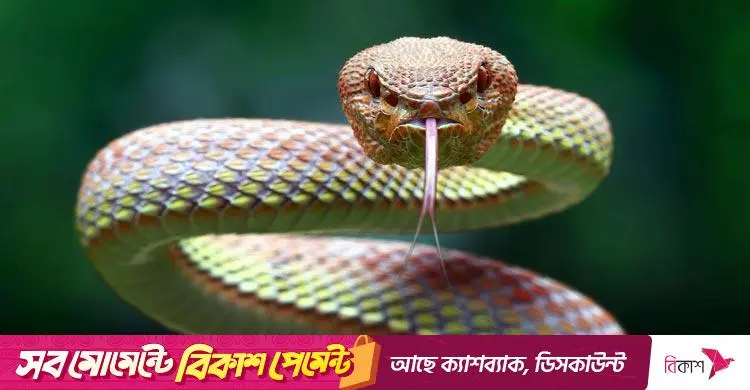
Today, 16 July, is Snake Day. Snakes are not as terrifying as people think; if anything, they are rather harmless animals, and this day is set aside for them.
Because people fear snakes, there are many frightening stories about them. We even call a friend who betrays us a "snake", and many other negative ideas about snakes are common in our society. There are about 3,500 species of snake in the world. That is no small number, but only a handful of them are venomous.
Inland taipan
This reclusive snake lives in the middle of the desert, in the Channel Country of Queensland and South Australia, and is also called the "fierce snake". Its LD50 (subcutaneous) is just 0.025 mg/kg, making it the most venomous land snake known so far. It averages 1.8 metres in length and is brownish-yellow; in winter its skin darkens to hold heat. It is nocturnal and eats rats. It flees when it sees people, but if cornered it can strike several times.
Eastern brown snake
This snake is found in Australia's farming areas, suburbs and even backyards. Its venom rating is 0.05 mg/kg, but its bite is very dangerous. It is active by day. A single bite, with a neurotoxin and a prothrombin-like complex, makes the blood clot, and death can come within half an hour. It is responsible for the most deaths in Australia every year. It feeds mainly on rats and small birds.
Coastal taipan
The coastal taipan is found in warm coastal Queensland, northern New South Wales and Papua New Guinea. It grows up to 2.5 metres long and has an elongated head. Striking with a leap, it can inject more than 120 mg of venom, a mix of neurotoxins and procoagulants. The main risk of death is rapid nervous paralysis. The story of a child who died in 19 days from the venom of a pet taipan remains a teaching case study for doctors.
Belcher's sea snake
It may look like a toy snake made of cloth, but it is one of the most venomous snakes in the world. Human deaths from its bite are very rare, however, because it lives on Indo-Pacific coral reefs at depths of 80 metres. It is slender, about 1 metre long, with yellow and white markings. In the sea it is in fact second in venom only to the Dubois' sea snake. It is calm and bites only when tangled in a net.
Dubois' sea snake
This snake lives at depths of up to 40 metres in the Coral Sea, New Caledonia and Australia's Great Barrier Reef. Its LD50 is just 0.044 mg/kg, making it the most venomous sea snake measured so far. It feeds mainly on small fish and lobsters and hides in holes during the day. When caught it coils around and struggles, but bites are rare.
King cobra
Found in South-East Asia and growing up to 3.7 metres, this is the world's longest venomous snake. It can inject 400-600 mg of venom at a time; besides neurotoxins, a rare beta-cardiotoxin disrupts the heartbeat. It lives by eating other snakes and is the only snake that builds a nest and guards its eggs. Although it is a cobra, its hood is relatively narrow. It can rear up from the ground and strike from 1.5 metres away.
In Bangladesh it is also called raj gokhra and padma gokhra. Unlike other cobras, its hood has no spectacle-like ring. The shankhachur is seen mostly in Bangladesh, Bhutan, Burma, Cambodia, China, India, Indonesia, Nepal, the Philippines, Singapore and Thailand. It prefers dense forest and hilly areas.
Source: Jagonews24. First published in Bengali on The Agro News.

Comments
(0)