
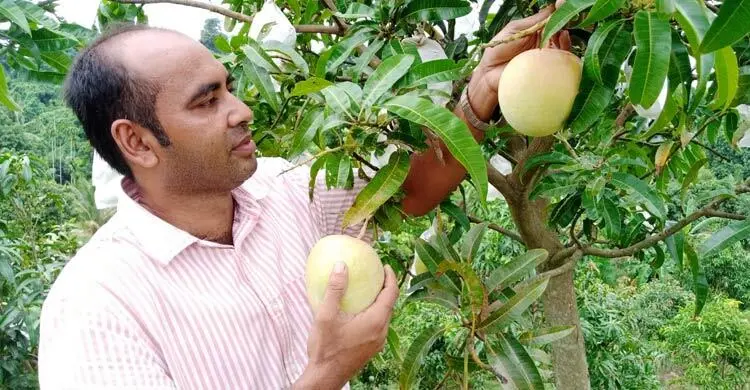
Md Rashed has profited by planting 30 local and foreign varieties of mango on abandoned land at the foot of the Sitakunda hills in Chattogram. Growing mangoes on 5 acres in Banshbaria union of the upazila, he is playing a big role in the rural economy. He did not do well selling mangoes last year, but has made a good profit this year.
According to the upazila agriculture office, farming families grow various mango varieties at Bhatiari union, Kumira, Banshbaria, Barabkunda, Baraiyadhala and different parts of Sitakunda's Chandranath hill. Most mangoes are grown in Banshbaria, Bhatiari, Kumira and the Chandranath hill area of Sitakunda municipality. The yield is very good this year, and wholesalers are buying the mangoes from markets across Sitakunda upazila.
Formalin-free mangoes
"There is no formalin in the mangoes from my orchard," farmer Md Rashed said. "I have been growing poison-free mangoes like this for about 13 years; I really began in 2011. My orchard has at least 30 varieties, including Kiew Sawoey, Banana, Fazli, Haribhanga, BARI-4, Dishari and Rangoye."
"I collected the varieties from different parts of the country and planted mango trees all along the foot of the hill," he said. "I always wanted to grow and eat formalin- and poison-free mangoes myself, and that wish has come true. Now my local and foreign mangoes go from Banshbaria to remote areas. So far I have sold Tk 3 lakh worth of mangoes, and I can sell another Tk 6-7 lakh worth."
Upazila agriculture officer Md Habibullah, an agriculturist, said: "Rashed of Banshbaria has succeeded in mango farming, and many are becoming interested after seeing him. Green mangoes grown in Sitakunda have been exported to Italy. The hill soil here is very fertile, and many are profiting from growing mangoes at the foot of the hills. With modern methods, production of different fruits will be good."
Source: Jagonews24. First published in Bengali on The Agro News.
Comments
(0)