
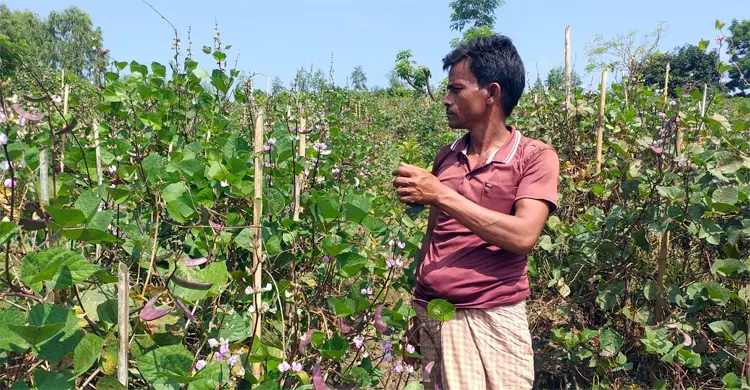
As far as the eye can see across the hills, there are bean fields. Under the hot midday sun farmers are at work, some tending the plants, some picking beans that hang in purple clusters. Every day the fruits of their labour go to different parts of the country. Alongside the plains, farmers in Sitakunda upazila, Chattogram, have brought about a revolution in growing Rupban beans on the hills.
The Rupban beans of Sitakunda are in demand across the country. Beans grown on the hills here do not even need to be taken to market: wholesalers from Dhaka, Chattogram and other cities wait at the foot of the hills, buy the beans there and take them away by truck. The upazila is famous for beans. Besides Rupban, churi, loitta and banta beans are in high demand, and because beans are tasty and profitable, cultivation is rising day by day.
Growers' earnings
Grower Md Solaiman said: "I have been growing beans on the hills for many years. This time I have grown beans on 250 decimals of hill land. So far I have sold about Tk 8 lakh of beans. I have also grown bottle gourd, yardlong beans, ridge gourd and other vegetables."
Farmers said that at the start of the harvest they sold Rupban beans wholesale at Tk 160-170 a kg and are still getting Tk 130-140. Production costs are somewhat higher because the land is remote and hilly, and the work is hard: to reach the fields they must cross streams, slippery paths and very high hillocks.
According to the upazila agriculture office, Rupban beans were grown on 75 acres this year by about 300 farmers, mostly in the hill areas of Banshbaria and Kumira, as well as in Saidpur, Baraiyarhala and the Sitakunda municipal area.
Bean grower Monir Ahmed said: "I have been growing Rupban beans on the hills for 5 years. This time I grew them on 120 decimals and have sold Tk 3 lakh of beans so far. I can sell for another 2-3 months. Farming on the hills is very hard and takes a lot of capital, but nobody thinks about us."
Mohiuddin said: "I grow Rupban beans and other vegetables on the hills all year round. For 3 years the hills have been like my home. I have grown beans on 250 decimals and so far sold more than Tk 8 lakh of beans. I can sell for another 3 months. But if there is rain or thick fog, the flowers may drop."
Traders and officials
Wholesaler Munaf told Jago News: "I have bought 1,145 kg of beans at an average of Tk 130 a kg. I will now sell them to retailers in various fresh markets in Chattogram city. I set the market rate depending on supply."
Mohammad Abul Monsur, sub-assistant agriculture officer for Banshbaria union, said: "Land on the plains is shrinking, and farmers are forced to farm on the hills. More than a hundred farmers in the area have grown Rupban beans on the hills and have profited. The upazila produces Tk 20 crore worth of beans in a season."
Md Habibullah, the Sitakunda upazila agriculture officer, said: "Rupban beans yield over a long period and fetch more than winter beans, so farmers are turning to them. Beans from here have a good reputation across the country. We give growers all kinds of advice as well as support."
Source: Jagonews24. First published in Bengali on The Agro News.


Comments
(0)