
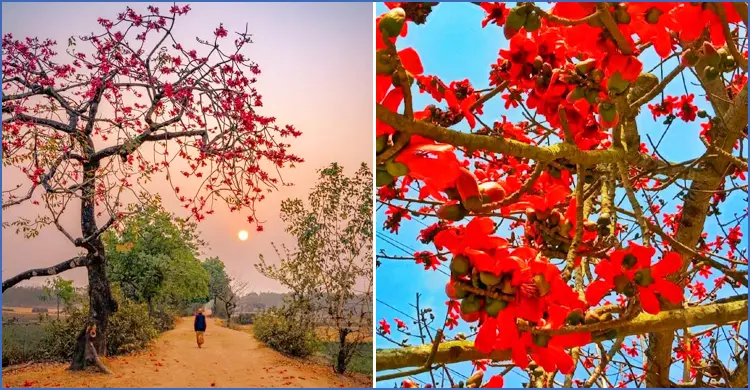
A thousand shimul (silk cotton) trees line both sides of the railway. The crop fields around them are green, a gentle breeze is blowing and the scent of shimul flowers drifts in the air. Here the blossoms are bright red, there yellow, elsewhere orange, as if someone had scattered handfuls of colour all around. The reason for this colour and variety is spring, the king of seasons.
This is how Salap in Sirajganj looks now. The area is alive with the hum of bees and the calls of birds, and the cuckoo's song rides the Falgun breeze. Fresh green leaves are appearing on the trees, and the buds and shimul flowers show that winter has gone and Falgun has arrived.
Every shimul tree on both sides of the line is covered in bright red flowers. The leafless trees, ablaze with blossom, catch everyone's eye, and nature lovers are crowding onto the railway to enjoy the scene.
Susmita Ara, a student of Sirajganj Government College who came to see it, told Jago News: "A few friends and I came from town just to see the mass of shimul flowers. Coming here, I have truly fallen in love with nature."
A tree in decline
The shimul flower colours the rural Bengal landscape with the arrival of spring. But over time the shimul tree, with its dazzling deep red display, is becoming scarce in Sirajganj. Even a decade ago, plenty of shimul trees could be seen around most village homes, along roads and on fallow homesteads in the district's upazilas, and their blossoms were a reminder that spring had come. The shimul tree is also one of the main natural sources of cotton.
Every part of the tree is said to have medicinal value. The leaves fall at the end of winter and the tree flowers at the start of spring. The flowers become fruit, which fills out towards the end of Chaitra and ripens and dries around Baishakh. The fruit bursts open in the wind, and seeds carried far on the cotton grow into new trees. Unlike other trees, nobody plants the shimul for pleasure or tends it; it grows naturally. Almost every part is useful, and its bark, leaves and flowers are a favourite food of livestock.
Today people cut the tree down with or without reason. In the past it was used for packing boxes, brick-kiln fuel and matchsticks, but it was not replanted in proportion, and so the number of shimul trees is falling.
Nazrul Islam, a resident of Sirajganj Sadar upazila, told Jago News: "There used to be lots of shimul trees in the villages. You don't see them like that any more, so the price of shimul cotton has gone up a lot. The main reason is that the fruit bursts and the cotton spreads everywhere. Rural people see the shimul tree as an extra nuisance."
Bablu Kumar Sutradhar, deputy director of the Department of Agricultural Extension (DAE) in Sirajganj, told Jago News: "Shimul trees or shimul cotton are not grown commercially anywhere in the country. The tree grows naturally, which is why it is disappearing."
Source: Jagonews24. First published in Bengali on The Agro News.

Comments
(0)