
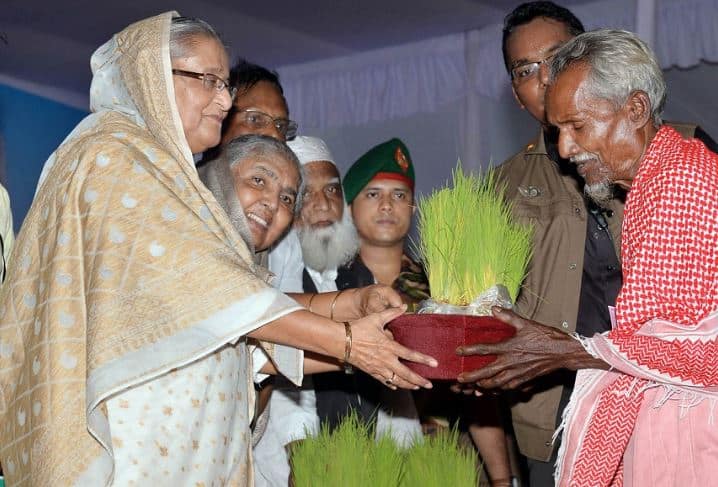
The newly elected government had taken office after a long, uncertain period. On 12 February 2009, a month after the prime minister and cabinet were sworn in, Zillur Rahman was taking the oath as the new president. All the country's leading figures had gathered at Bangabhaban, and after the oath came the reception, with the president and prime minister surrounded by VVIPs. I got past the security and guests to the prime minister and told the president and prime minister that it was the last day of the month of Magh and it was pouring outside. I held the microphone out to the prime minister and reminded her of Khana's popular saying. As soon as she heard "If it rains at the end of Magh", the prime minister recited both lines together: "If it rains at the end of Magh, blessed is the king and blessed the land." The guests in the Darbar Hall turned to listen. I asked Prime Minister Sheikh Hasina, "Nature says the harvest will be good this time. What do you say?" In that grand gathering she laid special emphasis on agricultural prosperity in the country's plans for the future.
A first gift for farmers
I live by a firm belief. On questions of the country's development I see the contribution of agriculture and farmers as the greatest. I believe deeply that the country cannot reach where it wants to go without watering the roots of this sector. If we have a gold mine, it is in agriculture. As the government took office, the first cabinet meeting announced the prime minister's first gift to farmers: a cut in fertiliser prices. The price of triple super phosphate (TSP) was brought down from Tk 90 to Tk 22 a kg and muriate of potash (MoP) from Tk 70 to Tk 15 a kg, a step to raise production through balanced fertiliser use. It was a remarkable prescription for turning the country's huge agricultural potential into real prosperity.
For several years before that I had been showing on television, one after another, the many crises in agriculture: no fertiliser, shortfalls of millions of tonnes of food, farmers deprived, first-hand stories of government subsidy money not reaching them. There were natural disasters, uncertainty and the private sector's long neglect of farming. It seemed to me that the messages I raised on television and in newspapers never escaped Prime Minister Sheikh Hasina. In later conversations I understood that for the seven or eight years before, while she was campaigning in the streets, facing imprisonment and going through extreme political anxiety, she still kept close attention on agriculture. I have no hesitation in saying that during the uncertain time of the caretaker government, whenever policymakers asked my advice on agriculture, I had one message: the country would not be safe without attention to agriculture and farmers, and policymakers had to go and stand beside farmers. I tried, as far as I could from my position, to bring policymakers to the fields, and to stand united with farmers in times of crisis. I am still in that same place.
Conversations with the prime minister
One of the great achievements of my life is that Prime Minister Sheikh Hasina has understood what I believe in and valued it again and again. The first time I met her privately in her office after she took office as prime minister in 2009, she talked at length about my programme. She said that while imprisoned by the 1/11 government she regularly watched my programme on Channel i from her solitary cell. She was especially moved by the boat race on the Ghaghar river in Gopalganj, her ancestral home. She said the traditional race carried memories of Bangabandhu's whole life and of her entire family, and it still shines in her childhood memories: from a stage on the Ghaghar bridge, Bangabandhu used to hand brass pitchers to the winners.
Over more than a decade I have had many chances to talk with Prime Minister Sheikh Hasina one to one, sometimes in long meetings. She has not only focused on putting her philosophy of agriculture into practice through her office; she has shown her own extraordinary love of farming again and again. From common and uncommon fruit, crop and flower plants to germination, pollination and hybridisation, she understands it all. We have talked more than once about her own farming inside Ganabhaban. I have looked for a chance to make a special programme on the prime minister's philosophy and practice of agriculture, but with her many commitments she has not been able to find the time. Still, I dream that the chance will come one day.
I have had the opportunity to make several programmes and documentaries on the agricultural philosophy and measures of the Father of the Nation, Bangabandhu. In bringing out the voices of grassroots farmers on his thinking about rural life, I came across things through which I saw the depth of the family life of a political leader, architect of independence and statesman who rose from Bengal's farming civilisation. I saw a reflection of great affection for grassroots farmers, not only in Bangabandhu but in his parents and earlier generations. Whether we call it an outlook or a philosophy of agriculture, I have found its reflection in the prime minister too.
A coconut tree in Tungipara
Tungipara, Gopalganj. An elderly farmer was crossing a field. I called out and asked whether he had any memory of Bangabandhu. He was overcome with emotion, took my hand and led me towards his house, and recalled a story from his childhood: "One Shab-e-Barat there was no food in the house. I went to Mujib bhai's house and told his mother we had nothing to make shinni for Shab-e-Barat. She scolded me like a mother, 'If you have nothing, what can I do?' Then she gave me some aatap rice and two coconuts. We ate one coconut. The other sprouted, so my mother said to plant it. That coconut tree, more than 60 or 70 years old, still stands in our yard." We saw the coconut tree. Such living memories of the Sheikh family's generosity are in home after home in Tungipara. Prime Minister Sheikh Hasina is a worthy successor of that family, and needless to say she is the skilled craftsman who has put Bangabandhu's philosophy of agriculture into practice. Another member of the family, the prime minister's younger sister Sheikh Rehana, deeply cherishes the traditions of rural Bengal and her own village. I have talked many times with her about rural life and farming. Truly, they keep an eye on every level of life in the country.
From food deficit to surplus
People say many things in many ways; I say it my way, and I believe what I see for myself. Bangabandhu's remarkable philosophy of agriculture is an important part of this government's plans. Let us count from 2009. When the prime minister took office, the country had a food deficit of 2.6 million tonnes. In line with her election manifesto, the 'Charter for Change', and 'Vision 2021', she took many steps: subsidies for farm mechanisation, bank accounts for farmers for Tk 10, more irrigation, more incentives for agriculture and order restored to fertiliser distribution. The problems of our farmers can be seen and understood with a little attention and sincerity. For ages farmers could not get their voices heard by the state's policymakers. When we tried to close that gap, we got Prime Minister Sheikh Hasina's wholehearted cooperation. When global powers advised withdrawing subsidies for agriculture and farmers from the national budget, the government stood firm, showing that farmers' problems cannot be seen from above but must be understood from below, from where farmers stand. That is how the country freed itself from the despair of food shortage. In 2009 food grain production was 33,833,000 tonnes; by the government's current figures it has risen to 45,344,000 tonnes.
Beyond that, Bangladesh has become a marvel to the world's thinkers in recent years. The reason is its approach to the Covid situation. When the Covid-19 pandemic devastated developed countries, Bangladesh was celebrating its graduation from least developed to developing country status. From the start of Covid, the prime minister reached out from the centre across the country, using modern communication technology to keep daily track of the grassroots. With emergency incentive support on one hand and backing for farm production on the other, she took a remarkable position in keeping food in homes. As a result, amid worldwide panic and recession, we stayed upright. Covid took a great deal from us, but it left the greatest lesson: keeping courage in a disaster is the job of leadership. Prime Minister Sheikh Hasina kept that courage, and Bangladesh and its people stayed brave through hers.
Bangladesh's rankings
Today Bangladesh has earned a remarkable place in the world for food production and agricultural success. The country counts its achievements this way: third in the world in rice production, third in vegetables, seventh in mangoes, seventh in potatoes, eighth in guava, fourth in tea, second in jute, third in inland open-water fish and first in hilsa. Bangladesh is third in the world in cereal production. I do not want to make too much of these figures. What I want to emphasise is the capacity, purchasing power, clothing and courage of grassroots people to claim their rights. Seen from there, one must speak of firm leadership and bring out the far-sighted, tireless success of the government and its head.
There is no denying, however, that the whole world faces a food crisis and economic recession, and we are heading for a major shock to food production. It is clear that the prime minister understands this deeply.
More still to do
I want to say that in agrarian Bangladesh there should have been more progress in agriculture than we see. We have not yet reached as far as farmers dream, or as far as Prime Minister Sheikh Hasina herself dreams. Because we have not, the prime minister still firmly puts forward new prescriptions, not only for Bangladesh but for the whole world, to end hunger and poverty and ensure safe food. She gives agricultural research special importance in present and future plans, and she understands deeply farmers' dissatisfaction over fair prices for their produce. In recent years I have attended the prime minister's press conferences after her foreign visits and asked her directly about many farming issues. However deep the question, I have seen that her attention, understanding or thinking is already there. I am repeatedly heartened: if a problem is in the head of government's sight, the way to solve it must be in her mind too. Recently, at another of her press conferences, the prime minister spoke of farming in the yards of people housed under the Ashrayan project. The Ashrayan project is a remarkable, innovative initiative: by bringing homeless grassroots people into secure lives and livelihoods, the country is moving towards its sustainable development goals.
Because I work on agriculture, I judge everything through it. The prime minister always keeps close watch on the country's agricultural development. I sometimes talk about these matters with Agriculture Minister Dr Abdur Razzaque, and I have learned from him that whenever any proposal on the country's agriculture and food security goes before the prime minister, she considers it with the utmost importance.
Rooftop farming and a lesson from the soil
I am moved again and again to see the prime minister pay sincere attention to the issues raised in my programmes. After the Mati O Manush programme on Bangladesh Television in the 1990s, and in recent years on Channel i with Hridoye Mati O Manush, once we started rooftop farming, the prime minister spoke about rooftop and urban farming in many places. During the pandemic she advised people confined at home to take up rooftop farming, and earlier, having seen arrangements for practical farm education for urban students, she urged students and people of various professions to go to villages and practise farming. And she made me grateful for life by saying, "We also learn a lot from your programme." I would say only a true leader educated by the soil can say such a thing.
My heartfelt good wishes to the prime minister on her birthday, with respectful greetings.
Source: Shykh Seraj. First published in Bengali on The Agro News.

Comments
(0)