
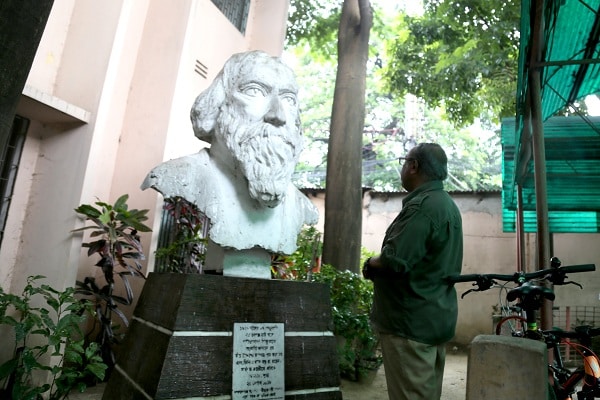
What we are thinking today, Rabindranath thought a hundred years ago. Coming close to each of his ideas, it feels as though he can see our age clearly too, as if even then he could see the times of the 21st century. Only the other day I went to film rooftop farming. Over the past several years rooftop farming has spread widely. It is good to see people in towns and cities farming not only on the roofs of their homes but in many other places, and rooftop farming is spreading to the roofs of government and private offices and schools.
At Narayanganj High School, the school's mathematics and science teacher Srikanta Chandra Nandi has set up a rooftop garden. While working there I learned that the school holds a memory to be very proud of: Rabindranath Tagore came here. Not only that, he gave a speech at the school, and the speech has been collected and kept there. Learning this lifted my spirits. An institution touched by Rabindranath Tagore surely has its own light, and now there is this green enterprise on its roof. Had Rabindranath seen it, he would surely have spoken positively of how essential it is.
The speech on the library wall
Headmaster Kamalkanti took me to the school library, where Rabindranath's short speech hangs in large print. I felt that any young student who reads and absorbs this speech can take a step forward in life through it. After seeing it I could not look anywhere else and read it in one breath. I want to quote part of it here.
"I entered East Bengal through the gateway of Narayanganj, and on my way back I have come here again. Wherever I went in East Bengal I said what I had to say, but I do not believe that saying things bears fruit. We must try to solve the many problems of our country through work. In the schools of Bengal, a job was the aim of education; people went to school and college to educate themselves in order to get jobs. Fortunately the road to jobs has narrowed, so educated young men have tried to earn a living by independent means. There has also been a change in the work of politics. There was a time when people thought they could get their work done by giving speeches, and out of old habit they still do so. But today's youth look to real, practical work. May they make lasting the enthusiasm that has come with the present movement. Many boys from East Bengal study at Santiniketan, and I have seen in them firmness of character, single-mindedness and respect. Travelling through East Bengal I saw that this is a good place to find workers. Whatever work the boys here are put to, they will succeed through their dedication and devotion. If I were still young, I would not be giving speeches here but would set to work with my own hands. Like the fertile soil here, the energy and eagerness of the people are strong. But today I have neither the age nor the health. My field of work lies at one edge of West Bengal, where the soil is not fertile and the people are rather indifferent. If people in this part of East Bengal start their work in suitable surroundings, they will succeed very easily. Political leaders give very good speeches in towns far from the villages; no good can be done for the villages this way. Rural development in East Bengal is undoubtedly possible."
The speech has a few more lines, but in this much he says a great deal. I was amazed anew by his practical philosophy and his searching outlook. I have always liked to learn about and see Rabindranath's development-minded side. That is why I have visited the major places in Bangladesh associated with him, and seen the work at Santiniketan and his dream project, Sriniketan. I even went to Dartington Hall in Devon, England, to understand the ideas of Rabindranath the developer. The further I went, the more amazed I was. The Rabindranath we know as poet, songwriter and playwright had such powerful ideas on development and cooperatives and did such powerful work to change the lives of ordinary people.
A message for young entrepreneurs
What Rabindranath wanted to say to the young then still applies today. In the thinking of the developed world today, entrepreneurship, or one's own initiative, is valued above all. Rabindranath also said at the time that a university is not only a place for acquiring knowledge but a place for new innovation.
The philosophy he set out a hundred years ago, of becoming an entrepreneur instead of chasing a job, is being put into practice by today's young people. I am most hopeful when I see the new ventures of the young generation succeeding across the country in agriculture, technology and production. Today the brightest light of promise in the country has been lit by our young agricultural entrepreneurs, who after formal education have not gone chasing jobs but have set remarkable examples of success with farm ventures. Thousands of young people like Atik of Natore, Abu Bakar Siddique Prince of Fulbaria in Mymensingh, Saifullah Gazi of Satkhira, Moniruzzaman Monir of Rajshahi, Kobbat Hossain Ovi and Razia Sultana of Savar, and Shahinur Rahman of Kushtia are now lighting up the country's prosperity and promise. Rabindranath saw greater promise in the youth of East Bengal even then, and understood deeply that, like the fertile soil of East Bengal, its young people too could yield gold.
From Shilaidaha to Dartington
I have tried to see for myself Rabindranath's work on agriculture, development and cooperatives. The testing grounds for his ideas on agriculture, the environment, society and human development were Shilaidaha in Kushtia, Shahzadpur in Sirajganj and Patisar in Naogaon. The place where they were put into practice was Sriniketan, next to Santiniketan at Bolpur in West Bengal, where he presented a model of village life. His partner in this work was his personal assistant, the agricultural economist Leonard Elmhirst. Many traces of Rabindranath's efforts remain there, but his ideas did not come to life in the form he imagined. Rabindranath was more hopeful about East Bengal, thought its young people more hard-working, and reckoned that a seed planted here would surely grow into a fruitful tree. That is what he set out in his speech when he came to Narayanganj High School on 27 February 1926.
Rabindranath made no lack of effort in his life. He wanted a revolution in a production-oriented way of life to begin across the world at that time. But even then circumstances were moving towards commerce, towards jobs and towards a process in which a limited number of people in society enjoyed everything. In search of Rabindranath's development work, I went to Dartington Hall in Devon, England. Elmhirst had been in charge of Rabindranath's Sriniketan project at Santiniketan. When he finished his work at Sriniketan and returned home, he built Dartington Hall on the vast estate of his wife Dorothy to put Rabindranath's development ideas to work. While farming came first in the ventures in Bengal, Dartington Hall focused on education, human values and environmental development. As a living centre of Rabindranath's memory, Dartington Hall still inspires people, and events that awaken the strength of youth are still held there at various times of the year, as Rabindranath directed many years ago.
How the speech was found
Seeing this link between Narayanganj High School and Rabindranath and reading the speech moved me deeply. I learned that the speech had been collected by Rafiur Rabbi, father of Twaki, the cultured teenager killed by criminals in Narayanganj. I went to his home to learn more.
He said the address of welcome presented to the poet at his reception in Narayanganj and the full text of the poet's speech appear in Bhuiyan Iqbal's book "Bangladeshe Rabindra Sambardhana", published by Bangla Academy, and that he collected the speech from there. The book says the poet reached Narayanganj at about 9am on 27 February 1926. A local student organisation welcomed him and his party at the steamer ghat, and the students then brought him in procession to Narayanganj High School, where a reception meeting was arranged in the school grounds. Rabindranath's biographer Prabhat Kumar Mukhopadhyay describes it in detail in "Rabindra Barshapanji".
The poet Dinesh Das wrote: "Your footprints are laid everywhere." Development experts say Rabindranath is a vast answer to every crisis of civilisation. Those doing most to realise the promising path he foresaw for Bangladesh are our young people who love farming and take the initiative. For those who still treat a job as the mission of their lives and have left life stuck at a helpless level, Rabindranath still stands before them with a practical prescription.
Source: Shykh Seraj. First published in Bengali on The Agro News.

Comments
(0)