
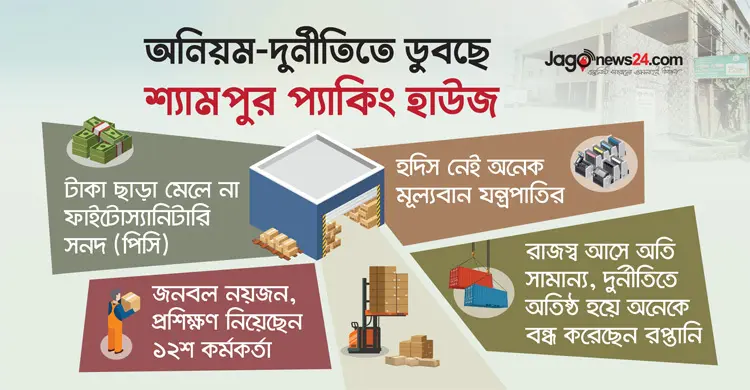
Any farm produce exported to European countries must be packed at the Central Packing House at Shyampur in Old Dhaka. The government's only packing house is vital for exporters: without its phytosanitary certificate (PC), goods cannot be shipped. Exporters say they are harassed by irregularities and graft at every step of packing, that gifts to officials and staff are pushing up export prices, and that many have given up and wound down their business in Europe.
Exporters say bribes must be paid at every step to get certificates at Shyampur. As a result, packing costs have risen so much that they cannot compete with rival countries in the European market, and many have been forced to stop exporting there. This has affected the country's overall exports over the past few years, and farm produce exports are on a downward trend.
Jagonews visited the packing house several times and spoke to officials and affected exporters. It found that, besides a set bribe on every consignment, money is extracted from exporters by holding their goods hostage on the pretext of poor quality. There have even been cases of goods being held back just before a cargo flight until illegal payments were made.
Exporters are also forced to buy various supplies for the packing house, the salaries of several contract workers are collected from the exporters' association, and export goods are taken as gifts; such irregularities are routine there.
Hundreds of crores spent on projects
The packing house has also been the scene of a festival of wasted public money. Hundreds of crores of taka have been taken through two rounds of modernisation projects since it opened. Most of the 70 pieces of equipment of 45 types bought under the first project, the "Bangladesh Phytosanitary Strengthening Project", cannot be traced. A few machines remain, still in their packaging; although several years have passed since the project ended, the packages have not been opened, and most of the equipment has deteriorated from lying idle. More than Tk 60 crore was shown as spent on buying them.
The first project, worth Tk 189 crore in total, was to set up a farm produce testing laboratory at the packing house. Today nothing of that lab can be found on the third floor except its four walls. Even so, a new Tk 153 crore project has been taken up to modernise that non-existent lab, buy more equipment, build ten separate laboratories and train officials to run them. The project, "Conversion of the Plant Quarantine Laboratory into an International Standard Laboratory", was initiated by the Ministry of Agriculture, is fully government-funded and is being implemented by the Department of Agricultural Extension (DAE).
The project began in October 2021 and is due to run until October 2024. In two years, progress has gone no further than stripping the ordinary plaster from the old lab's floor and walls and applying epoxy resin plaster, along with initial work to air-condition the whole building. The project director has already been changed once, and the new director has moved to extend the project by another year because he cannot finish on time; costs are also likely to rise.
The "cooling house" is now a dormitory
On a visit to the packing house, the reporter found that vegetables and fruit for export to any European country must regularly be tested for contamination including salmonella, pesticide residues and viral, bacterial or fungal infection, along with various MRL tests. With no lab, this is not being done. None of the four cooling rooms built at a cost of crores of taka is working properly. A temporary repair of one has been started, and two others are closed. In the remaining cooling room the reporter found something strange: people sleep there. Staff have long been using it as their living quarters, cooking three meals a day there, with a stove and some bits of furniture.
Three high-quality freezers are broken and locked. The rooms for sorting, grading and packing produce are in a poor state: no air-conditioning works in any of them, the rooms are dirty and damp, and rubbish is piled up.
Produce must be washed in hot water to disinfect it, but hot water does not reach that room either. A few tables and some broken trolleys seem to be all the packing house has.
On the ground and first floors of the three-storey building there are separate rooms for checking and sorting the quality of vegetables and fruit, cleaning, washing, drying and packing. But apart from three or four workers, no one was there.
The officers' rooms on one side of the first floor were also empty. On the third floor, the large air-conditioned training room for exporters, the meeting room and the luxurious room for foreign importers were all deserted. On the other side, floor plastering for the lab was under way.
S M Khalid Saifullah, the deputy director appointed by the DAE to run the packing house, told Jagonews that because cargo flights leave at night, exporters usually come in the afternoon, and processing goes on from evening through the night.
The reporter went back the following Sunday evening. That day only one exporter, Bhuiyan Corporation, was packing goods, in a single ground-floor room. Its workers were packing some guavas and palm fruit for Europe. As on other days the other rooms were empty, though two officials were seen on the first floor. Asked where the other officials were and why packing was so slow, additional deputy director Sajib Mukharji said it was not the season for sending goods to Europe, so there was little work and everyone was here and there.
Nine staff, but more than a thousand trained
The Shyampur packing house now has a total staff of only nine: five civil service officers, two attached officers and two working there on transfer. None of them is trained.
Yet 1,250 officials were trained at home and 90 abroad (in India and Singapore) with money from the first project to run this packing house.
Asked where they are now, the deputy director said some were at Khamarbari (the DAE) and some had been transferred elsewhere. "Actually I don't know exactly who was trained for this place. But none of us here now is trained," he said.
The Ministry of Agriculture said the DAE holds a list of the trained staff, and that they are now running quarantine labs at various ports around the country.
Under the current project, the ministry has been asked for 50 more officials through outsourcing to run the renovated lab. A new proposal for 133 posts is also with the Ministry of Public Administration. If they are appointed, they too will take part in various training at home and abroad under the new project, and the government's extravagance will go on, the report says.
Locked rooms, no trace of the old equipment
Seventy expensive pieces of equipment were bought for the packing house under the first phytosanitary project. Because the lab was never fully set up during that project, they were not used. The authorities now say the equipment is locked in two rooms on the third floor. But no one actually knows what is in those rooms; the reporter was not shown any of the equipment, and the room is said never to be opened.
The equipment is supposed to be reused in the current project, yet the project director does not know what is there. Shamim Ahmed, director of the international standard laboratory conversion project, told Jagonews: "The equipment is there, locked in two rooms on the third floor. The air-conditioning inside is kept running round the clock. It will be set up again. But I don't know whether it is 70 pieces. I don't know what is there."
Asked the same question, deputy director Khalid Saifullah said: "When the lab was demolished, they put it in the storeroom. Some of it that is functional will be used. There is probably a list of the equipment. I don't know."
"I joined here six months ago. No one handed the equipment over to me. The storekeeper's post here is vacant. Perhaps someone took charge of it at the time. So I have no clear idea about the equipment. And why would I touch it? I have no expertise," he said.
One of the three directors of the "Bangladesh Phytosanitary Strengthening" project that bought the equipment has died. The other two have retired and did not want to speak to Jagonews.
Several former officials of the packing house said the supplier delivered the equipment in 2019 and it has been lying there for nearly five years. Without checking, there is no way to say whether any of the machinery has broken down. More advanced equipment has also come out since then, so how acceptable the old equipment will be for accreditation of the new lab is a big question.
Because there has been no lab here despite various initiatives over the past six years, exporters are suffering. They now have to get tests done at private laboratories and pay high fees. They can export only after leaving their goods at the central packing house, testing them at a lab and bringing back the report. The extra time harms the quality of the produce, and in many cases the quality of the testing is also open to question. Depending on the product, hot water treatment and other technologies must be used; all of these are supposed to be at the lab, but in reality they are not.
Exporters say this is putting them well behind in world markets and causing them trouble at home too.
At least Tk 4,000 in bribes for a Tk 250 certificate
The government has set a total fee of 25 paisa per kilogram for the certificate after produce is processed at the Shyampur packing house. That means an exporter should pay Tk 250 for a one-tonne consignment, more for larger shipments and less for smaller ones. But three exporters told Jagonews they must pay a bribe of at least Tk 4,000 on every consignment, and more on larger ones; otherwise the phytosanitary certificate (PC) is held up.
The head of one exporting firm, speaking on condition of anonymity, said: "Bring goods to Shyampur for export and you'll understand how much it takes. You have to pay at least Tk 4,000 in bribes per shipment. Without money the goods won't go to Europe; the PC will be blocked. For a big shipment they (the packing house officials) take even more."
"Apart from that money there are many other costs. If a quarantine certificate is needed, that costs extra. And once we bring the goods here we have to bear all the costs. Without money the goods don't move off the truck or get loaded. What do they (the officials) care if our goods don't go? We are forced to pay," he said.
Khalid Saifullah, the official running the packing house, denied this. He told Jagonews: "I don't know about the past. Since I came, I have told exporters to complain to me if anyone asks for money. I am here every day, and there is no problem here. I have not heard of any such thing."
The same exporter, however, alleged that this deputy director receives a share of Tk 1,500 from the bribe on every consignment.
Exporters pay for supplies and staff salaries
Large quantities of mangoes were exported to Europe last fruit season. The agriculture secretary inaugurated the exports at the Shyampur packing house, and at that time up to 58 consignments of fruit went abroad in a single day.
But load-shedding rose across the country then. The packing house had a backup power system, but it was out of order. Exporters were then held hostage and made to buy a generator for the packing house and IPS units for the officials' rooms.
This is nothing new. Whatever breaks at this government facility, from lights and fans to water taps or brooms, the exporters must repair or replace it. The authorities do not, and the exporters do so because they need to export.
The Bangladesh Fruits, Vegetables and Allied Products Exporters' Association (BFVAPEA), the association of vegetable, fruit and fresh produce exporters, has a coordination committee with the packing house to look after exporters' facilities there. BFVAPEA senior vice-president Mobashwer Rahman Jewel is the committee's convener, and he bought an IPS for the packing house during that load-shedding. "Last season I gave an IPS," Jewel said.
Asked about facilities at the packing house, he said: "Exporters constantly complain about this packing house. It is hot there and the air-conditioning doesn't work. With workers sweating, packing is not hygienic. They provide hardly any facilities."
The BFVAPEA senior vice-president said the association also has to pay the salaries of four cleaners there, and exporters must pay the salaries of the representatives coordinating contract farming in various areas. "We have had to form a sub-committee to raise this money. At the end of the day all the costs fall on the exporters, which raises the price of export goods," he said.
"We told the agriculture secretary all this just a day ago, but there has been no solution," Jewel said.
A leading exporter quits Europe
Ferdousi Begum, managing director (MD) of Ferdous Biotech Limited, is one of the country's leading exporters of farm produce and president of the potato exporters' association. She said she has turned away from exporting to Europe because of irregularities and graft at the Shyampur packing house.
She told Jagonews that her truck of goods was once held up shortly before shipment and illegal money demanded. She faced such complications at every step when she packed goods there, and the extra cost of illegal payments weakened her company in the European market.
"I have left the European market because of the crookedness at that packing house. To export to Europe, their certificate is mandatory, and for that you have to pay money at every step. Whatever the goods, if you pay there you can clear everything; otherwise not," Ferdousi Begum told Jagonews.
Describing her experience, she said: "Shipments go at dawn. All night they torment our company's staff working there for money. One day I was asleep when my manager phoned before dawn to say the authorities would not release the truck without Tk 6,000. I had to arrange the money then."
"And they won't give quarantine clearance without money. Why should I go there? It is better to send goods to other countries. The packing house isn't fit to show any European buyer. There is nothing there now. All the machinery has vanished. It is just a waste of government money," she said.
Negligible revenue, only 4,500 tonnes packed
The facility that is cutting so deep into exporters' pockets brings the government little. With exporters turning away, the government earns only Tk 18 to 20 lakh a year in revenue from the packing house, about the same as its annual electricity bill.
Meanwhile the volume of vegetables and fruit packed keeps falling. Data show that 5,112 tonnes of farm produce (fruit and vegetables) were exported through the house in the 2020-21 fiscal year, falling to 4,569 tonnes in 2021-22. In the last fiscal year, 2022-23, it stayed at close to 4,500 tonnes.
Ministry promises action
Jagonews spoke to agriculture secretary Wahida Akter about the irregularities and graft at the Shyampur packing house. She said: "Officials are being told again and again, warned and instructed, yet what is or isn't happening often does not come to light. We send hand-picked officials there. Even so, I will find out whether these things are happening."
The secretary advised speaking to Rabindrashree Barua, additional secretary of the ministry's extension wing. Rabindrashree Barua told Jagonews: "Steps have been taken through the new project to fix the cooling centre. In terms of cleanliness, the environment is better than before; that is, it used to be even worse."
On the old project's equipment and the training of staff, she said: "When the new lab opens, the old equipment will be used. There is a database of those who were trained under that project; they have been transferred and are working in other quarantine labs. The training will not go to waste. They are still working."
On extra money being collected for certificates, Rabindrashree Barua said: "This is very unfortunate. We will look into it. No one will be above the law. We will work on this from now on. I also call on exporters to give us information."
"If we get a complaint against anyone specific, we will act quickly. Punitive action will be taken," she said.
Source: Jagonews24. First published in Bengali on The Agro News.


Comments
(0)