
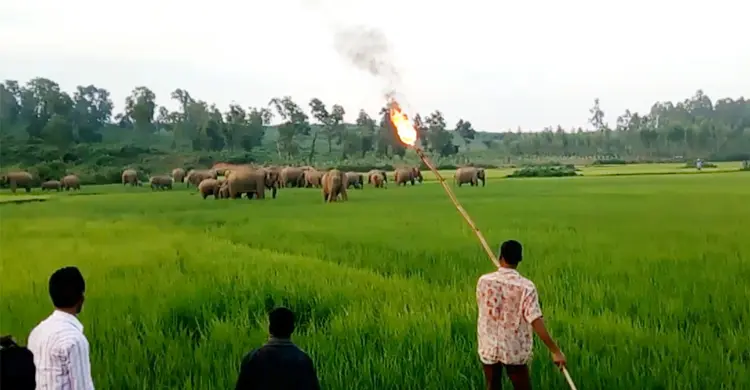
The conflict between elephants and people on the Sherpur border shows no sign of ending. With no permanent step taken in a decade and a half, wild elephants are being killed and people are dying in attacks. Experts say the conflict cannot be stopped because homes have been built where wild animals roam.
According to the forest department, about 28 elephants have died in attacks by local people in 15 years, while more than 50 people have been killed by elephants. Solar fencing, searchlights and generators have not solved the problem of elephants entering villages.
Fences and fire fail
Wild elephants have recently begun rampaging on the border again. They are seen in the Garo hills every winter, and herds come down into villages in search of food during the paddy seasons, including boro. Fear grows in the border villages, where people spend sleepless nights guarding their lives and property. Beating drums, bursting crackers and lighting torches have not stopped them.
Meanwhile the country's first electric fence, built in Nalitabari and Jhenaigati upazilas at a cost of crores of taka in government money, lies out of order. Money has been wasted, and hill people get no benefit.
Anyone might be surprised to see signboards beside the paved road in the Garo hills marking an elephant crossing. Herds use this route to enter villages in the aman and boro seasons. As settlements have grown in the hills over time, conflict with the elephants has increased.
Desperate to protect crops, lives and property, and with the government's pilot solar fencing, searchlights and generators failing, local people are electrifying areas, lighting torches, throwing burning missiles and setting elephants on fire. Accidents are rising and elephants are dying, and the herds, frightened and angry, are also harming people.
Last year, after two elephants died within ten days, the forest department and local administration took a tough stand, and several environmental groups formed human chains demanding an investigation and punishment.
For the first time on the Sherpur border, the forest department has filed a case against four people over killing an elephant. The forest department is now paying compensation of Tk 3 lakh to the family of someone killed by a wild elephant, Tk 1 lakh to the injured and Tk 50,000 for crop damage. But locals fear delays in getting it.
Voices from the border
Ripon Koch of Chhoto Gazni said elephants start coming as soon as the paddy in the hills ripens. They used to stay two or three days; now they stay in the villages for one and a half to two weeks, destroying crops and vegetables.
Chhamir Mia of Nakugaon in Nalitabari upazila said: "It has come to the point where we have to stay awake at night guarding the paddy fields from elephants. Otherwise, once an elephant gets into the field, all the paddy is ruined. Every farmer on the border is in the same state."
Meraj Uddin, convener of the environmental group Sabuj Andolon, said people on the Sherpur border have long lived in the space of forests and wildlife. "We are being attacked by elephants because we have blocked their paths." A joint effort by the forest department, local administration and local people was urgently needed to end the conflict.
Officials' response
Upazila agriculture officer Alamgir Kabir said the conflict in the area is long-standing, with wild elephants damaging houses and fields in the hills. The upazila agriculture department is giving affected people incentives and support, has sent lists of affected farmers to senior officials, and is monitoring affected areas and advising farmers on protecting crops.
Jhenaigati upazila nirbahi officer Faruk Al Masud said they were working on the conflict under the district administration's direction. In response to border residents' demands, the local administration had taken various steps, installing solar fencing and giving searchlights to border farmers.
Mollah Rezaul Karim, chief conservator of forests of the forest department's Wildlife and Nature Conservation Circle, Dhaka, said local people as well as the government must come forward to protect wildlife rather than building settlements where animals roam. The department was holding consultation meetings and seminars with local people.
Local people are calling for thorny trees to be planted, elephant response teams and electric fencing, among other measures, to keep elephants out of villages.
Source: Jagonews24. First published in Bengali on The Agro News.

Comments
(0)