
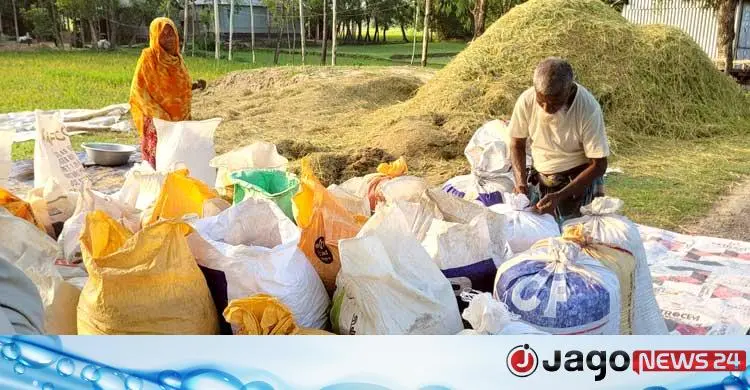
Paddy harvesting and threshing are in full swing in the border district of Sherpur, but the golden crop has brought little cheer. Marginal farmers who cannot get a fair price for their paddy are at a loss; in many places they are struggling to pay the harvest labourers, let alone recover what it cost to grow the crop.
Continuous rain, a shortage of harvesting and threshing machines during the fuel oil crisis, the damming of low-lying drainage channels for fishing and land grabbing, and steep labour wages have left boro growers squeezed from every side.
Farmers say paddy is selling at Tk 850 to Tk 900 a maund. Because of a syndicate, farmers in outlying areas cannot sell paddy and rice to the government at the fixed price; instead, political leaders and large wholesalers supply the government. In many cases farmers are not even covering their production costs.
Two extra kilograms on every maund
Almost half of Sherpur's annual rice output comes from the boro crop, whose season runs from December to April. The government has already begun procuring boro paddy to ease the crisis, but farmers had started selling to mill owners and traders at low prices before that, and they must hand over two kilograms extra on every maund.
Zahed Ali of Naokunchi village in Kangsha union, Jhenaigati upazila, said the paddy market at Jhenaigati Sadar Bazar is the biggest in the area. "When we sell there we have to give two kilograms more per maund. On 10 maunds, half a maund is gone."
Farmer Shahijal Islam, standing beside him, said: "When we sell, they count 42 kg as a maund. All the wholesalers buy the same way, and we lose a lot."
Monowara Begum of the same village said angrily: "When we buy paddy they weigh out exactly 40 kg, but when we sell we have to give one and a half to two kilograms more per maund. The books say 40 kg is a maund; here a maund is 42 kg. There is nobody to look out for us."
Shut out of government godowns
The government is buying paddy at Tk 36 a kg, or Tk 1,440 a maund, but farmers complain that they cannot sell at that rate.
Rubel Mia, a farmer of Joginibagh village in Char Sherpur union, Sherpur Sadar upazila, said: "My grandfather was a union parishad member here for nearly 30 years. Many paddy growers came to him about selling to the government godown, but nothing was ever resolved. I have tried many times myself; it is not possible to sell there without a third party."
Mezbaul Islam, a farmer of neighbouring Joginimura, said: "We used to grow paddy on about 10 acres, but we could never sell at the government rate. When we take paddy there, the godown staff ask all sorts of questions and want papers. But those involved in the syndicate, who are not farmers, need nothing. Out of anger I have put all my land under bananas."
Mahfuz Mia, a farmer of Kharia Kazir Char in Sreebardi upazila, said: "The government is buying paddy at Tk 1,400 and we are selling at the market for Tk 700 to Tk 800. They do not take our paddy into the godown; the brokers' paddy goes there. People who have never worked in a field and sit in air-conditioned rooms are the big farmers to the godown staff!"
Wages and costs up
Farmers say even a maund of paddy no longer pays for one labourer, whose daily wage is Tk 1,000 to Tk 1,100.
Almas Ali, a boro farmer in Chandrakona union of Nakla upazila, said falling prices mean heavy losses. "The cost of ploughing, irrigation and pesticide has all gone up. I am worried about how I will repay shop credit and loans. A labourer now costs Tk 1,000 to Tk 1,100."
Boro growers in the district say production costs are up 20 per cent on last year because of higher prices for fertiliser, diesel and pesticide and higher wages, bringing the cost of producing a maund to more than Tk 1,100. Yet they are having to sell at Tk 600 to Tk 700 a maund, and are counting losses.
Jhenaigati Upazila Nirbahi Officer Al Amin said he had heard that two kilograms extra per maund were being taken at the market. "We will go to the market and take action quickly. No injustice to our farmer brothers will be tolerated in any way. They are the pride of the country."
Solaiman Ahmed, Sherpur district president of the Bangladesh Krishak Samity, said the government buys paddy and rice for two reasons: to build the stocks it needs, and to make sure farmers get a price. "But because of a flaw in how the purchase timing is set, farmers have been cheated year after year. A syndicate sells paddy and rice to the government godowns in place of farmers, and this syndicate is very powerful while the administration looks on. So the government's second aim is not achieved."
He said farmers are cheated at the market on one side and cannot sell to the government on the other. They cannot buy fertiliser at the government rate either; getting a Tk 1,050 bag for less than Tk 1,500 is like winning a war. Irrigation disrupted by the diesel shortage has cut yields. "All in all, Sherpur's farmers are under pressure from four sides," he said.
Source: Jagonews24. First published in Bengali on The Agro News.
Comments
(0)