
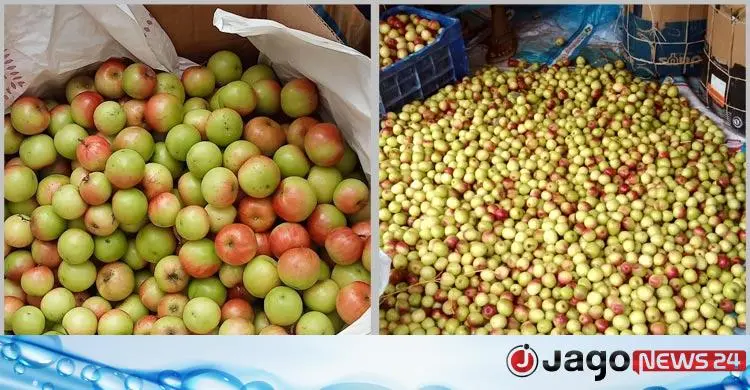
As winter sets in, Beltala Bazar in Sharsha, Jashore, has taken on a festive air. From foggy morning to evening, the market is filled with the scent of fresh kul (jujube plum) and brisk trading. Centred on the seasonal fruit, the market has become one of the most important fruit markets in the southern region.
Local sources say kul farming was once limited in Sharsha's fields but is now one of the main drivers of the farm economy. Commercial kul orchards have grown up across wide areas of Sharsha and neighbouring Kalaroa upazila in Satkhira. Because it is profitable, new farmers take it up every year, with a positive effect on Beltala Bazar.
Fair weights, good prices
Local kul farmer Aksed Ali said he has grown kul on two bighas this season. "Although the yield is a little lower than last year, we are getting good prices in the market. The big advantage of Beltala Bazar is that correct weight is ensured here, with no cheating, so we farmers get a fair profit," he said.
Various kul varieties reach the market every day, including Ball Sundari, Thai, China, apple and sour kul. Prices vary by variety, but all types sell quickly. Traders say kul is sent from here every day to Dhaka and other divisional cities because of strong demand in big cities.
Fruit trader Mujahid, who comes from Jhenaidah, said he has been in the fruit business for about 17 years and comes to Beltala Bazar every winter. "This year yields are lower in some areas, but demand is high, so prices are good. Even buying at relatively high prices, you can make a good profit in other markets," he said.
Local commission agents (aratdars) Salauddin Mukul, Minarul, Kamal and Abdur Razzak said demand and sales of kul have both risen compared with last year. "Kul is sold at fair prices and correct weight in our market. Trading runs non-stop every day from 12 noon to 7pm. With prices good, both farmers and traders are satisfied," they said.
Hopes of a kul market like the mango markets
Kamruzzaman Munna, general secretary of the Beltala Bazar fruit traders' association, said the market has great potential around kul, and farmers and traders need the administration's cooperation to do business smoothly. With kul farming growing as it is, Beltala Bazar could in future become known as a kul market in the southern region, just as there are mango markets, he said.
Sharsha upazila agriculture officer Dipak Kumar Saha said kul has been grown on about 138 hectares in the upazila this season, mostly Ball Sundari, Thai, apple, China, narkeli (coconut) and sour kul. With good yields and market prices, farmers have profited, and if this continues kul farming will expand further next season, he said.
He said that at this time of winter Beltala Bazar is not just a fruit market but a bright picture of Sharsha upazila's economic potential. The commercial activity built around kul is bringing new hope to the rural economy, and kul from the fields is now a reason for Sharsha to smile as it meets the country's demand.
Source: Jagonews24. First published in Bengali on The Agro News.

Comments
(0)