
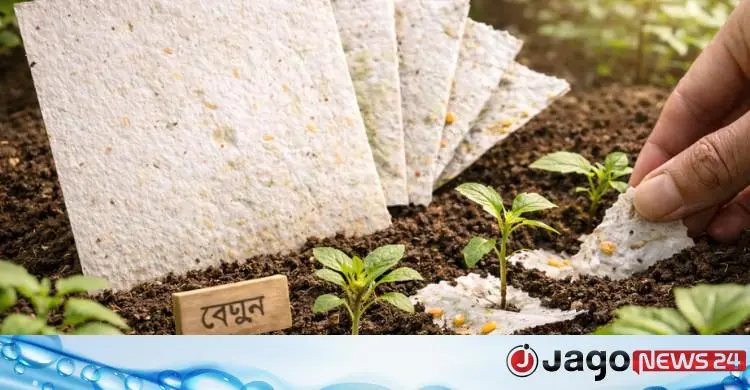
Surprised to hear that plants can grow from a leaflet? It is not nonsense. You may already know about pens and calendars made from seed paper: paper that, when made into a pen and put in the soil after use, grows into a plant. That is the paper in question, known as bon-kagoj or seed paper.
This time a novel, eco-friendly initiative has joined Bangladesh's election campaign. BNP chairman Tarique Rahman and several other top party leaders and candidates are using leaflets made of this special seeded paper in their campaigns, which can turn into vegetable seedlings once they fall on soil.
BNP leaders say the main aim is not only to deliver an election message but to raise awareness about protecting the environment and the importance of greening. If campaign paper falling on the ground grows into plants instead of going to waste, it will be a practical example of "zero waste" thinking.
This is not a completely new invention. Seed paper and seed posters are becoming popular in many countries in the interest of the environment. In Japan, the United States, the United Kingdom, Australia, India, Spain, the Netherlands, Canada and South Africa, seed paper is used in elections and in various social and awareness campaigns.
How seed paper is made
The whole process of making seed paper is itself eco-friendly. It is made mainly from waste or used paper. First the paper is torn into small pieces and soaked in water for about 42 hours until it breaks down completely. The pulp is then placed in a set frame. Next, seeds are added to the pulp by a special method so that they remain viable after the paper dries. Finally the paper is dried and shaped into leaflets or posters.
How the plants grow
Seed paper is paper with seeds of various vegetables or herbs embedded in it. If the leaflet, whole or torn into small pieces, is buried in or dropped on soil with enough moisture, the seeds start to germinate within 8 to 10 days.
If the soil is dry, the paper should be laid on the soil and lightly sprinkled with water. In the right conditions, seedlings from seed paper grow into plants in the normal way. The paper remains viable for up to a year, meaning that if it is put in soil within a year, there is a chance of plants growing from it.
Which seeds are used
Seed paper is usually made with herb and fruit seeds, but seeds of five local vegetables are being used for this election: brinjal, tomato, chilli, red amaranth and stem amaranth. These grow easily and need relatively little care at home. So if you get a leaflet, plant it in a pot on the balcony; you will have vegetable seedlings in a few days and vegetables after about a month.
These eco-friendly leaflets cost somewhat more to make than ordinary paper, at about Tk 8 per seed-paper leaflet. According to the makers, the cost is reasonable given the environmental benefits. Environmentalists see initiatives like this as a positive example on the road to reducing pollution and reaching a "zero waste" goal.
Source: Jagonews24. First published in Bengali on The Agro News.

Comments
(0)