
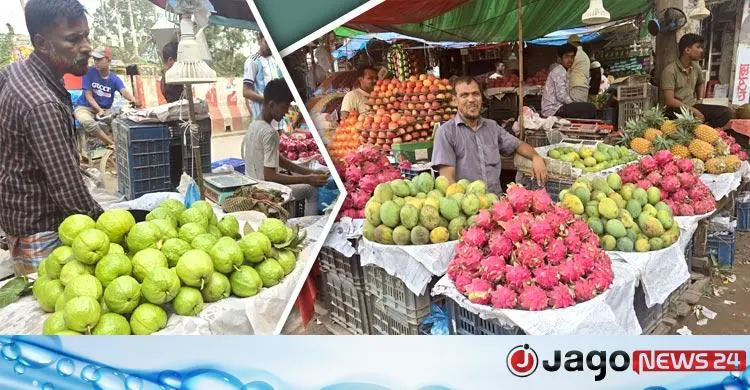
Orchards of local jackfruit, jujube and other native fruits are no longer seen as they once were in the villages of Savar and Dhamrai upazilas near Dhaka. A few years ago the roads of the two upazilas were filled with the scent of local jackfruit every season; now there are orchards of Vietnamese year-round jackfruit, Thai guava, dragon fruit and other foreign or hybrid fruits.
Farmers are turning to these fruits in the hope of higher yields, year-round production and bigger profits. But agricultural scientists and environmentalists believe this shift could affect the country's fruit diversity and food security in the long term.
Visits to Shimulia, Ashulia, Dhamsona and Pathalia in Savar and Kulla, Sutipara, Nannar and Roail unions in Dhamrai found that the number of dragon fruit, Thai guava and year-round jackfruit orchards has risen significantly in recent years. Local farmers say demand and market prices for these fruits are higher than for local ones.
Farmers follow the money
Farmer Motahar Hossain told Jagonews24: "Local jackfruit fruits once a year, but year-round jackfruit is available almost all year, and the price is good. So I have turned to the new variety."
Thai guava grower Habibur Rahman said the same: "The income from one bigha of Thai guava is hard to get from local fruit. That is why many people are now planting orchards of new fruit varieties."
While there are economic reasons for this trend, experts say many of the country's local fruit varieties could gradually disappear as a result.
Bangladesh once had countless local varieties of jackfruit alone in different regions, and great diversity in pineapple, jujube, black plum, banana, sapodilla and other fruits. But as cultivation of a few commercially profitable varieties grows, many local varieties are now at risk of extinction.
A genetic resource at risk
Dr Muhammad Zillur, senior scientific officer in the fruit division of the Bangladesh Agricultural Research Institute (BARI), said: "The country's fruit diversity is an important agricultural asset. Local varieties matter not only for taste but for their disease resistance, adaptation to the environment and genetic traits."
"Local fruit varieties are part of our germplasm resource. Many have valuable traits that could be used in future to develop new varieties or to adapt to climate change. If these varieties are lost, we will permanently lose an important genetic resource," he said.
In his view, when one or a few varieties dominate farming, the balance of biodiversity can suffer, because heavy dependence on the same crop or fruit increases disease and climate risks. A new disease or pest attack could cause widespread damage.
Nutrition and heritage
Environmentalists say the issue is not confined to agriculture; it is also linked to food and nutrition security. Some local fruit varieties are more nutritious than many foreign fruits now popular in the market, but as their production and marketing decline, they are gradually disappearing from people's diets.
Environmental organisations working on fruit diversity and biodiversity say commercial farming is certainly necessary, but conserving local fruit varieties should receive equal importance alongside profit.
Environmental activist Salauddin Khan Nayeem said the fruit diversity once found in rural Bangladesh is declining fast. "Local fruit varieties are not just food, they are part of our culture and heritage. If market demand means the same few fruits are grown everywhere, biodiversity will suffer in the long term."
In his view, the biggest impact of declining fruit diversity could fall on future generations, because once local varieties are lost it is almost impossible to recover them. And as the food system becomes less diverse, sources of nutrition become more limited.
"Farmers are now making decisions based on profit, which is natural. But the state's responsibility is to adopt policies that encourage farmers to conserve local varieties while also making a profit. That requires incentives for maintaining local fruit orchards, better market management, expanded research and stronger gene banks for local varieties," he said.
Dhamrai upazila agriculture officer Arifur Rahman said: "Alongside commercial fruit farming, a coordinated effort is needed to conserve local fruit varieties. Otherwise, in a few decades many of the country's traditional fruit varieties may exist only in laboratories or on the pages of books."
Source: Jagonews24. First published in Bengali on The Agro News.

Comments
(0)