
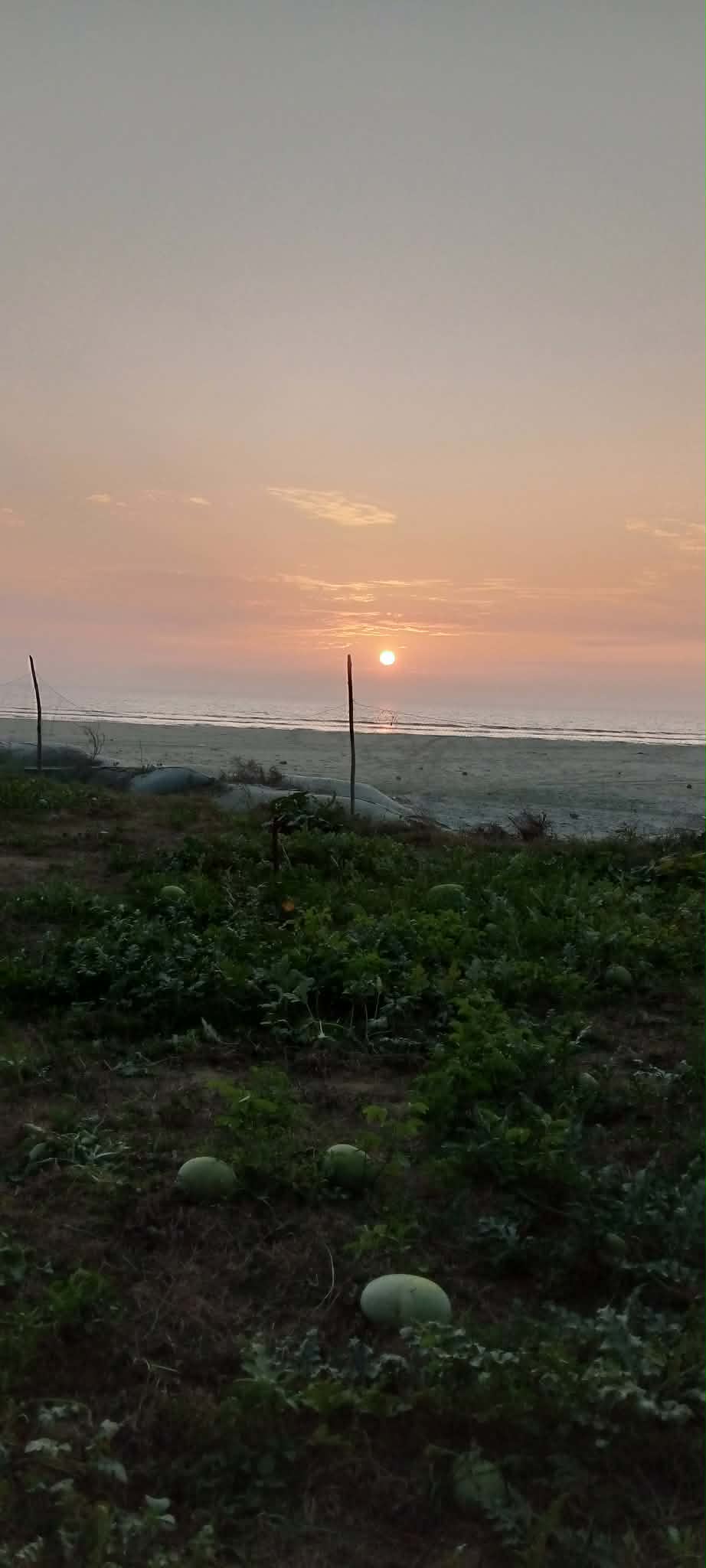
Off-season watermelons now hang along the banks of fish ponds (ghers) in Satkhira. The raised embankments of saline-water ghers used to lie idle; farmers have built trellises on them and grow watermelon and vegetables alongside their fish, earning extra income, and the practice is spreading fast because it pays, Krishi Shomoy reports.
This season off-season watermelon covers about 141 hectares in the district's seven upazilas, some 65 hectares more than last season. In Nagarghata union of Tala upazila, fish swim in the ghers, watermelons trail over the embankments, and on some ghers bitter gourd, yardlong beans and cucumber hang from trellises.
Krishna Mondal, a farmer in Nagarghata, has already sold about Tk 1 lakh of watermelon grown on his gher banks and expects another Tk 1.5 lakh from the crop still in the field. Another farmer, Niranjan, said nobody used to think a crop could grow on the ridges of a saline gher; with improved seed and care on the advice of agriculture officers, they have had good harvests of bitter gourd, yardlong beans and okra as well as watermelon.
Women of the households take part in every task, from planting seedlings and building trellises to picking fruit. Farmers say water salinity in some areas reaches 12 to 15 ppt in the months of Chaitra and Baishakh (March to May); conventional crops cannot grow then, but improved seed and special methods are bringing results.
Agriculture officers say watermelon on level land costs Tk 40,000-45,000 a bigha and, when prices are good, sells for Tk 1.5 to 2 lakh. High-yielding varieties such as Supreme Honey, Black Baby, Tripti, Sugar Queen and Banglalink are grown in the area.
Iqbal Ahmed, additional deputy director (crops) of the Department of Agricultural Extension in Satkhira, said demonstrations and training have been used since 2020 to spread summer watermelon. Experts stress sustainable irrigation and scientific water management to cope with irregular rainfall and sudden changes in the weather.
Photo: a watermelon field (Cox's Bazar), Milli Tami / Wikimedia Commons (CC BY 4.0)
Source: Krishi Shomoy

Comments
(0)