
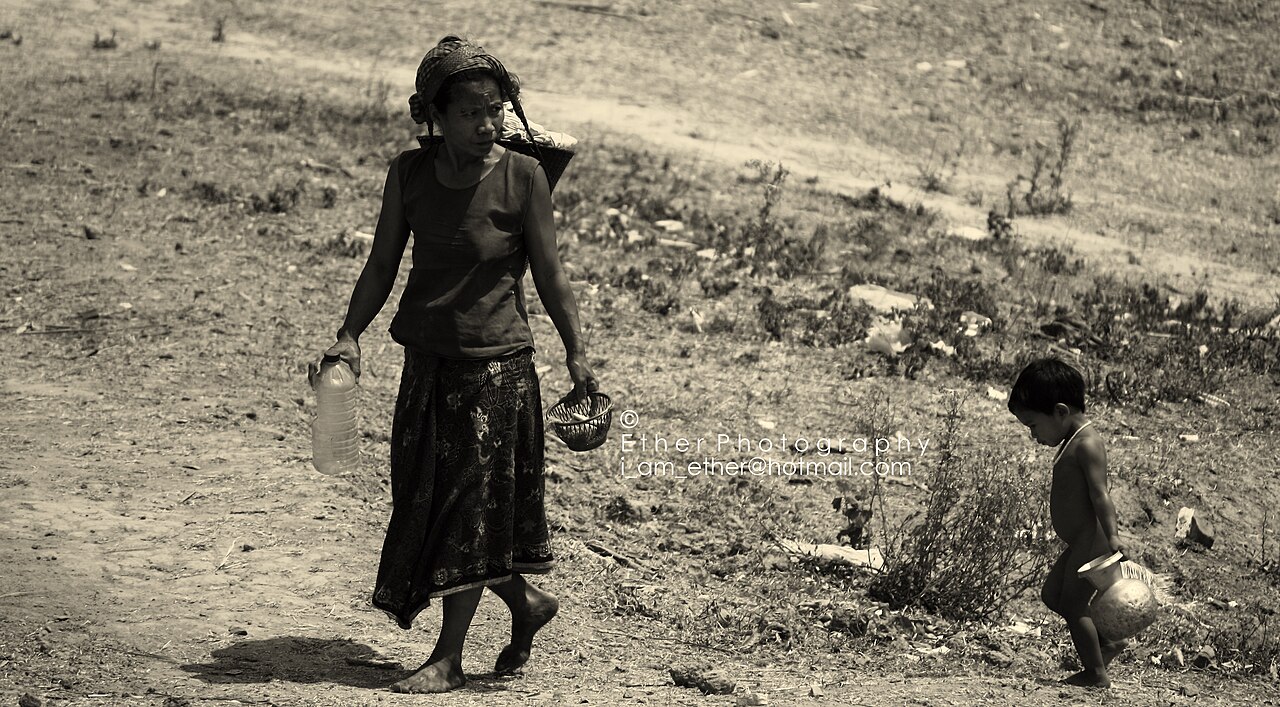
In the hill villages of Rowangchhari upazila in Bandarban, farmers have planted orchards of mango, litchi, cashew, coffee, latkan (Burmese grape) and jujube, but there is no irrigation. Carrying water from distant streams costs them about Tk 2 a litre, which pushes up costs and eats into any profit, Krishi Shomoy reports.
About 92 families in Bengchhari Para, Khabre Para, Ongjai Para, Lunglai Para, Bikromoni Para and Munthar Para, some eight kilometres from the upazila town, face the problem. Mixed orchards cover about 100 acres there, with Amrapali, Kiujai, Miyazaki and "surjo dim" mangoes alongside litchi, cashew, coffee, latkan and jujube. Some families have five to 15 acres.
The orchards, built over years with savings and loans, are the families' main living. Their only reliable source of water is a stream about one and a half kilometres away. Paying labourers to carry water along hill paths is hard for small and medium growers, so trees often go short even when they need it, and growth, yield and fruit quality suffer.
Ubai Marma, a grower in Bengchhari Para, says he and his wife work in the orchard all day, but fetching water from the stream is hard, harder still in winter, and without enough water the yield is poor. Another grower, Ongshoinu Marma, said: "If we had proper irrigation, our output would be three times what it is now."
The agriculture department is planning solar-powered irrigation pumps. If a suitable water source, irrigation works and a distribution system can be put in place, the cost and labour of hauling water would fall and both yields and incomes could rise.
Abu Naeem Mohammad Saifuddin, deputy director of the Department of Agricultural Extension in Bandarban, said several plans to secure water supply have been made for the new fiscal year, including a special proposal for solar irrigation pumps. The department is working with the Bandarban Hill District Council and the Chittagong Hill Tracts Development Board on a quick and lasting solution.
Reported by the Krishi Shomoy correspondent in Bandarban.
Photo: hill people of Bandarban, Faisal Akram / Wikimedia Commons (CC BY-SA 2.0)
Source: Krishi Shomoy

Comments
(0)