
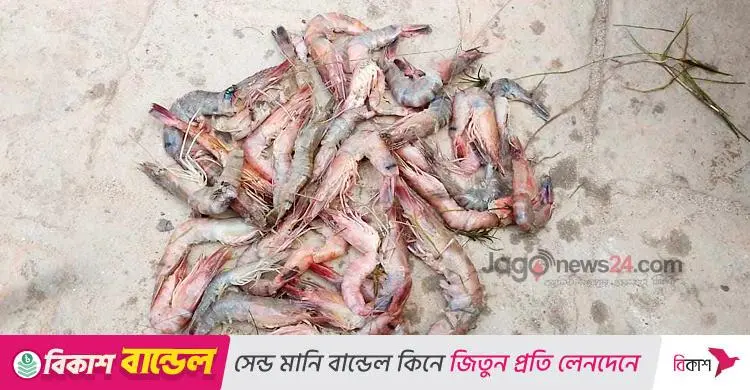
A sudden die-off of bagda (tiger) shrimp has hit the fish ghers of Kaliganj in Satkhira. The shrimp are dying and rotting in the ghers, and the water smells. The shrimp die before farmers can understand what is happening, and the various medicines they have used have had no effect. Most bagda ghers in Kaliganj upazila are in this state, and farmers face heavy losses at the start of the season.
According to the Kaliganj Upazila Fisheries Office, the upazila has 15,000 ghers on 1,600 hectares, with a target this year of 6,000 tonnes of bagda shrimp. By that reckoning, the office puts farmers' target at 400 kg of bagda per hectare. The die-off at the start of the season has been a major blow, raising fears that the target will not be met.
Farmers' losses
Shahadat Hossain, a bagda farmer from Berakhali village in Dakshin Sreepur union, told Jagonews24: "I released bagda fry in my gher some time ago, and they had grown to 60 a kg. Then suddenly they started dying. I am badly hit. I farmed with a loan from a samity. Now I am at my wits' end."
Shariful Islam, a shrimp farmer from Srikola village, said: "I farmed fish with a loan. At the start of the season I released fry at every tide cycle. All the fish in my gher died twice in a row, and the dead fish rotted under the water."
Rajiun Ahmed, a farmer from the same village, said: "I farm bagda on 14 bighas across three ghers. Some time ago I released 1.2 lakh bagda post-larvae, but most have died. All the ghers around, small and large, are in the same state. Bagda farmers will face big financial losses."
Bagda farmer Monirul Islam said: "As no medicine is working, some are drying out their ghers completely to make them ready to farm again. Farmers have already spent money on land lease, fry and feed. There is no way to get that capital back, but the debts still have to be paid."
Officer blames virus-laden water
Taukir Ahmed, senior upazila fisheries officer of Kaliganj, told Jagonews24: "After complaints from farmers, I inspected some ghers. They had bought bagda fry from the local market and recently changed the water in their ghers. One farmer released virus-infected water from his gher into the canal, and another let that water into his own gher. That is why the virus spread more. They did not use bleaching powder or treat the water. That is why the fish are dying."
He said: "Once a virus gets into a gher, there is no antibiotic against it. Antibiotics are used to kill bacteria, so medicines do not work once a virus is in. If farmers in other areas bring water and soil to the fisheries office before releasing fish, we will test them and give the necessary advice."
Source: Jagonews24. First published in Bengali on The Agro News.


Comments
(0)