
The villages of Assasuni and Shyamnagar on the Satkhira coast were once rich in fruit trees. Homesteads had mango, black plum (jam), jamrul, jackfruit, lychee, guava, sapodilla, bilimbi, olive, jujube, karamcha and coconut trees, and in season the villages were full of the scent of fruit. These local fruits were a major source of nutrition for children.
But over the past two decades, climate change, rising temperatures, frequent cyclones and saltwater entering villages through breached river embankments have increased soil salinity and changed that picture. Cyclones Sidr, Aila, Bulbul, Amphan, Yaas and Remal, one after another, have brought major changes to the coastal environment, and many varieties of familiar fruit trees are disappearing in many areas.
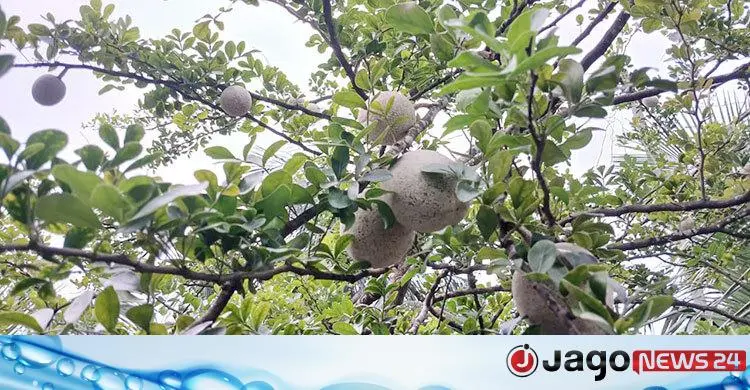
Nature abhors a vacuum. Where mango, jackfruit and lychee cannot survive, palmyra palm, coconut, tamarind, wood apple (kadbel), sapodilla and a few local salt-tolerant fruit trees are taking their place. These trees not only survive but also yield well, and their fruit is now used as raw material by the country's big pickle makers.
How much salt trees can take
According to the botany department of Satkhira Government College, not all fruit trees tolerate salinity equally. Mango and jackfruit are relatively less salt-tolerant: when soil salinity exceeds 2 to 3 dS/m, growth is stunted, leaves scorch and yields fall.
Black plum is somewhat more tolerant, while coconut and palmyra palm can survive highly saline conditions. Experts say coconut grows well in soil of 6 to 8 dS/m and palmyra palm in soil above 8 dS/m, and jujube can give satisfactory yields at 4 to 6 dS/m. Choosing salt-tolerant species is therefore vital for expanding orchards in coastal areas.
The Social Forestry Department says sour fruit trees such as tamarind and wood apple have a unique ability to withstand extreme weather and salinity on the coast. Sapodilla, guava, jujube, tropical almond, palmyra palm and coconut are also yielding well, and planting new mango varieties such as Amrapali is recommended on the banks of freshwater ponds, where salt levels are lower.
Villagers' loss
Abdul Karim Gazi, 62, of Burigoalini union in Shyamnagar upazila, said: "There is no counting how many kinds of fruit trees there were around our house. Yet children today hardly know the names of those trees. Since Aila, so much salt has built up in the soil that even if you plant a mango, black plum or jackfruit sapling, it is hard to keep it alive."
Nitai Mondal, a farmer from the same area, said: "We used to meet the whole family's needs from our own orchard. Now we have to buy fruit. Because of salinity, even if we plant new mango, jackfruit or lychee saplings, they do not survive more than two or three years."
Local people say saltwater lying on the land for long periods has destroyed the soil's natural fertility, and an acute shortage of fresh water adds to the problem, so fruit trees are dying early for lack of nutrients.
Record salinity
According to the Satkhira regional office of the Bangladesh Rice Research Institute (BRRI), the normal salinity level for farmland in coastal areas is taken as 7.5 dS, but because of climate change salinity of 25 dS has been found in farmland on the Satkhira coast.
Shamsun Nahar Ratna, senior scientific officer (additional charge) at the Satkhira regional office of the Soil Resource Development Institute (SRDI), said soil and water salinity in coastal areas is rising at an alarming rate. Both the spread and the level of salinity have increased, posing a major threat to farm production, she said.
The SRDI's latest survey in 2026 recorded salinity of up to 55.32 dS/m in the Kholpetua river in Shyamnagar upazila in May this year, surpassing all previous survey records. Farmland salinity reached up to 13.50 dS/m in the same period.
Experts say that if this rising trend in soil and water salinity continues, it could have long-term negative effects on farming, safe water and the lives and livelihoods of coastal communities.
Shamsun Nahar Ratna said this extreme salinity is severely hampering the growth of crops and fruit trees. She advised farmers to test their soil and grow salt-tolerant varieties; farmers can have their soil tested free of charge at the SRDI office in Satkhira.
A 'dead zone' for ordinary plants
Drawing on the SRDI data, Prof Dr Mosa. Nasrin Akter, head of the botany department at Satkhira Government College, said salinity in coastal soils is reaching 8 to 25 dS/m, a "dead zone" or death trap for ordinary plants.
Scientifically, once soil salinity exceeds 3 to 5 dS/m, the roots of fruit trees run into problems with osmosis. Because the soil is so salty, the tree cannot absorb water, nitrogen or calcium from it; instead, the fresh water inside the tree seeps out into the soil and the tree dries up and dies.
She explained that traditional trees such as mango, black plum and jackfruit cannot withstand this salty soil, which is why they die within 2-3 years of planting. But the cell structure of tamarind, wood apple and sapodilla is naturally salt-tolerant, and their roots go deep through the salt layer to survive. Given the reality of climate change, planting these particular local species is now the most scientific way to protect nutrition and the environment on the coast, she said.
Nutrition suffers
Health and development workers believe the falling availability of fruit in coastal areas is also affecting the nutrition of children and women.
Rahima Khatun, a homemaker in Gabura union of Shyamnagar, said children used to pick guava, jujube and mango from the trees, but now these are rarely found. Fruit in the market is expensive and cannot always be bought, though a wood apple tree in her yard has produced plenty of fruit.
Moniruzzaman, who works on a local NGO's nutrition programme, said: "Less fruit diversity means a shortage of vitamins and minerals in the diet. Children and women in particular suffer most. On the coast this is emerging as a silent crisis."
Salt-tolerant trees bring income
Visits to coastal villages found tamarind, wood apple, sapodilla, in some areas local jujube, and to a limited extent coconut trees in relatively good condition.
Manjurul Islam, a farmer in the Khajra area of Assasuni, said wood apple and tamarind now survive best. They need little care and are not easily damaged by storms. Palmyra palm, coconut and sapodilla trees also fruit well, he said.
Shefali Rani, a homemaker in the same area, said wood apple used not to get much attention, but now many people are planting it. It fruits well, there is demand in the market, and it needs no extra care; it simply grows.
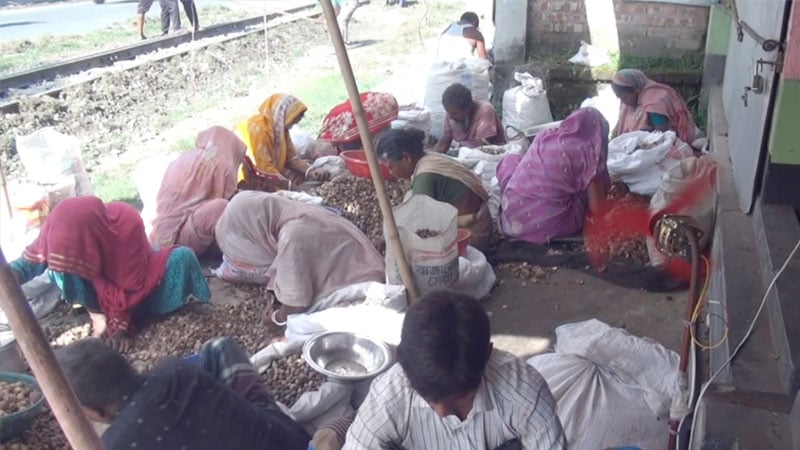
According to local traders, large quantities of tamarind and wood apple are collected in season from various parts of Kaliganj, Assasuni and Shyamnagar.
Jamal Uddin of Kushlia haat in Kaliganj upazila said people from pickle companies in Dhaka, Jashore and Khulna come directly to buy the fruit. Tamarind is in the highest demand, and a lot of wood apple is also sold. Fruits once used only by families are now becoming a source of extra income for many households, he said.
Planting for a saltier future
On roads in the upazilas, new tamarind and wood apple saplings have been planted in places. ASM Tariqul Hasan Khan, executive engineer of the LGED in Satkhira, said many of the trees once planted for beautification or shade are no longer surviving, so the department is considering giving priority to species that can survive in the local environment. Tamarind, wood apple, khoi babla, local neem and several other trees are surviving in saline areas, he said.
If the forest department and other offices include climate-resilient species in roadside planting programmes, it will be more effective in the long run, he said.
Priyanka Halder, assistant conservator of forests at the Satkhira Social Forestry Department, said new strategies are being adopted for afforestation in coastal areas because of climate change. Rising salinity and harsh weather have made it hard for many earlier species to survive, so the emphasis is now on planting species tolerant of salinity and extreme weather.
Sour fruit trees such as tamarind and wood apple have shown a special ability to survive on the coast, she said, while sapodilla, guava, jujube and coconut are also yielding well.
According to the forest department, amloki (Indian gooseberry), tamarind, wood apple, arjun, khair, khoi, babla, local neem and tropical almond are growing relatively well on the Satkhira coast. The Social Forestry Department is distributing saplings of these trees to local people, and saplings of the mangrove species keora and baen are being planted along riverbanks for coastal protection and biodiversity conservation.
Satkhira deputy commissioner Kawsar Aziz said the government has taken an initiative to plant 5 crore trees across the country to protect the environment. In Satkhira, planting has begun in earnest this year, with equal importance given to fruit, timber and medicinal trees.
He stressed that this time the afforestation programme will give top priority to species that can survive long-term in the coast's extremely harsh weather and severe soil salinity, and the relevant offices have already been given the necessary instructions.
A changing coast
Experts say the spread of salinity on the south-west coast is changing not only agriculture but the whole ecosystem of rural life, and the loss of fruit tree diversity is one visible example.
Traditional orchards are disappearing, while tamarind, wood apple and a few local species are adapting to the new reality. These trees are no longer only part of protecting the environment; they are becoming part of the local economy and food security too.
Children on the coast are now growing up in a reality where the fruit trees their parents knew are fast disappearing, and tamarind, wood apple and palmyra palm are replacing mango, jackfruit and lychee. This story of adapting to climate change is one of the struggle to survive, but also of lost biodiversity, nutrition and rural culture. The question is whether the coast of the future will be limited to a few salt-tolerant trees, or whether science and planning together can bring back its fruit diversity.
Source: Jagonews24. First published in Bengali on The Agro News.
Comments
(0)