
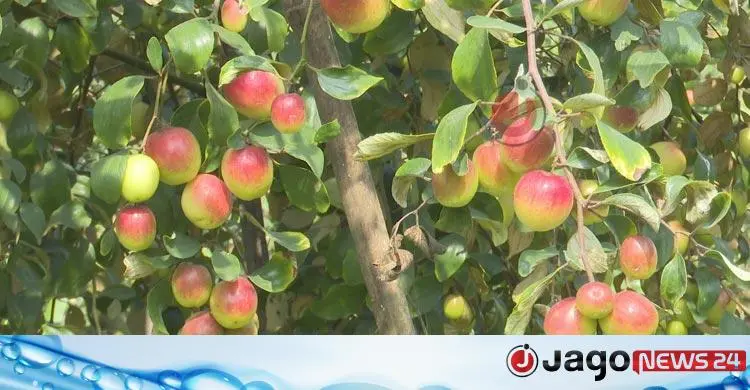
Satkhira is a coastal district in the south-west. Its low elevation above sea level makes it more exposed to climate change, and heavy rain, intense heat and saline river water have reduced crop production in many areas. Amid these challenges, boroi (jujube) farming is showing new promise. Boroi trees can tolerate low levels of salt and moisture, bear fruit quickly and carry relatively little risk. So boroi is no longer just a seasonal fruit but an important source of income for farmers in coastal areas.
846 hectares and Tk 160 crore
According to the Satkhira district Department of Agricultural Extension (DAE), boroi has been grown on about 846 hectares in the district this year, with the potential for about Tk 160 crore of trade. In particular, growing boroi on beds or raised mounds, with vegetables on the field ridges and fish in the ponds, has reduced farmers' risk. This is called "real adaptation": when one crop is at risk of failing, another becomes the farmer's source of income. The mixed farming method is not only protecting soil health but has also brought a revolutionary change to the rural economy.
The success of boroi is not limited to economic prosperity; it has also created social protection. Many previously unemployed women in the area have become self-reliant by working in orchards and in marketing.
Despite the huge potential, some limits remain. Boroi fetches good prices in local markets and in Dhaka, but there are not enough cold stores to keep this perishable fruit, so at the height of the season farmers are often at risk of missing out on fair prices. If Satkhira's tasty, improved boroi could be exported, it could open a large door to foreign exchange earnings.
Market insiders say that if the government and the agriculture ministry build specialised cold stores for Satkhira's boroi growers and create special opportunities for export, it would add a new dimension not only to agriculture in the south-west but to the whole country's export sector.
This season the agriculture department has set a target of more than Tk 160 crore in transactions from boroi grown in the district's seven upazilas. With good yields and growing demand across the country, Satkhira is becoming a big boroi market.
Various hybrid boroi varieties are grown commercially in Tala, Kalaroa, Sadar, Debhata and other upazilas, including Bilati sweet boroi, Thai apple boroi, Ball Sundari, Kashmiri apple, local apple, Narikeli, Bombai and sour varieties.
Agriculture department officials say boroi does well even on mildly saline land. Local farmers have grown it for a long time, so they are experienced and know the right methods. The department is giving regular advice and training in the field on seedling supply, care, fertiliser use and disease management.
Costs, income and a missing market
According to growers, boroi costs Tk 30,000-50,000 per bigha, and with a good harvest earnings range from Tk 80,000 to Tk 1.5 lakh. Boroi currently sells for Tk 70-150 a kg. Because other crops can be grown on the same land, many are taking up boroi.
But there are problems too. With no local wholesale market in the district, farmers rely on Satkhira's Bara Bazar and the wholesale markets of Khulna, which raises transport costs, and dependence on commission agents cuts into fair prices. Some wholesalers buy directly from orchards, but with no transparency in market prices many farmers are not getting a fair price. Growers want a modern local wholesale boroi market.
Panjab Ali, a veteran boroi grower from Mithabari village in Tala upazila, told Jago News: "I have been growing boroi on seven bighas for the past 15 years. From apple boroi, Ball Sundari, Bilati sweet, Kashmiri apple, local and sour varieties I earn around Tk 10 to 12 lakh a season. Compared with other crops, boroi has less risk and more profit. The market is growing now, so many people across the area are turning to boroi."
Monirul Islam, a boroi grower in the same upazila, said: "I grow apple boroi, local apple and Bombai boroi on 11 bighas. It cost about Tk 30,000 per bigha. Along with boroi I grow turmeric, elephant foot yam and other crops. But the rising prices of fertiliser and pesticides have raised costs, which has hit my income."
On the problems, he said: "With no storage, once the boroi start ripening on the tree they have to be marketed quickly. But with no local wholesale market, I have to sell in the big markets of Khulna or Satkhira. That takes time and the quality of the fruit suffers."
Abdus Sattar of Ufapur village in Kalaroa upazila told Jago News: "Many wholesalers are buying boroi directly from the orchards. That has reduced transport hassle, but with no transparency in market prices we are not getting the right price. We want a modern local wholesale boroi market."
Lovlu Islam, a retail fruit seller in Satkhira town, said: "Demand for boroi is very high now. I bring boroi straight from orchards in Tala and Kalaroa and sell it, and I make a good profit. Buying from the market costs a lot in commission agents' fees and tolls. Buying from the orchard avoids those costs."
Idris Ali, a wholesale trader at Sultanpur Bara Bazar, told Jago News: "Hundreds of tonnes of boroi are traded every day at the Bara Bazar wholesale houses. The boroi market is now linked with Khulna, Barishal and other districts, and wholesalers from there buy directly from here. We trade on a limited commission."
Advice from the agriculture department
The agriculture department says regular field advice and technical support are being given to make boroi farming more sustainable and profitable, including supply of improved seedlings and training in care and disease management.
Suman Mondal, sub-assistant plant protection officer at the Shyamnagar upazila agriculture office in coastal Satkhira, told Jago News that some small boroi orchards have sprung up in the coastal area, and many people plant boroi trees on pond ridges and in their yards. In the saline areas here, besides local boroi, Baukul, apple kul, Ball Sundari and Narkeli varieties can be planted, though yields vary with soil type.
"We advise farmers to build small raised mounds of soil in crop fields and plant boroi seedlings on them," he said. "That way water does not collect at the base and the tree survives even waterlogging. After harvest, certain branches of the tree should be pruned so new branches bear well the next year."
Hajira Khatun, Tala upazila agriculture officer, told Jago News that boroi growers are given regular advice: when to plant seedlings, how to prepare pits and land, how much fertiliser and water trees need at each age, and how to identify diseases or pests and act quickly. On choosing varieties, she said selecting a suitable variety is very important for good yields, and farmers are advised to grow large, sweet, disease-resistant, high-yielding varieties.
Agriculturist Saiful Islam, deputy director of the Satkhira DAE, told Jago News that the target this season is 18,000 to 20,000 tonnes of boroi from orchards on 846 hectares in the district, with a current market value of more than Tk 160 crore. If local wholesale markets and storage improve, growers will benefit even more, he said.
Source: Jagonews24. First published in Bengali on The Agro News.
Comments
(0)