
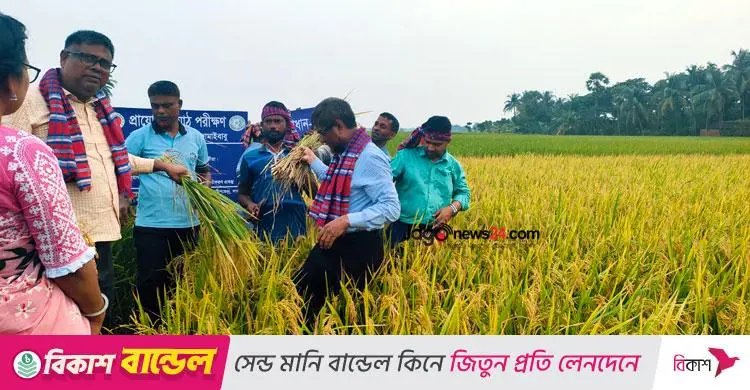
Farmers in Satkhira see new hope in the high-yielding, salinity-tolerant variety BINA dhan23, and the aman harvest has begun for the first time this season. On the afternoon of 21 September a field day was held in Chhonka village of Ghona union in Sadar upazila, organised by the Bangladesh Institute of Nuclear Agriculture (BINA) sub-station. Agriculturist Saiful Islam, deputy director of the Department of Agricultural Extension (DAE) in Satkhira, inaugurated the harvest.
Speaking as chief guest, he said: "The biggest challenges to rice production in the coastal region are salinity and waterlogging. BINA dhan23 can tolerate these. It is a promising variety, giving more output in less time at lower cost. It can be harvested 15 days earlier than other varieties, after which early mustard and other crops can be grown. Because it suits this region's weather, its cultivation will increase. With today's harvest of this variety, the aman harvest has begun in Bangladesh for the first time."
Present were Dr Md Kamruzzaman, officer in charge of BINA's Satkhira sub-station; Plabani Sarkar, additional agriculture officer of Sadar upazila; scientific officer Md Moshiur Rahman; and Milon Kabir. Local farmers also took an active part in the field day.
Farmers' experience
Chhonka farmer Monirul Islam said: "This rice is very good for our area. There is no problem growing it on land with low salinity and standing water. The cost is low and the yield high. With organic fertiliser, very little chemical fertiliser and pesticide is needed. I got a better yield than from earlier aman rice. I grew it on 1 bigha, but next year I'll grow it on 5 bighas."
Sirajul Islam, a farmer from the same area, said: "We used to worry that if heavy rain flooded the land, the rice would be ruined. But this time with BINA dhan23 I saw that it was not damaged even after 15 days under water. That has boosted our confidence."
Dr Md Kamruzzaman said: "BINA dhan23 was developed mainly for farmers in tidal and saline areas. Its life cycle is only 115-125 days, but in Satkhira it is being harvested in just 112 days, so farmers can bring in their rice in less time. It also gives a good yield with less fertiliser and irrigation, which lowers production costs."
He said: "This variety can tolerate salinity of up to 8 dS/m and survive up to 15 days of submergence. So it is quickly becoming popular in coastal areas like Satkhira."
Plabani Sarkar said: "Coastal farmers always suffer from natural disasters. If BINA dhan23 is widely grown, farmers will benefit, rice output will rise and food security will be ensured."
Agricultural experts said that if this variety gradually spreads further in the coastal region, it will bring positive change to rice production, and farmers will become self-reliant by getting more yield at lower cost.
Farmers at the event said that, having seen BINA dhan23's yield and tolerance, they want to grow it on more land next year.
Source: Jagonews24. First published in Bengali on The Agro News.

Comments
(0)