
A US start-up wants to price crop insurance for each field rather than for a whole county. SAGE, short for Soil Analytics Geospatial Engine, is an agricultural risk intelligence company that combines public and private data, including satellite data, soil information and scientific papers, to assess farming risk and work out the cover a grower actually needs, AgNavigator reported.
Behind it is Bill Veghte, a Silicon Valley veteran who spent much of his career at Microsoft, HP and SurveyMonkey and grew up on a farm in northern New Hampshire. He told AgNavigator that crop insurance has long been set from countywide averages, which can hide the risk of a particular farm, so growers can end up paying more than they need. AI changes that, he said, by calculating risk at field level and speeding up the collection of farm data. SAGE's models combine observations of soil, water, weather and human activity.
SAGE has announced a partnership with the professional services firm Aon and the specialty agricultural insurer AgriCap to offer what they call precision crop insurance to corn and soybean growers in 15 states in 2027. It grows out of a four-county pilot developed with the Resilience in Agricultural Lending and Insurance Coalition (RALIC), funded by the Michigan Department of Agriculture and Rural Development, which covers more than one million acres (about 405,000 hectares) of farmland, or roughly 12 percent of Michigan's agricultural production.
"When we make resilience visible, it becomes underwritable," Jonathan Sherrill, Aon's senior vice president for its Agriculture Resilience Center, said in a press release. The article asks whether better crop insurance could lead more farmers to adopt regenerative practices.
Co-founder Robert Bonnie, who worked at the US Department of Agriculture for more than a decade under the Obama and Biden administrations, pointed to the scale of the system. "In the last 15 years, crop insurance has really become the dominant safety net tool of the farm bill," he said, adding that taxpayers provide between $14 billion and $20 billion a year to subsidise it.
Veghte expects field-level repricing to affect everyone from farmers to governments, food companies and consumers, and not only in the United States. The article was written by Ryan Daily.
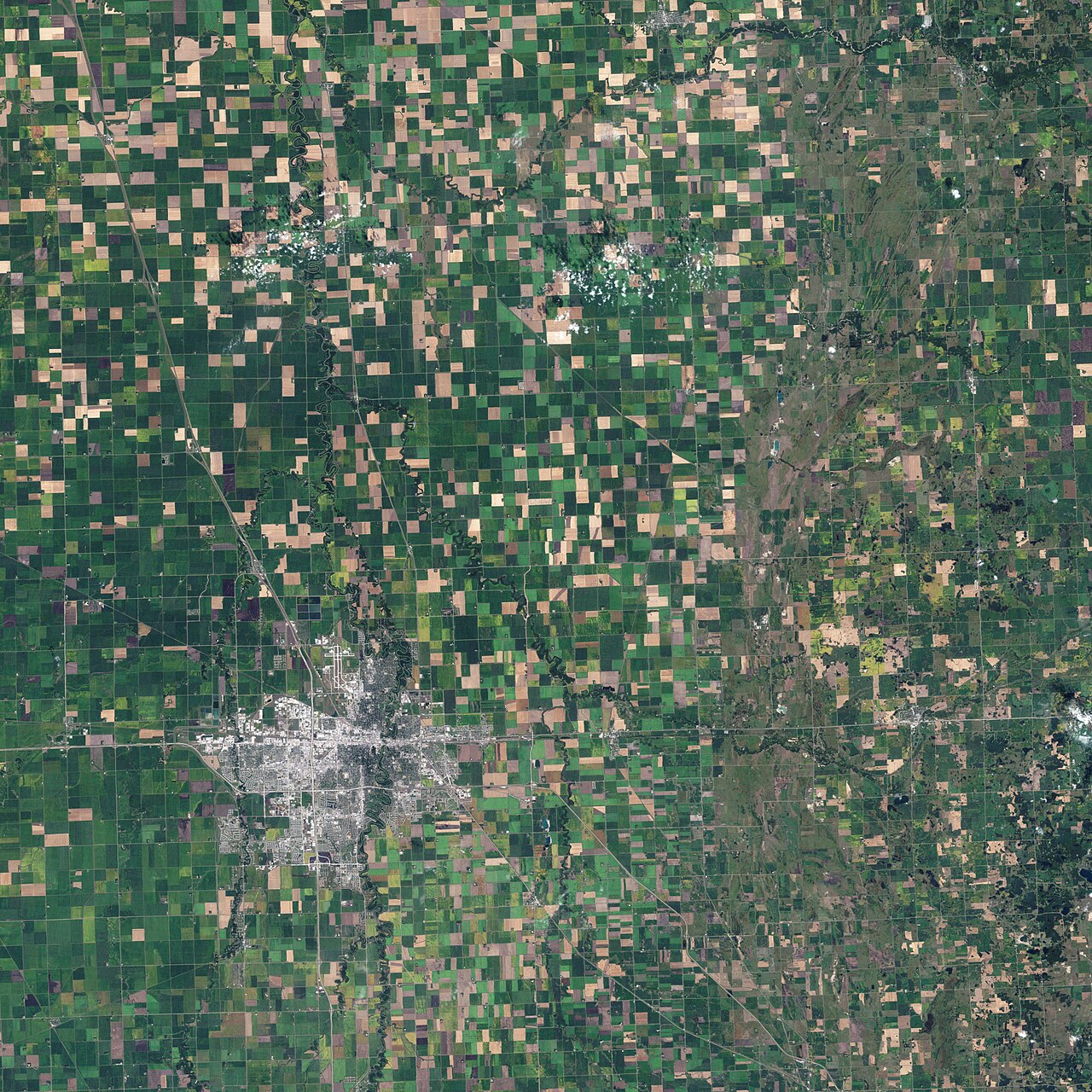
Photo: Landsat true-colour image of farmland in northwest Minnesota, NASA Earth Observatory, Jesse Allen / Wikimedia Commons (public domain)
Source: AgNavigator



Comments
(0)