
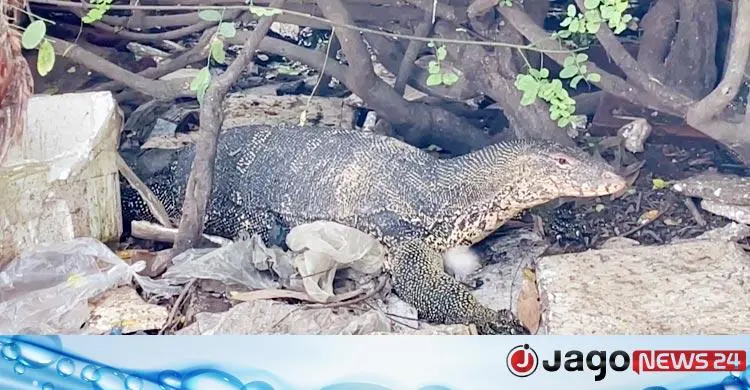
Around 50 huge, near-endangered monitor lizards roam freely along the banks of a waterbody in Sadarpur, Faridpur. Weighing around 30 to 40 kg, they move in groups openly through rubbish dumps, bushes, the market and even household yards. Yet they do no harm to people or families, and have become something like friends to the locals.
They live on rotten fish, dead chickens, the bones and offal of slaughtered cows and goats and other rubbish thrown out by market shops and homes, and in doing so keep the market and yards clean. As a result they have become an inseparable part of the market and of local life.
The big lizards have roamed in groups along the canal bank next to the upazila headquarters market for about two decades. At first only two to four were seen, but through breeding their number is now about 50 to 60. They have not harmed anyone so far. Although they wander openly through the market and yards, they eat nothing but refuse and rotten food and do not harm householders' ducks, chickens or anything else. Locals feed them when they see them.
A useful animal
According to the livestock department, the monitor lizard is a calm animal. It usually lives in holes in the ground, tree hollows, cracks in old walls or abandoned brick kilns. It is diurnal, hunting by day and resting at night, and usually lives on venomous snakes and their eggs, dead fish, frogs, crabs, snails and rotting animals.
Three kinds of monitor lizard are usually found in Bangladesh. Of these, the ramgadi or black monitor is the largest in the country and the second largest monitor lizard in the world; it can be 8 to 9 feet long and weigh about a maund. As they are hard to tell apart, all species are known to people as guishap, and in different areas also as tarbel, guil and ghorel. The monitor lizard is very useful. As its numbers fall, crop pests and rats are increasing, along with venomous snakes. It also keeps the environment clean by eating rotting carcasses and stops germs spreading.
Traders and residents
Chandan, a sweeper at the market, said: "I sweep the market rubbish. The lizards eat the rubbish and cut my work a lot."
Mizan Howlader, a trader at the market, said nobody knew where or how the lizards had come. They do no harm to people and instead help clean up the market's rubbish, so no one chases them away; rather, people help them live safely. A stranger would be scared, he said; "at first we were scared too, but now nobody is". Everyone considers them helpful friends, many feed them, and they wander everywhere in their own way.
Another trader, Jinnat Ali Khan, said that by the look of them each one weighs one to one and a half maunds, depending on size. They roam the market, the bushes and in the open, and sometimes come into nearby yards too. "But they are completely harmless. So far I have not heard of them biting or harming anyone," he said, so they cause little fear and locals have accepted their presence as normal.
Local resident Md Nurul Islam told Jago News that about two decades ago two or three lizards were seen, and now there are about 50 to 60. They are huge and look as if they weigh 30 to 40 kg. They eat refuse, the rotten food people throw away, and do not eat the ducks and chickens that walk in front of them, so a friendly relationship has grown with people. He said the animals are almost endangered and called on the administration and others concerned to let them roam freely and conserve them, or one day they will disappear.
Officials promise protection
Moniruzzaman Monir, general secretary of the Faridpur Environment Development Forum, told Jago News that the monitor lizard is not harmful to people and keeps the environment in balance. It is now largely extinct, he said, and the presence of such an animal is a sign of a healthy ecosystem, so protecting these lizards and their habitat is very urgent.
Sadarpur upazila livestock officer Sabyasachi Majumder told Jago News there are about 50 of them, seen moving in groups of eight to ten. They do not leave because there is enough food, and people feeding them has built a kind of friendship. They have no venom like snakes, but because they carry bacteria, a bite or a blow from the tail could cause infection.
He said the monitor lizard is called the farmer's friend because it eats rats in paddy fields and crop pests. It is also a very good swimmer, so its habitat is mostly found near wetlands. "If they have any problem we can treat them, but conservation is the responsibility of the forest department," he said.
Tawhid Hossain, assistant conservator of forests in Faridpur (additional charge), told Jago News he had learned of the matter and would visit the site that day. A written proposal on how to conserve the animals would then be sent to higher authorities.
Md Sharif Shawon, upazila nirbahi officer (UNO) of Sadarpur, told Jago News that care would be taken so the animals can live in their own way and no one harms them.
Source: Jagonews24. First published in Bengali on The Agro News.

Comments
(0)