
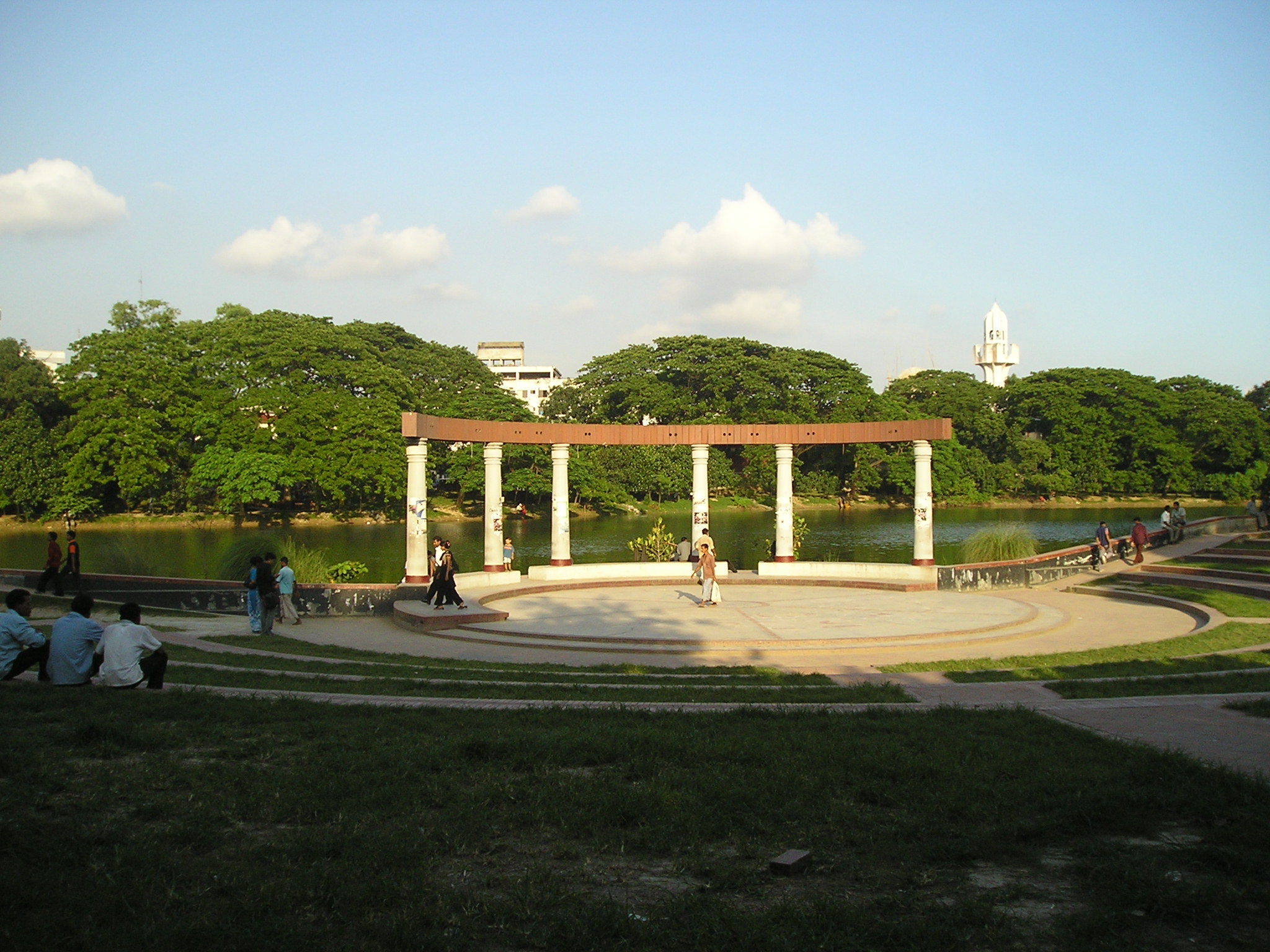
Russian House in Dhaka held a "Garden of Memory" tree-planting ceremony on the bank of Dhanmondi Lake on the morning of Friday 24 April 2026. The programme honoured the Soviet soldiers and citizens who died in the Second World War and marked the 81st anniversary of victory in what Russia calls the Great Patriotic War (1941-1945). Guests planted saplings at the lakeside. The chief guest, Dhaka South City Corporation (DSCC) administrator Md Abdus Salam, used the occasion to set out two tree targets: the government's plan for 25 crore trees over five years, and his corporation's plan for 3 lakh trees between 2026 and 2030.
The ceremony at the lakeside
Guests, students and members of the public took part, according to United News of Bangladesh (UNB), which reported the event the same afternoon. The programme began with a visit to the Russian House and moved on to the official ceremony at the lake. Alexandra Khlevnoy, director of the Russian House in Dhaka, chaired the event. In her opening remarks she spoke of preserving historical memory and of strengthening humanitarian ties through initiatives that connect people across countries and generations.
The special guest was Vyacheslav Sentyurin, minister-counsellor at the Russian embassy in Bangladesh. He spoke about the historical significance of 9 May 1945 and said the Soviet Union's victory in the war came at a human cost of about 27 million lives. The general secretary of the Soviet Alumni Association Bangladesh also attended.
Speakers described the Garden of Memory as a tribute to those who fell in the Second World War, as a symbol of friendship between the peoples of Bangladesh and Russia, and as a reminder of a shared responsibility for protecting the environment. The central moment of the event was the ceremonial planting of saplings by the guests on the lake bank. The event ended with a reception at the Russian House. The reports of the day do not say how many saplings were planted or of which species.
What the Garden of Memory campaign is
The Garden of Memory, known in Russian as Sad Pamyati, is an international memorial tree-planting campaign that began in Russia. It is dedicated to those who lost their lives in the Great Patriotic War, and trees are planted every year in Russia and in other countries, with one tree standing for each life lost. Its organisers also present it as a way of promoting environmental sustainability. Russia's federal forestry agency, Rosleskhoz, is involved: its deputy head spoke at the presentation of the 2026 season.
The figures below are the organisers' own. In June 2025 the head of the Russian movement Volunteers of Victory said residents of 83 countries had taken part that year and had planted more than 27 million trees, in memory of the 27 million Soviet citizens who died in the war. She called the number of countries a record for the six seasons held so far. Trees were planted under the campaign for the first time that year in countries including Indonesia, Iran, Kenya, Singapore, South Korea, Sri Lanka and Tanzania.
In December 2025 the campaign's press office reported that the Garden of Memory and a second Russian campaign, Save the Forest, had together put more than 100 million new trees in the ground in Russia during 2025, with more than 1.5 million people taking part. The seventh season opened on 18 March 2026. At its presentation, reported on 16 March, the organisers said more than 160 million memorial trees had been planted over the six earlier seasons, and an official of the Russian agency Rossotrudnichestvo said 20 countries had by then confirmed taking part in the new season. The organisers also promote a "Garden of Memory at home" format, under which anyone can plant a tree in a yard or garden and add it to a memorial map on the project's website.
The Russian House in Dhaka
The Russian House is the former Russian Cultural Centre in Dhaka. It marked 50 years in Bangladesh with an event in February 2025, attended by the head of Rossotrudnichestvo and the Russian ambassador. The foreign affairs adviser told that event that many Bangladeshis had learned the Russian language and explored Russian literature at the centre, and that a significant number of Bangladeshi students had benefited from educational opportunities at Russian institutions.
The two tree targets
In his speech, Md Abdus Salam praised the programme and spoke of Bangladesh's commitment to protecting its environment. He said the government plans to plant 25 crore (250 million) trees over the next five years to tackle climate change and build a green Bangladesh, and that Dhaka South City Corporation plans to plant 3 lakh (300,000) trees between 2026 and 2030 to expand green cover in the city.
The national figure had been stated earlier in the spring. On 11 March 2026 the environment, forest and climate change minister told a World Wildlife Day discussion at Ban Bhaban in Agargaon that the government would plant 25 crore trees across the country on a priority basis over the next five years. He added that about 200 hectares of mangrove plantation would be created in coastal char areas and that 1.1 million saplings would be planted along roads and embankments under social forestry programmes, and he urged people to plant forest, fruit and medicinal trees around their homes.
Three days before the Dhanmondi ceremony, on 21 April 2026, Bangladesh Sangbad Sangstha (BSS) reported that the government had asked institutions to come forward as voluntary partners in the programme. Two kinds of institution were eligible:
- social organisations, autonomous or private institutions and NGOs with prior experience of planting and maintaining trees;
- institutions skilled in building GIS and remote-sensing web map dashboards and apps to monitor tree planting.
Concept papers were due by 25 April. The second category concerned the monitoring of the planting and not the planting itself. The DSCC target of 3 lakh trees is the figure the administrator gave at the ceremony; the reports of the day do not list its sites or species.
The national target can be read against an official figure. In March 2021 the then environment minister said tree-covered land had reached 22.37 per cent of the country's area, with steps taken to raise it above 24 per cent by 2025.
Dhanmondi Lake, where the saplings went in
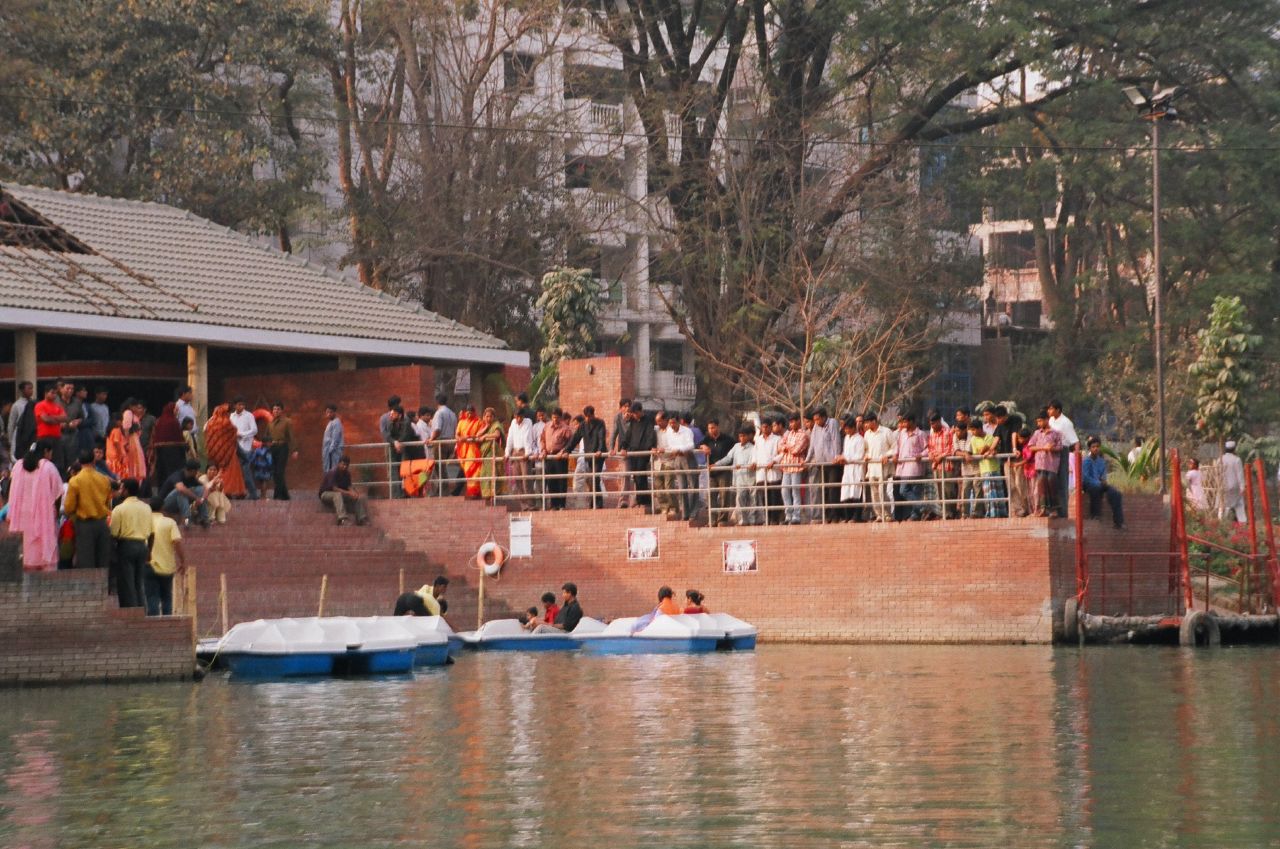
Banglapedia, the national encyclopedia of Bangladesh, describes Dhanmondi Lake as an abandoned channel of the old Karwan Bazar river, once known as the Carevan River. Urban expansion during the Pakistan period changed the natural water system of the area, and the Dhanmondi residential area was developed in 1956 on 240.74 hectares of land. The lake makes up about 16 per cent of the total area of Dhanmondi.
The lake runs for about 3 km from Jigatola, is 35 to 100 metres wide and has a maximum depth of 4.77 metres. Its water body covers 37.37 hectares. It is more than an ornament: Banglapedia says it plays a vital role in the drainage of Dhanmondi and the neighbouring areas, and part of it still works as a storm-water drain into the Begunbari Khal. A box culvert near Sukrabad is its only outlet, and excess floodwater after heavy rain leaves through it. The encyclopedia lists several authorities with a hand in the lake, among them the Ministry of Works, the Fisheries Department, the Department of Environment and the city corporation, and records renovation work between 1998 and 2001 to make it a pollution-free recreation zone.
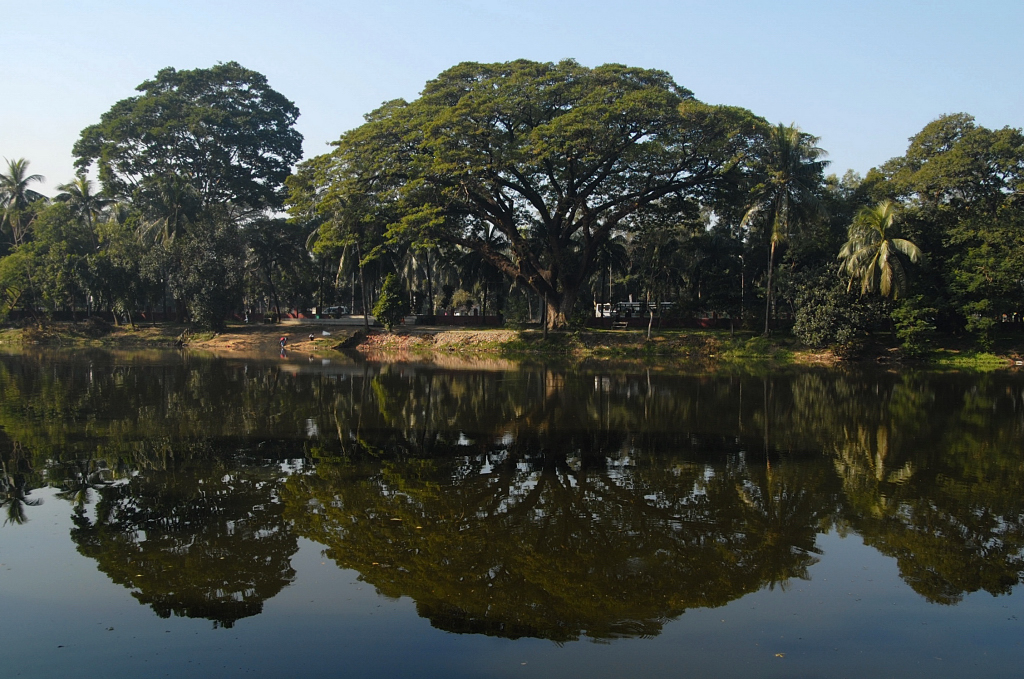
The banks already hold a varied stand of trees. A study in the Bangladesh Journal of Plant Taxonomy, published in December 2023, recorded 2,322 individual trees of 118 species in 39 families at the lakesides of Dhanmondi, Hatirjheel and Gulshan. Of the species, 61 per cent were native and 39 per cent exotic. The most abundant were mahogany, mango, coconut, Khaya anthotheca and krishnachura, and Dhanmondi scored highest of the three sites on the Shannon diversity index, at 3.78. Of the visitors surveyed, 85 per cent favoured positive action on managing the lakeside trees.
The lake also supports birds. A survey at Dhanmondi Lake from March to December 2021, published in the Jagannath University Journal of Life and Earth Sciences in June 2023, counted 34 bird species, of which 94 per cent were residents and 6 per cent migrants. It named large gatherings, festivals, dumped waste, plastics and vehicle noise as the major threats to them.
How much tree cover Dhaka has
The city's first comprehensive tree survey, the Urban Tree Inventory of Dhaka City, was carried out by the Bangladesh Forest Department and the US Forest Service, with data collected between November 2022 and 8 August 2023 from 755 randomly chosen plots, 370 of them in the south. Prothom Alo reported its findings in June 2025. It found about 1.3 million large and small trees in 306 square kilometres of the city, or one tree for every seven residents. About 616,900 of them were in the DSCC area and 682,600 in Dhaka North City Corporation (DNCC).
DSCC had the denser stand, with an average of 15 trees per hectare against about 7 in DNCC, and tree cover of 10.8 per cent against 10.5 per cent. The report set these against about 27 per cent in Toronto, 37 per cent in Atlanta and nearly 21 per cent in New York. The survey identified 110 species from 33 families, the commonest being mango, mahogany and coconut, and estimated that the city's trees absorb about 538 tons of pollutants a year, 219 tons of it in the DSCC area.
Because that was the first such survey, it could not show change over time. Satellite studies give a longer view, but they measure all vegetation and not only tree canopy, so their figures are not directly comparable with the inventory. A 2024 study in the journal Land, using Landsat images of the DSCC area, found green coverage of 46 per cent in 1991, 21.3 per cent in 2001, 19.7 per cent in 2011 and 9.5 per cent in 2021. A study of the DNCC area published in May 2023 in PLOS Sustainability and Transformation put its green share at around 47 per cent in 1992 and 16.17 per cent in 2022. That study cited a United Nations Environment Programme guideline that an ideal city should have at least 25 per cent green space.
Other studies point the same way. A study from the urban and regional planning department of Bangladesh University of Engineering and Technology (BUET), released in March 2023, said only 8.5 per cent of the land in Dhaka had tree cover. The DNCC study recorded barren land that could be used for planting falling from around 11 square kilometres in 2012 to 2.2 square kilometres in 2022. The inventory put the cost of removing by artificial means the pollutants that Dhaka's trees absorb at nearly Tk 35 crore. Beyond the species already named, its list of the city's trees includes banyan, koroi, jarul, arjun, neem, bakul, kadam and hijal. Open land and water in the city have legal cover under the Playground, Open Spaces, Parks and Water Bodies Conservation Act 2000.
Trees and heat in the city
Researchers have linked Dhaka's heat to its green cover. A survey by the Centre for Atmospheric Pollution Studies (CAPS), reported by The Business Standard in May 2023, found summer temperatures in the city's heavily urbanised areas to be three to five degrees Celsius higher than in areas with more green cover and water. The director of CAPS said the Dhanmondi residential area was among nine cooler parts of the capital, along with the Botanical Gardens, Ramna Park and Chandrima Udyan, because it has more trees.
The Food and Agriculture Organization of the United Nations (FAO) made a similar case at a global level in 2019, when it said well-managed urban forests could lower air temperatures by up to 8 degrees Celsius and cut air-conditioning costs by up to 40 per cent. The DNCC study also found the cooling and humidifying effect of medium-sized green areas most noticeable on high-temperature days, and said water basins inside green spaces had a significant effect on local cooling. Dhanmondi, with its lake and its lakeside trees, has both.
Earlier tree dispute in the same area
Trees in this part of the city have been a public issue before, and DSCC was at the centre of it. In early 2023 the corporation began felling trees on the road dividers of Satmasjid Road, which Banglapedia gives as the western boundary of the lake area, under a Tk 9.62 crore project to develop infrastructure, including road medians and footpaths. Local people and environmental and cultural activists formed a human chain on 31 January, and the felling stopped for three months. It resumed on 1 May.
Environmental activists alleged that 600 trees had been cut. The corporation's chief engineer said the road was narrow and the new dividers could not be built without removing the trees, and that designated spaces had been kept for planting new ones. The then mayor apologised to Dhanmondi residents, saying the trees were cut because there was no other way and that about two lakh trees had been planted during his three years in office. The chief executive of the Bangladesh Environmental Lawyers Association denounced the felling and said the sand and concrete filler used in the divider left no way of planting local varieties of tree. On 19 May DSCC said it had planted about 650 flowering plants, among them rangan, kamini and kanchan, on 800 metres of the 1.7 km divider, and on 21 May police blocked demonstrators marching towards its headquarters.
Whether saplings survive is a separate question from whether they are planted. Prothom Alo reported in June 2025 that of a DNCC project to plant 100,000 trees in 2023, many were planted and some survived, while others died.
Which trees are to be planted
Planting in 2026 also falls under a rule on species. On 15 May 2025 the environment ministry issued a notification banning the plantation, collection and sale of eucalyptus and akashmoni saplings, and directed government bodies, NGOs and individuals to use native fruit, timber and medicinal plants in afforestation programmes instead. The ministry said those species draw excessive groundwater, that their fallen leaves leave the soil unsuitable for other plants, and that many native plants, insects and birds cannot find shelter or food in them.
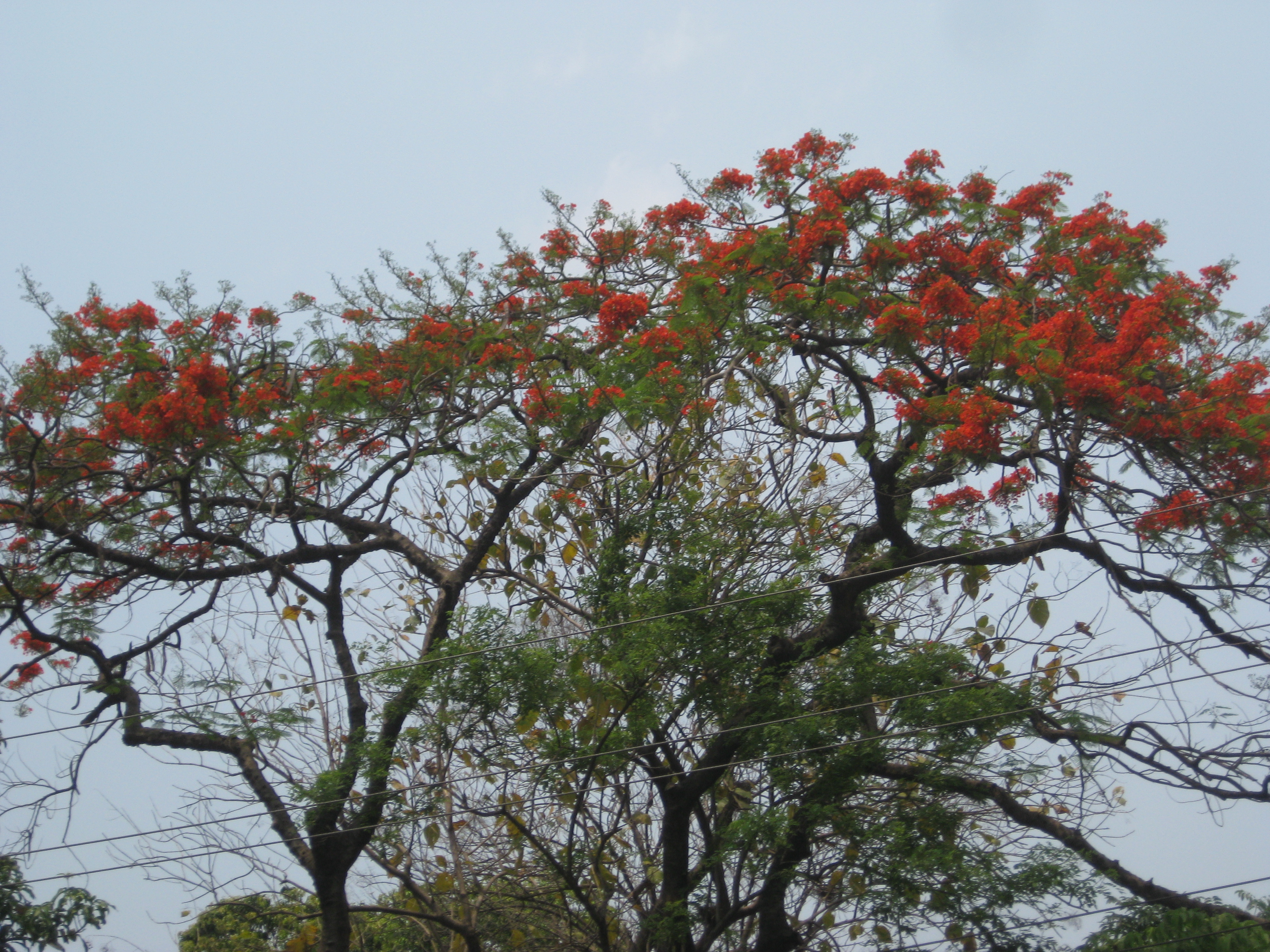
A Chittagong University professor involved in the inventory noted that 62 per cent of Dhaka's trees are non-native, and recommended that future greening projects give priority to species such as mango, black plum, white koroi, jackfruit and konokchura over purely ornamental trees. In the lakeside study, three of the five most abundant species, mahogany, Khaya anthotheca and krishnachura, were exotic.
Photo: Md. Shafiqul Islam Chowdhury 'Tutul' / Wikimedia Commons (CC BY-SA 3.0). The top picture shows the Rabindra Sarobar stage on Dhanmondi Lake with trees along the far bank, an earlier view of the place and not of the ceremony.
Sources: Jagonews24, United News of Bangladesh, Bangladesh Sangbad Sangstha, Prothom Alo, The Business Standard, The Daily Star, Dhaka Tribune, The Financial Express, Banglapedia, Bangladesh Journal of Plant Taxonomy, Jagannath University Journal of Life and Earth Sciences, Land (MDPI), Eco-Business, RAPSI, Obyasnyaem.rf (Russian government information portal).
Comments
(0)