
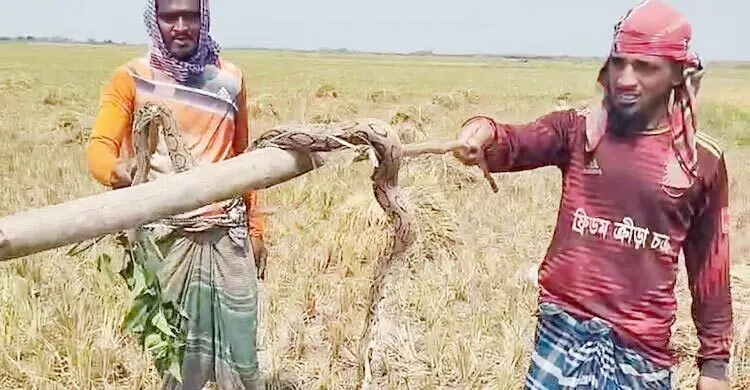
For several years the venomous Russell's viper has been a source of fear in the north-western part of the country. It has spread especially in the districts along the Padma, and via the Padma and Meghna it is now also being found in Chandpur and Chattogram.
As the number of Russell's vipers grows, so does the number of people bitten. But because hospitals do not have its antivenom, deaths are rising. Although medicines made in Bangladesh are exported to 157 countries, no local drug company has yet produced antivenom for venomous snakes. Incepta Pharmaceuticals Limited imports antivenom from India and supplies it in the country, but it is not at hand when it is needed.
A study by the Non-Communicable Disease Control (NCDC) branch of the Directorate General of Health Services, published in 2023, found that about 403,000 people in the country are bitten by snakes every year, and 7,500 of them have died.
Deaths on the Padma chars
Farmer Hafizur Rahman Sohel died recently after a Russell's viper bite on the Dikrir Char at Ishwardi in Pabna district, on the bank of the Padma. His relative Hasan Adib told Jago News that after the 42-year-old was bitten in a field on the char, he was taken first to Ishwardi Upazila Health Complex and then to Pabna Medical College Hospital. No Russell's viper antivenom was available anywhere. Even after going from hospital to hospital, he did not get proper treatment, and he died untreated.
Hasan Adib said: "We learned that in the north, only Rajshahi Medical College Hospital (RMCH) has antivenom. But Russell's vipers have spread through the crop fields of Kushtia, Pabna and Natore. It takes two and a half hours just to get a bitten patient from these districts to Rajshahi. Doctors say venom [antivenom] must be given within 100 minutes, that is 1 hour 40 minutes, of the bite. Hospitals in Kushtia and Pabna do not have that facility. Yet Russell's vipers are most common in Pabna, Kushtia, Natore, Rajshahi, Naogaon and Meherpur."
Shortly before this, Rajshahi University student Shakinur Rahman Sabbir died from a Russell's viper bite. His classmates and friends said Sabbir was chatting with friends on the bank of the Padma. He was bitten when he reached for a paper packet he had thrown away after eating jalebi, to wipe his hands. He was rushed to Rajshahi Medical College Hospital for treatment but could not be saved.
So far this year, at least 10 deaths from Russell's viper bites have been reported in districts along the Padma, including Rajshahi, Rajbari and Manikganj. In the three months from March to May this year, five people died from the snake's bites in the char areas of Harirampur in Manikganj alone.
Why locally made antivenom matters
According to the World Health Organization (WHO), antivenom made from local snakes is the most effective for treating snakebite patients, because the nature and type of snakes differ from country to country. Only 20 per cent of the snakes from which venom is collected in India match Bangladesh's snakes. Yet for years, snakebite patients in Bangladesh have been treated with antivenom made in India.
To reduce snakebite deaths, research on making venom from snakes found in the country is under way at Chittagong Medical College under the Directorate General of Health Services' non-communicable disease control programme.
Dr Abdullah Abu Sayeed, a researcher at the Venom Research Centre, told Jago News: "We carried out a national survey on snakebite. It showed that about 7,500 people die of snakebite in the country every year, and more than 400,000 snakebites occur."
He said: "The main aim of our Venom Research Centre was to collect venomous snakes, then rear them and collect their venom. Venom collection is now under way. Antivenom of 11 kinds of venomous snake in our country has been collected. But antivenom cannot be made quickly; the process is very long. Many tests on this venom are now going on, and many tests at this stage are not done in our country. Recently, with WHO's help, some venom was sent to a laboratory in Spain. We have to identify the character of our venom."
Although many snakes bite in Bangladesh, most are not venomous. The common venomous snakes in the country belong to the elapid group, a family of venomous snakes found in tropical and temperate regions, mainly across the Indian Ocean and Pacific regions. So far 61 genera and 325 species of this family are known, the cobra among them. The Viperidae, also known as vipers or viperids, are one of the four families of venomous snakes found in the world, and they are found worldwide except in Antarctica, Australia, New Zealand, Ireland, Madagascar, Hawaii and the Arctic Circle region. The Viperidae group includes the green viper and the Russell's viper. These are venomous snakes of our country.
How the viper spread
Professor Farid Ahsan of the zoology department at the University of Chittagong told Jago News that about 104 species of snake are found in the country, 30 of them venomous, including the Russell's viper. The Russell's viper lives in dry or low-lying areas, but it can live equally well in water. Because it gives birth to live young rather than laying eggs, it breeds more. In many cases it may spread from place to place on water hyacinth in the char areas.
Professor Farid Ahsan said the Russell's viper gives birth to many young at once. For many years there was no news of it in the country. Around 2011-12 it was seen at Tanore in Rajshahi. It then spread beyond Rajshahi, along the Padma and Jamuna and via the Meghna to Chandpur. Now many are found in Manikganj. The snake moves along river basins, it is breeding fast and spreading to different places.
On the other hand, because the Russell's viper's colour closely matches the colour of the soil, farmers often do not notice it and are bitten while working.
What to do after a bite
Advice from the UK's National Health Service says that after any kind of snakebite, one should stay calm and seek medical treatment quickly. The bitten part of the body should be moved as little as possible. Watches or jewellery should be removed. If the bite is bound with cloth, it should be loosened but not removed.
- Do not try to suck the venom out of the bite.
- Do not cut the bite further or make it bleed to try to get the venom out.
- Do not apply ice, heat or any chemical to the bite.
- Do not leave the victim alone, and seek a doctor's advice quickly.
Researcher Farid Ahsan said that during rain or in the monsoon, when low-lying areas are flooded, snakes take shelter on dry ground, and much more caution is needed at such times. Farmers should wear jeans before going into farmland so they are not bitten, and should stir the field with a bamboo pole before entering so that any snakes move away. After a snakebite, the victim must go to the nearest hospital quickly.
The antivenom available in the country is used after bites from four types of snake. Research on making Russell's viper venom [antivenom] is going on but has not yet succeeded, and no private drug company in the country has made antivenom.
Supply of antivenom
Asked what steps are taken over Russell's viper attacks and snakebite deaths, Nushayer Chowdhury, deputy programme manager of the non-communicable disease control programme (NCDC), said: "Snakes have become more common. So we bought 10,000 antivenoms from Incepta through Essential Drugs Company Limited. We also had 10,000 antivenoms with WHO's help. WHO's 10,000 have been supplied to hospitals across the country. Of the 10,000 we bought, 3,000 have been given, and the remaining 7,000 will be given according to demand. Demand will rise when the monsoon begins, and we will send them then."
Saying there is no shortage of antivenom, Nushayer Chowdhury added: "In many cases hospitals are late in placing their demand. They should apply before the antivenom runs out or as soon as it does. But their carelessness sometimes causes danger." He said: "In Bangladesh only Incepta imports antivenom from India. We are forced to buy from them."
Farhana Laizu, senior manager at Incepta Pharma, said: "The government places orders and buys antivenom from us. We also sell privately." She said: "In the case of Russell's viper, treatment must be sought quickly. Patients also come from remote areas and it takes them time to reach a hospital facility. If antivenom is kept in the pharmacies of nearby health facilities, hospitals can use it when needed."
Antibodies from hens and goats
Dr Abdullah Abu Sayeed of the Venom Research Centre said that although antivenom has not yet succeeded, the centre is making antibodies from Russell's viper venom. First, a set amount of the venom is given to hens, and the antibodies are found in their eggs; the antibodies are then collected from the egg albumin. Venom has also been given to goats, and antibodies have been separated from their blood. Antibody purification is now under way, after which the researchers will test it on mice to see how effective the locally made antibody is. The kind of antibody they are trying to make would allow 100 per cent treatment of Russell's viper bites, he said, whereas patients bitten by the snake cannot be saved even after Indian antivenom is given.
He said results on the separation and purification of the antibodies could be given this year. "Our project on the antibody separation data will end this year. And if in future we have a good quantity of venom, with mapping done and the work of separating its character completed, we will go a long way in the process of making antivenom."
Source: Jagonews24. First published in Bengali on The Agro News.
Comments
(0)