
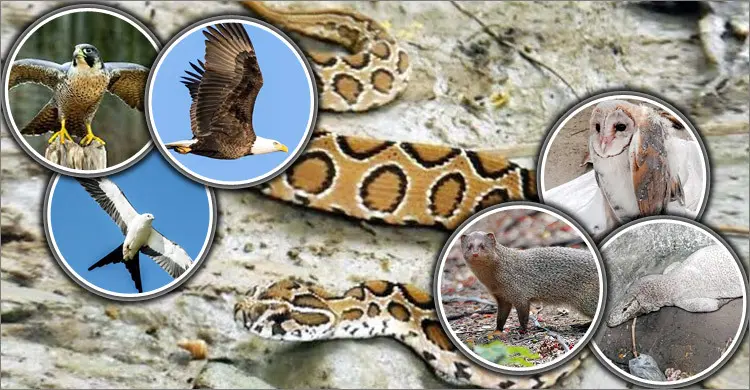
The venomous chandrabora, or ulubora, snake had almost disappeared. Over the past few years, and especially this year, it has spread fear under its English name, Russell's viper. Once seen in the country's Barind region, it has now spread to 32 districts.
Experts say Russell's vipers (chandrabora) are ranging more widely in the country because snake-eating animals are facing extinction. As the snake's range grows, the number of people bitten is also rising. Most patients recover after being taken quickly to hospital and given antivenom injections (used to treat snakebite patients), but some die because time is wasted on treatment and ritual healing by an ojha or baidya (faith healer) and antivenom is not given in time.
Panic across the country
Meanwhile, fear of the Russell's viper has spread to all 64 districts of the country. Facebook pages are flooded with posts about it, and ordinary non-venomous snakes are being killed and called Russell's vipers. On 21 and 22 June, locals in Lohagara upazila of Chattogram beat two pythons to death, thinking they were Russell's vipers.
On the evening of 22 June, villagers in the Lalchamar area of Kapasia union in Sundarganj upazila, Gaibandha, beat a young python to death thinking it was a Russell's viper. On the night of 23 June, two snakes were killed in Patgram, Lalmonirhat, on suspicion of being Russell's vipers.
In addition, some videos that have gone viral on Facebook from Feni and other districts show non-venomous snakes being killed and passed off as Russell's vipers. Experts believe that killing Russell's vipers and other venomous and non-venomous snakes is affecting the ecosystem.
Asim Mallik, inspector at the Wildlife Crime Control Unit, told Jagonews24 that with the Russell's viper panic spreading across the country, each of the five hotlines of the Forest Department's Wildlife Crime Control Unit is receiving an average of 50 calls an hour. People call in panic as soon as they see any snake, and some even kill a snake and then call the department asking for reward money. Checking the information people give over the phone shows that 80 per cent of the snakes killed are non-venomous, he said.
Prof Dr M A Faiz, a snakebite specialist, president of the Toxicology Society of Bangladesh, former director general of the Directorate General of Health Services and professor of medicine, has written a book on snakebite and its treatment. In it he notes that without treatment, a patient may die on average 8 hours after a cobra bite, 18 hours after a krait bite and 72 hours, or three days, after a chandrabora or Russell's viper bite.
In Bangladesh snakes usually become more common in the monsoon. Bangladesh is a low-lying downstream country, and in the rainy season many areas are flooded. When water enters their habitats, many species of snakes and insects take shelter in settlements or on higher ground. Bangladesh has about 94 species of snake, about three-quarters of which are non-venomous. The venomous snakes found in Bangladesh belong mainly to the Elapidae family, while some from the Viperidae and the marine Hydrophiidae families are also found.
Asked about this, Asim Mallik said the snake that has suffered most from people's panic over the Russell's viper is the harmless ghorginni, which many people mistake for a young Russell's viper. Villagers who do not recognise this snake spread fear in their area by saying a Russell's viper has been found.
Why the snake is spreading
Experts say snakes are multiplying in the country mainly because of changes in the ecosystem. With snake-eating animals facing extinction, snakes have spread. For example, an owl eats one snake or rat a day, so if an area had 20 owls they would eat 20 snakes or 20 rats a day. Owls were once seen in large numbers in forests and villages, but as their numbers fell, fewer snakes and rats were eaten. Snakes now breed undisturbed, and instead of becoming food those snakes breed further.
Asim Mallik sees the decline of snake-eating animals such as mongooses, monitor lizards, owls, eagles, kites, hawks and jungle cats as the reason the Russell's viper's range has grown. He said the country used to have many chars where ordinary people did not go for fear of snakes or wild animals. Snakes, mongooses, monitor lizards, owls, eagles, kites, hawks and jungle cats lived there. But farmland gradually expanded, and these animals lost their place. Pesticide use on cropland and shrinking forests harmed them. Snakes were on their menu, so without these animals most of the snakes that bred survived. Then, during floods, Russell's vipers spread to various flooded districts riding on water hyacinth or with the tides.
Snakebite specialist Prof Dr M A Faiz said the chandrabora is a very sluggish snake that travels on water hyacinth. It does not charge at people or run away when it sees them, and does not flee even after biting. As a result, victims see the snake and doctors can quickly give the right antivenom. For this reason too, it is less of a worry than other venomous snakes, he said.
The former director general said people cannot stop snakes breeding by killing them with their own hands. To curb snake breeding, campaigns must be run to protect snake-eating kites, owls, jackals, jungle cats, monkeys, monitor lizards, mongooses and several other animals, so that snake numbers are controlled naturally.
Recorded in 32 districts
Zoologists say the Russell's viper has long been, and still is, present in Bangladesh. In the book Bangladesher Sap (Snakes of Bangladesh), published by the Bangla Academy in 1992, wildlife expert Md Ali Reza Khan says the chandrabora is found most in Rajshahi division. In 2013, a snakebite patient from Nachole upazila in Chapainawabganj came to Rajshahi Medical College (RMC) Hospital with the dead snake, which was identified as a Russell's viper.
The Venom Research Centre at Chittagong Medical College says Russell's vipers were found in 32 districts of the country from 2013 to May 2024. Its data show the snake's range has been growing since 2013: it was seen in 9 districts between 2013 and 2016, rising to 11 districts in 2018. In 2023 Venom Research Centre researchers recorded it in 23 districts, and by May 2024 it had been seen in 32. This picture did not emerge overnight; it took 11 years, from 2013 to 2024.
The districts where Russell's vipers have been seen are Nilphamari, Dinajpur, Rangpur, Bogura, Chapainawabganj, Rajshahi, Pabna, Natore, Jashore, Satkhira, Khulna, Bagerhat, Chattogram, Rajbari, Faridpur, Madaripur, Shariatpur, Manikganj, Dhaka, Munshiganj, Kushtia, Chuadanga, Meherpur, Jhenaidah, Chandpur, Noakhali, Lakshmipur, Bhola, Barishal, Patuakhali, Jhalakathi and Barguna.
Source: Jagonews24. First published in Bengali on The Agro News.
Comments
(0)