
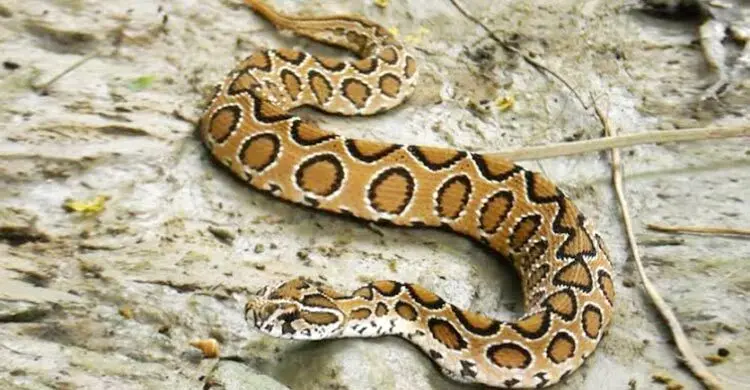
The Ministry of Environment, Forest and Climate Change has issued a statement urging caution and awareness following recent reports of Russell's viper (known locally as chandrabora, bora or ulubora) being seen in various parts of Bangladesh, and growing public concern about it.
The ministry said that although the presence of Russell's viper is worrying, it is important to remember that people are unlikely to come face to face with the snake. It usually lives in low-lying grassland, scrub, open forest and farmland and avoids human settlements. Its earthy colour lets it blend easily with the soil. If a person goes very close to it without noticing, the snake senses danger and strikes out of fear. Because Russell's viper is a skilled swimmer, it has spread to different areas of the country with river currents and floodwater. The ministry asked everyone to take precautions.
How to avoid snakebite
- Take extra care when moving around in areas where the snake has been seen.
- Be careful when walking through long grass, bushes and farmland. Do not put your hands or feet into holes.
- Wear boots and long trousers when working in these areas.
- Always use a torch when moving about at night.
- Keep the surroundings of your home clean and free of rubbish.
- Take special care when moving fallen trees, firewood or straw.
- If you see a snake, do not try to catch or kill it.
- If needed, call the national helpline 333 or inform the nearest Forest Department office.
What to do after a snakebite
- Do not move the bitten limb. If bitten on the leg, sit down and do not walk; if bitten on the arm, do not move it. Moving the joints makes the muscles contract, which can spread the venom quickly through the blood and cause poisoning.
- Gently wash the bite with soap or gently wipe it with a wet cloth.
- Remove any watch, jewellery, amulets or threads.
- Do not cut the bite, prick it with a needle, or apply any paste or anything else to it.
- Do not waste time by going to a traditional snake healer (ojha).
- Go to the nearest hospital or health centre as quickly as possible.
- Do not panic: antivenom for Russell's viper is available free of charge at the nearest government hospital.
Reducing the spread of Russell's viper
Mongooses, monitor lizards, large Indian civets, small Indian civets, jungle cats, fishing cats, crested serpent eagles, storks, lesser adjutants and some species of snake eat Russell's vipers and keep their numbers in check. Because people kill these wild animals indiscriminately, Russell's viper numbers are rising in nature. The ministry asked people not to kill wildlife needlessly on sight and not to destroy their habitats.
It should be remembered that Russell's viper is a protected animal under section 6(1) of the Wildlife (Conservation and Security) Act 2012. By eating rats it protects crops, and it plays an important role in keeping the environment in balance and conserving biodiversity. Many life-saving medicines are made from its venom. Killing snakes is a punishable offence, and people should refrain from it.
Source: Jagonews24. First published in Bengali on The Agro News.
Comments
(0)