
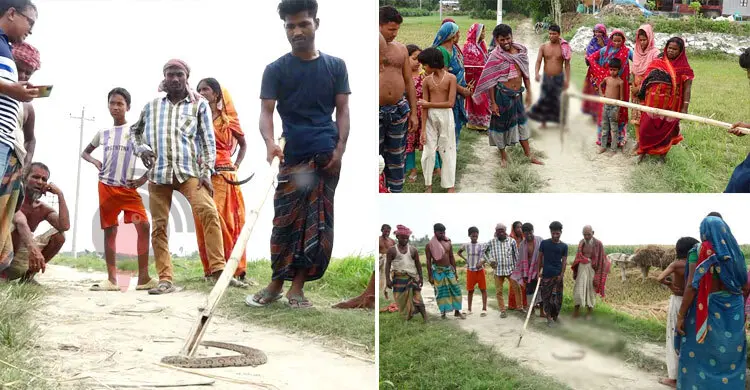
The venomous Russell's viper (chandrabora) has become a growing menace along the banks of the Padma. In the last three months at least five people have died of its bites in the char areas of Harirampur upazila in Manikganj, and locals have killed more than 20 of the snakes. The sudden rise has left people on the chars living in fear.
Harirampur Upazila Nirbahi Officer (UNO) Md Shahriar Rahman and local public representatives confirmed the information.
Snakes in the paddy and maize fields
The snakes are seen most in Azimnagar and Lesraganj unions, both on the far side of the Padma. It takes 45 minutes by engine-driven trawler to reach Azimnagar char from the upazila's Andharmanik ghat. Visiting Azimnagar char on Monday (3 June) and travelling several kilometres by motorcycle, this correspondent came across a Russell's viper, the country's most venomous snake.
Farm labourer Samad Sekh of Kazirkanda village in Lesraganj union spotted the snake while working in a paddy field. Hearing his shouts, people nearby came with sticks and killed it.
Abubakkar of the same village said Samad Sekh had a narrow escape and could have been bitten with a moment's carelessness. "What else can we do but kill the snakes? We have to survive too," he said.
Several more men and women of the village gathered, all speaking of their fear of the viper. They are afraid even to step out of their homes. It is the paddy harvesting season, but farm labourers cannot be found. The snake is being seen most in paddy and maize fields.
Deaths and no treatment nearby
Lal Mia (38), son of Idris Sekh of Kazirkanda village, died of a Russell's viper bite. He was bitten three months ago while working on farmland. He was first given local folk treatment (jhar-phuk), then admitted to a hospital in Faridpur, where he died after three days of treatment. He was buried in the yard of his home, and his wife has been left helpless with two small children.
Local farmer Shamser Ali said another man, Tota Mia, died in a neighbouring village some days ago. By their count at least five people have died in three months, and several others, including a woman, have been injured by bites.
Lesraganj Union Parishad Chairman Moazzem Hossain said that with no hospital in the area, snakebite patients cannot get treatment in time. By the time they cross the Padma to reach a hospital their condition has worsened. People are beating the snakes to death as soon as they see them.
Harirampur Upazila Health and Family Planning Officer Dr Meheruba Panna said many people waste time with an ojha (traditional healer) after a snakebite. A patient's chances of survival are higher if they go straight to hospital for treatment, and she advised taking victims to hospital quickly.
She added that Harirampur Upazila Health Complex has no antivenom and no capacity to treat snakebite patients. Any such patient is referred to Manikganj Colonel Malek Medical College Hospital.
Administration plans awareness drive
UNO Md Shahriar Rahman said he had learned of the Russell's viper menace on the Padma chars through public representatives. Steps including miking will be taken to raise public awareness, and an initiative has been taken to distribute gumboots among farmers.
He said the snake reached the Manikganj chars along the Padma basin, perhaps on water hyacinth or by some other means, and has bred more because there has been no major flood for several years. The country's most venomous snake gives birth to live young instead of laying eggs.
Source: Jagonews24. First published in Bengali on The Agro News.

Comments
(0)