
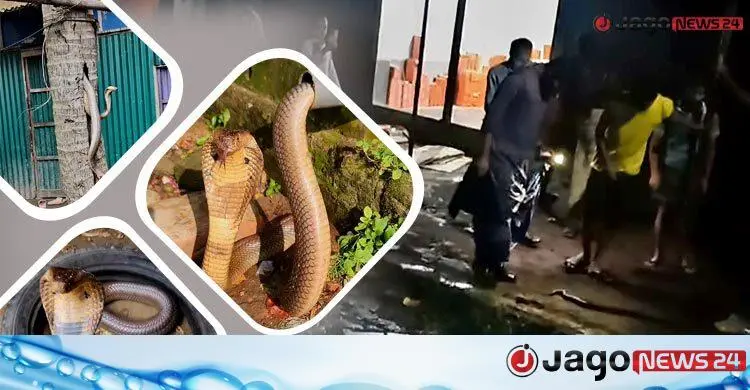
Waterlogging caused by monsoon rain has triggered a snake scare in Rupganj, Narayanganj. Continuous rain, waterlogging and flooded fields have led to an alarming rise in both venomous and non-venomous snakes. Snakes are being seen almost every day in homes, courtyards, crop fields and around homesteads.
Residents are living in fear as snakes move closer to settlements. Many people in the upazila's low-lying areas no longer leave home after dark unless they have to. Locals complain that the problem becomes acute every monsoon and that no effective step is taken to solve it.
Why the snakes are moving in
For most of the year snakes stay in areas away from people and are rarely seen. But when fields and low-lying land go under water during the monsoon, they move into settlements looking for safe shelter. Bushes, abandoned plots, clogged drains and stagnant water make matters worse. Snakes are regularly being seen on paths through courtyards and around houses.
Victims said continuous rain has waterlogged many areas of the upazila, including Kanchan Hatabo Tekpara, Kaladi, Nalpathar, Narabo, Kushab, Aitala, Dulurdia, Tarabo, Barpa, Bhulta, Golakandail, Madhyapara, Dakshinpara, Nagerbag, Boubazar, Bagmorcha, Khalpar, Islambag, Natun Bazar, Kandapara, Balaikha, Bijoynagar, Madinanagar, and Tetlabo, Shantinagar, Baganbari, West Kandapara, North Masabo and Jatramura in Tarabo municipality, as well as Majhipara, Sonab, Pachaikha and Islampur in Rupshi and Bhulta unions.
Reports of snakes come in almost daily. In some places snakes have entered bedrooms, in others kitchens or cowsheds, spreading panic. Many families now search the whole house before going to bed.
Residents' accounts
Al Amin Sheikh of Tetlab Khalpar told Jagonews: "At night I saw two snakes trying to get into the house. When I shouted 'snake, snake', everyone nearby came running. We managed to kill one, about four cubits long, but the other got away."
Asia Akter, a housewife in Shantinagar, said: "I'm scared even to go to the toilet at night. A few days ago a snake was seen in the kitchen. Since then I haven't let my children go anywhere alone." She added: "We used to see a snake once or twice a year; now we hear of one almost every day. There is fear among local people."
Selim Bhuiyan of Karnagop said: "On the afternoon of 17 July a snake got into the house of my nephew Rasel. When they shouted, neighbours rushed over and killed the snake, which was five and a half feet long. We are very frightened with the children."
In his view, it is not only monsoon water: unplanned urbanisation, filling of wetlands and destruction of natural habitats are also bringing snakes closer to human settlements, and the authorities concerned should act.
Health officer's advice
Rupganj Upazila Health Officer Dr Tansiv Zubayer told Jagonews that the risk of snakebite is higher in the monsoon. But for lack of awareness, many people still rely on faith healers and superstition, which delays their arrival at hospital and puts patients' lives at risk.
"If someone is bitten by a snake, keep the person calm and bring them quickly to the health complex," he said. "The hospital has enough antivenom and specialist doctors. A snakebite patient can be saved if antivenom is given in time."
Source: Jagonews24. First published in Bengali on The Agro News.

Comments
(0)