
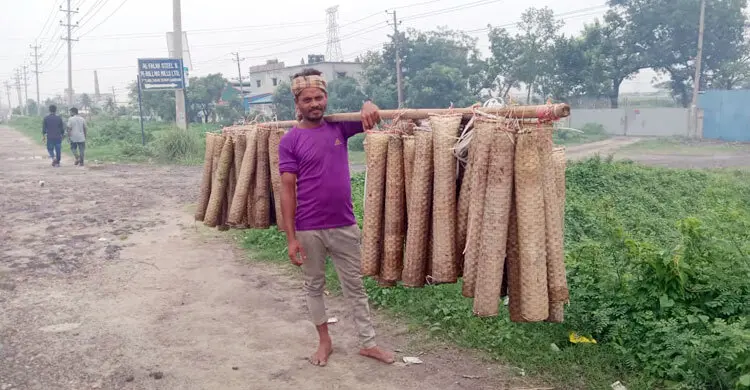
Kuchia, or mud eels, that breed and grow naturally in the canals, beels, ditches, paddy fields and open and closed water bodies of Rupganj in Narayanganj are going abroad. More than a hundred hunters set bamboo tube traps, known as chonga or oka, using a special method, and catch about 500 to 600 kg of kuchia every day. Together they earn about Tk 50 to 60 lakh a month.
There is a small kuchia market at Masab in the Tarabo municipal area of the upazila. Wholesale buyers come from Dhaka every day to buy from the hunters there. The eels change hands from depot owners to wholesalers and then, through exporters, go abroad. More than a hundred families here make their living from hunting kuchia.
A fish in demand abroad
Kuchia is known in different places as kuche baim, kuche mach or kuichcha. Its skin is smooth, slippery and scaleless, and its body dark brown. It grows 60 to 70 cm long. It is nutritious and tasty and has medicinal properties. Kuchia is not widely eaten in the country, but there is strong demand abroad. Large quantities from all over the country are exported every day to Thailand, Hong Kong, China, Japan and other countries.
Hunters, wholesalers and depot owners said they once farmed their own land to support their families. Facing losses, they gave up farming and came to Rupganj. Unable to find other work here, they took up this unusual trade. Most came from Moulvibazar, Habiganj, Kishoreganj, Mymensingh and other districts. About a hundred families live by catching and selling kuchia.
The hunters work in Karnagop, Bangshinagar, Nagaon, Shantinagar, Bhulta, Bhayela, Paragaon, Miabari, Hatab, Amlab, Kali, Baraipar, Panchaikha, Golakandail, Kayetpara and other areas of the upazila. Every afternoon each hunter baits 100 to 150 chonga or oka traps with earthworms and sets them in shallow water along pond banks, canals, beels, ditches and paddy fields. A hunter catches an average of 5 to 6 kg of kuchia a day.
From Rupganj to exporters in Uttara
Kuchia sells for Tk 300 to 350 a kg, so a hunter can earn about Tk 1,500 to 2,000 a day. On that basis the upazila's hundred or so hunters earn Tk 50 to 60 lakh a month. Wholesalers come from Dhaka every day to collect the eels from the small market at Masab in Tarabo municipality. Many hunters, hoping for a little more profit, sell at depots in Uttara House Building, Konabari and other areas of the capital. After changing hands, the eels are exported abroad.
In Bangshinagar, Swapan Biswas was hurrying out to hunt kuchia with a load of tube traps on his shoulder. He said farming in his village did not bring in much, and he lived in hardship. One day Sanatan Sarkar told him he had a kuchia depot in Rupganj and that good money could be made hunting kuchia here. He came with him, and now, after covering household costs, he is able to save from selling the eels.
Kuchia hunters Shahadat Hossain and Subed Ali said they are from Chandra in Karimganj upazila of Kishoreganj. They have lived in various parts of Rupganj for a long time hunting kuchia. Setting 100 to 150 traps a day yields 5 to 6 kg of kuchia, which sells for Tk 1,500 to 2,000.
They said many people from their area have come here and chosen this work. Because the income is good, about a hundred people from different areas, including Zakir Hasen, Ramzan, Maju, Uhad Ali and Kashem from Habiganj and Dulal, Babul and Deen Islam from Mymensingh, have taken it up.
Depot owner Sanatan Sarkar said: "My home is in Habiganj district. With no work there, I came here several years ago looking for a job and got into this trade. Fifty to 60 hunters sell kuchia at my depot. Many others sell at depots in Dhaka. About a hundred kuchia hunters in Rupganj support their families through this work."
Dilip Biswas, a wholesaler from the capital, said he belongs to a group of 11. They collect kuchia from depot owners and hunters in Rupganj, the districts around Dhaka and elsewhere in the country, and sell them to several exporting firms in Uttara, Dhaka. Every month they supply 60 to 80 tonnes of kuchia to exporters.
Rupganj upazila fisheries officer Imran Hossain told Jago News: "Because kuchia is in good demand abroad, farming and marketing it has become a profitable trade. If kuchia can be farmed commercially through training, it will contribute to the national economy and create jobs. The Department of Fisheries is working on taking up commercial projects."
Source: Jagonews24. First published in Bengali on The Agro News.



Comments
(0)