
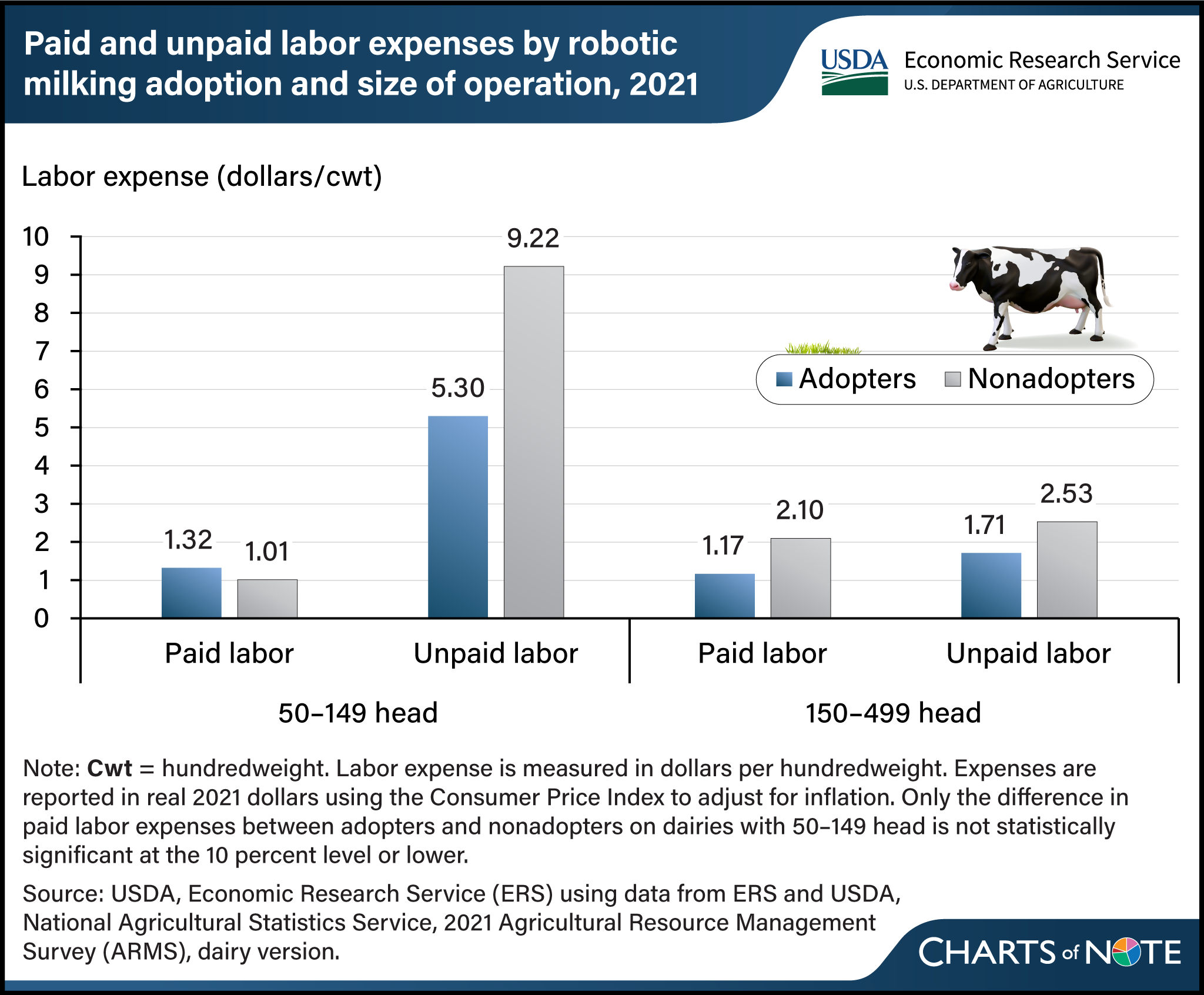
Robotic milking lowers what a dairy spends on labour, but which labour bill it lowers depends on how many cows the farm milks, according to a Chart of Note from USDA's Economic Research Service (ERS).
In a robotic milking system, cows enter a box-like stall, are milked automatically without manual labour and walk out. The systems are becoming more common on U.S. dairies, ERS says, but their effect on labour expenses varies with herd size.
On smaller dairies with fewer than 150 head, paid labour is often hard to find and afford, so the operator and household members do much of the work unpaid. ERS values that unpaid work as an opportunity cost, using average wage rates and the hours the operator reports working.
Survey data show that dairies with 50 to 149 head that used robotic milking had substantially lower unpaid labour expenses in 2021 than dairies that had not adopted it: $5.30 per hundredweight (cwt) of milk compared with $9.22 per cwt. Small dairies also pay for some hired labour, but those paid expenses were not statistically different between adopters and nonadopters.
As herds grow, dairies rely more on paid workers for milking and the other tasks that come with more cows. On midsized operations with 150 to 499 head, robotic milking adopters spent $1.17 per cwt on paid labour in 2021, significantly less than the $2.10 per cwt averaged by nonadopting farms.
ERS says the differences suggest robotic milking could help dairy farmers reduce their labour expenses, with the effect depending on farm size. For a family dairy the saving shows up as hours returned to the household; for a midsized one it appears on the payroll. The chart, prepared by ERS economist Jonathan McFadden, is drawn from the report Precision Dairy Farming, Robotic Milking, and Profitability in the United States, published in January 2026.
Source: USDA Economic Research Service


Comments
(0)