
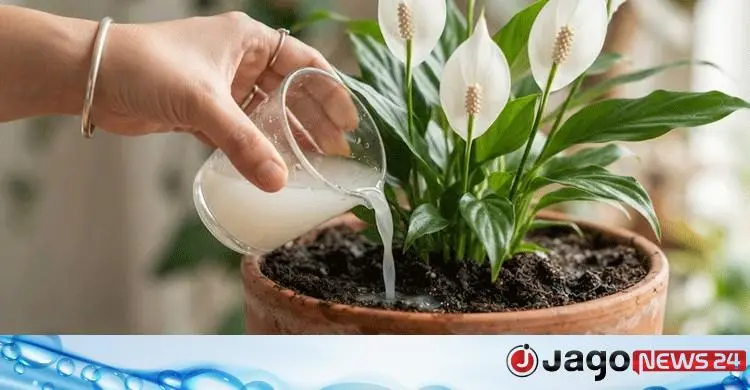
Some kitchen scraps that would otherwise be thrown away can be used to care for house plants, and water left from washing rice, or the starch drained from cooked rice, is a well-known home remedy. Rice water may contain small amounts of starch and some minerals, which can help add organic matter to the soil.
That does not mean rice water or rice starch should be poured at will around the base of every plant. With indoor plants in particular, excess water that collects can do harm instead of good, so it is important to know how to use it on which plant.
Plant by plant
Many people keep a peace lily to brighten their homes. With its green leaves and white flowers, it grows beautifully with the right care. Clean rice water can be used on its soil from time to time, but water must not be left standing in the pot. It is best used in moderation, depending on the state of the soil and the plant.
The money plant, or pothos, is one of the most popular indoor plants for homes and offices because it grows with little care. Rice water can be given now and then to money plants grown in soil. Giving rice starch at the base once a week helps keep the leaves from yellowing easily. Rice water can be poured into the pots of any pothos, not just the money plant.
The snake plant tolerates relatively little water, and overwatering it can be dangerous. So give it rice water only once every 10 to 15 days, where it works as a fertiliser, and only after the soil has dried out.
What to avoid
Rice water should not be seen as a substitute for a plant's regular fertiliser. How much water and nutrition a plant needs depends on its type, the pot, the soil and the environment, so what helps one plant may not have the same effect on another.
Water used for plants must not contain salt, oil, spices or any other cooking ingredient. Starch from cooked rice that has salt or spices mixed in should not be given to plants.
It is better to pour rice water on the soil than to spray it directly on the leaves. If starchy water repeatedly settles on leaves, dirt can stick to them and, in humid conditions, the risk of fungal problems can rise.
No single rule for using rice water suits every indoor plant. In general, occasional use in moderate amounts is safe. Most important is not to water again before the soil has dried. If the pot has no drainage hole, the risk of overwatering is even greater.
Look after plants as needed by watching leaf colour, soil moisture and growth. Remember that the key to healthy plants is not rice water alone: enough light, correct watering, good soil and a balance of the necessary nutrients matter most. The article draws on the Times of India.
Source: Jagonews24. First published in Bengali on The Agro News.

Comments
(0)