
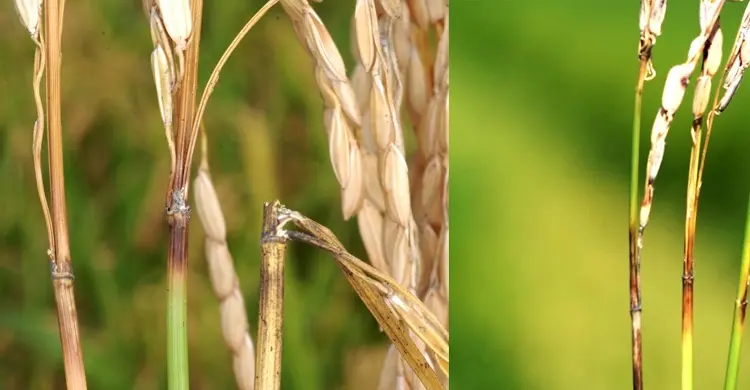
Blast is a serious fungal disease of rice. It usually appears in the Boro and Aman seasons, and in favourable weather an attack can cut the yield by up to 100 per cent.
The disease can appear at any time from the seedling stage until the rice ripens. It attacks the leaves, the nodes and the neck or panicle of the plant, and is accordingly known as leaf blast, node blast and neck blast.
Neck blast is more common in all aromatic varieties in the Aman season, and in the Boro season in slender, early and aromatic varieties including BRRI dhan28, BRRI dhan50, BRRI dhan63, BRRI dhan81, BRRI dhan84 and BRRI dhan88. The Agriculture Information Service has set out what farmers should do to control it.
What to do after the disease appears
- Temporarily stop top-dressing affected fields with urea fertiliser.
- If 1–2 inches of water can be kept standing in the field in the early stage of blast, the spread of the disease is greatly reduced. The disease is more common in dry fields.
- If leaf blast appears, top-dress with an extra 5 kg of potash fertiliser per bigha.
- Blast spores spread quickly from place to place, mainly through the wind. When the weather is warm by day (25–28 degrees Celsius) and cool at night (20–22 degrees Celsius), with long dew-soaked mornings, high humidity (85 per cent or more), cloudy skies, stormy weather and drizzle, farmers should spray whether or not the disease has appeared: once when the panicles are emerging from the boot, and again 5–7 days later. For every 5 decimals of land, mix 6 grams of a tebuconazole 50% + trifloxystrobin 25% group fungicide, or 8 grams of a tricyclazole group fungicide, thoroughly in 10 litres of water and spray late in the afternoon.
Once neck blast has set in, there is no way to control it.
Source: Jagonews24. First published in Bengali on The Agro News.
Comments
(0)