
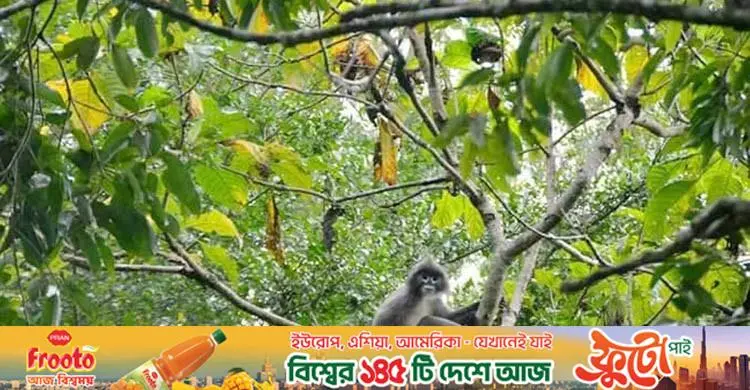
Rema-Kalenga is a deep forest of great natural beauty, green in every direction. The country's second-largest forest has rare trees and many rare animals, which are often seen roaming freely in the treetops. Its beauty delights tourists and nature lovers. A few years ago there was nowhere for visitors to stay; now there are several cottages where they can spend the night. The forest covers a large area of Chunarughat upazila in Habiganj and extends beyond the district to Sreemangal in Moulvibazar and India's Tripura state.
After the Sundarbans, Rema-Kalenga ranks second in size and age. Rema-Kalenga Sanctuary is a protected forest and wildlife sanctuary in Bangladesh—a dry, evergreen forest and the richest in the country for flora and fauna. It was established as a sanctuary in 1982 and expanded in 1996, and now covers 1,795.54 hectares. It is one of the few natural forests in Bangladesh still in reasonably good condition. The whole area is divided into Rema, Kalenga, Chhonbari and Rashidpur beats, and 11 units and 7 camps look after it.
Rich biodiversity
The sanctuary is rich in rare biodiversity. It has 37 species of mammals, 215 species of birds, seven amphibians, 18 reptiles and 638 species of trees, plants and climbers. It is well known for rare birds, including the greater racket-tailed drongo, parakeets, common hill myna, red-headed trogon, red-whiskered bulbul, great hornbill, vultures, kalij pheasant, red junglefowl, owls, kingfishers, eagles and kites.
Three species of monkey live in the forest: the pig-tailed macaque, rhesus macaque and the nocturnal slow loris. Five species of squirrel are also found, including the rare Malayan giant squirrel, found only in this forest. Other notable wildlife includes the capped langur, Phayre's langur, hoolock gibbon, barking deer, fishing cat, wild boar, common palm civet, mongoose and porcupine. Eighteen species of snake, including the king cobra, are found here. Snakes, birds, squirrels, monkeys and langurs roam freely in the treetops.
The Malayan giant squirrel
Behind the dense green it is as if another world lies hidden. Sunlight filters through the leaves to the ground, and all around is silence. In that silence, unusually large squirrels suddenly appear high in the branches, racing from branch to branch with long tails and big bodies. This is an everyday sight. The animal is not an ordinary squirrel but the Malayan giant squirrel, one of the largest squirrel species found in Bangladesh. An adult's body can be about 60 cm long, with a tail almost as long, so it can measure more than a metre from head to tail tip. It is reported to weigh up to about two kilograms. Its black, brown or reddish-maroon body and thick bushy tail easily set it apart from other squirrels, and the long tail helps it balance as it moves quickly through the treetops.
Dr Subash Chandra Deb, professor of zoology at Habiganj Brindaban Government College, told Jago News: "It is hard to keep animals like the giant squirrel alive without conserving large, old trees. If deep forest and old trees decline, these animals will lose both food and safe shelter."
Kalenga beat officer Al Amin told Jago News: "The presence of the Malayan giant squirrel in Rema-Kalenga is important for the forest's biodiversity. The existence of such rare animals proves the sanctuary still survives as an important wildlife habitat. Local people's cooperation is needed to protect the forest and wildlife."
He said: "There used to be few facilities for tourists in the forest. Now accommodation and food are available. Students from various universities do research here. But tourists must be careful not to frighten the wildlife. If you walk quietly and carefully on the designated trails, you can see many rare animals."
Divisional forest officer Abul Kalam of the Wildlife and Nature Conservation Division told Jago News: "Alongside government efforts, conscious citizens must help conserve the forest and wildlife. The forest should be allowed to grow naturally. Nothing that damages it should be done, and trees must not be cut. Tourists should also walk quietly and carefully on the designated trails so the animals are not frightened. These animals give joy and peace of mind to nature lovers."
How to get there and where to stay
The sanctuary is about 130 km by road from Dhaka and about 40 km from Habiganj town. From Dhaka, take a bus or train to Shaistaganj, then a CNG auto-rickshaw to Chunarughat and another CNG from there to Rema-Kalenga. Alternatively, a reserved CNG from Shaistaganj can take you straight there, costing about Tk 500.
A few years ago there was nowhere to stay at Rema-Kalenga. Now there are several cottages, which can be booked in advance for day and overnight stays. At night visitors can enjoy the forest's beauty and see many rare animals; tigers, deer, hares and other animals are seen at dawn, according to the report. A restaurant has been set up, where meals must be ordered in advance.
Source: Jagonews24. First published in Bengali on The Agro News.

Comments
(0)