
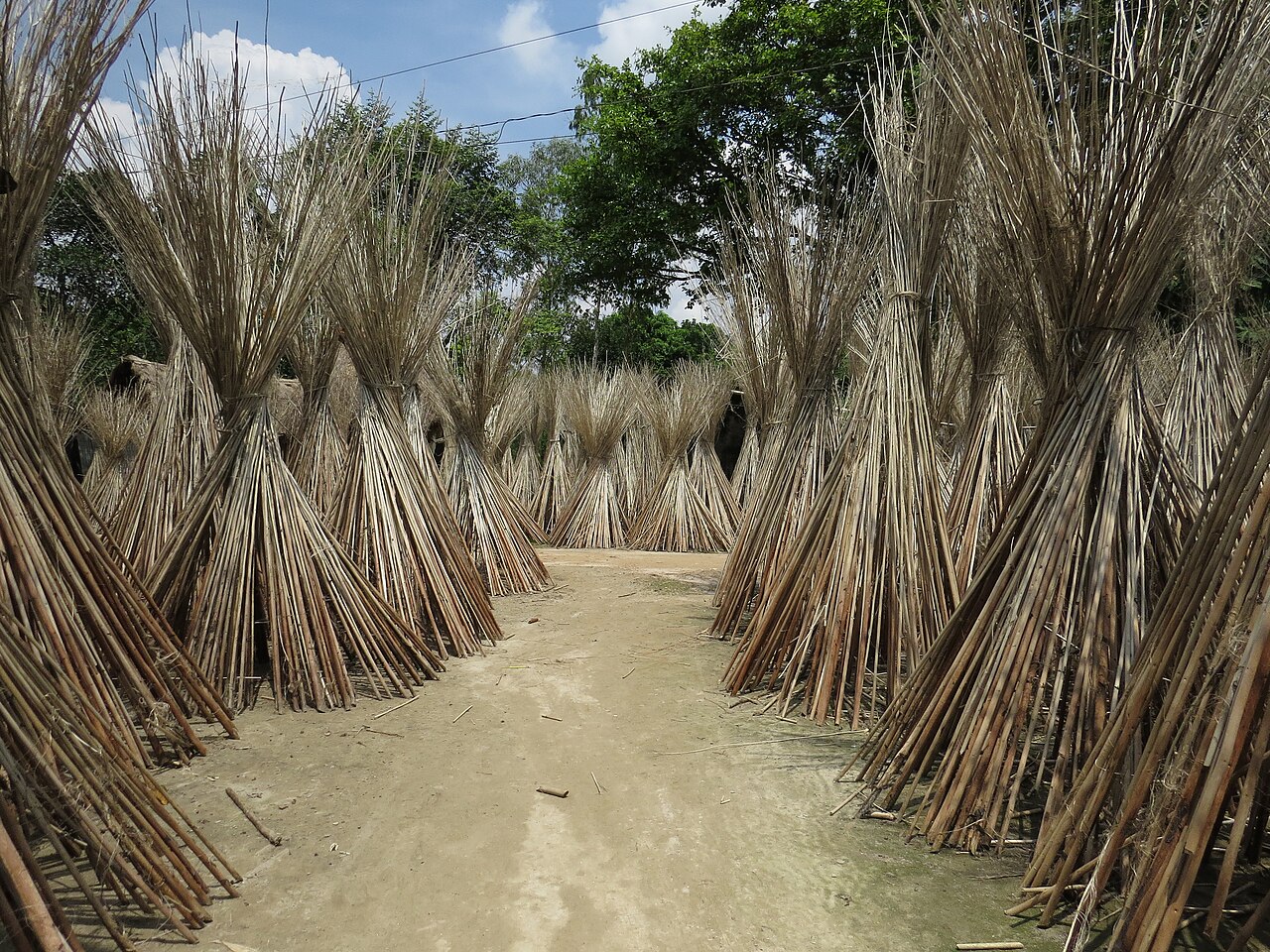
Jute farmers in Kaunia, Rangpur, are getting good prices this year not only for the fibre but for the sticks. The jute sticks from one done (24 decimals) of land sell for Tk 10,000 to 15,000, and 100 bundles fetch Tk 700 to 1,000. At the markets, tossa and local jute sell at Tk 3,800 to 4,500 a maund (40 kg) depending on quality, Amar Desh reported.
Jute prices fell by about Tk 500 a maund early in the season. Farmers say the better price for sticks is making up much of that loss, so across the villages they are storing sticks with care, on bamboo platforms, in stacks or wrapped in polythene. Alamin, a farmer in Gadai village, said this year he paid the labourers who retted his jute in bundles of sticks instead of cash.
Sub-assistant agriculture officer Anwar Hossain said jute sticks are no longer just fencing or fuel. Representatives of charcoal and particle-board factories buy them directly from farmers, and demand has risen because those products are exported. Alenur, a trader at Takipal Hat, also pointed to demand for fuel and rural industries.
Costs have risen too. Early in the season, low water in the Teesta chars and the beels forced many farmers to ret their jute in distant rivers or with pumped irrigation water, Anwar Hossain said, but jute and stick prices are covering the extra cost.
Upazila agriculture officer Md Salahuddin said jute was grown on 865 hectares this year against a target of 740, with a production target of 10,101 bales. Favourable weather gave a good yield, and improved seed and training raised the fibre's quality and colour.
If current prices for jute and sticks hold, he expects Kaunia's jute area to grow further next season.
The report is by Amar Desh's Kaunia (Rangpur) correspondent.
Photo: sadot arefin / Wikimedia Commons (public domain)
Source: Amar Desh

Comments
(0)